




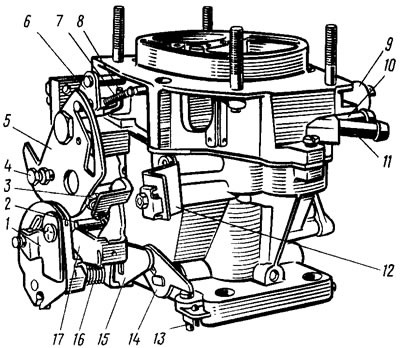
Figure 15. Carburetor: 1 - sector with throttle control bracket; 2 - pin of the second chamber locking lever; 3 - adjusting screw for opening the throttle valve of the first chamber; 4 - air damper drive rod mounting screw; 5 - air damper control lever; 6 - air damper lever; 7 - air damper return spring; 8 - diaphragm rod of the starting device; 9 - electromagnetic shut-off valve; 10 - fuel supply pipe; 11 - branch pipe for draining part of the fuel into the fuel tank; 12 - bracket for fastening the air damper drive rod casing; 13 - adjusting screw of the second chamber; 14 - second chamber throttle lever; 15 - second chamber throttle actuator lever; 16 - return spring of the first chamber throttle valve;/7 - throttle control lever
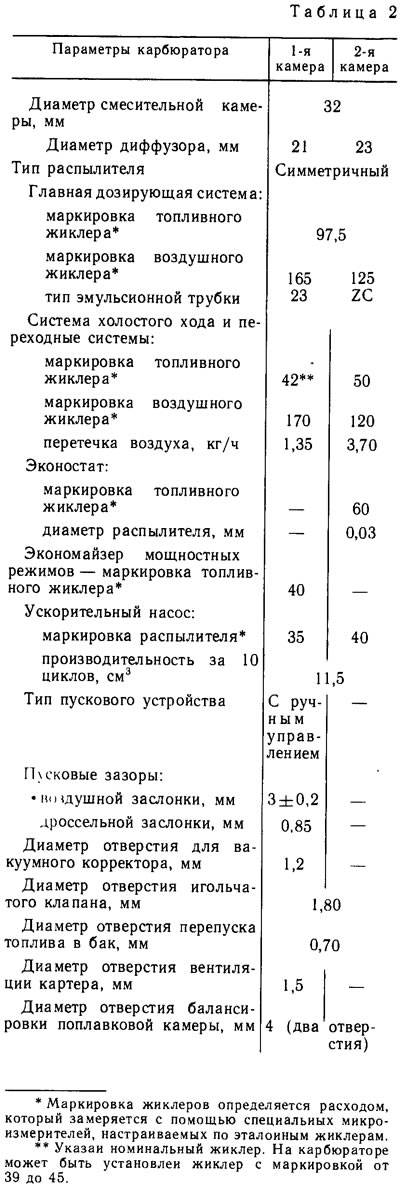
The carburetor has two main metering systems, a transition system and an idle system with an electromagnetic shut-off valve of the first chamber, a transition system of the second chamber, an economizer, a power mode economizer, a diaphragm accelerator pump, and a starting device.
The main data of the carburetor are given in Table 2.
The main metering system is fed from the float chamber, into which fuel enters through the needle valve 17 (figure 16). Fuel enters the emulsion wells through the main fuel jets 28 and 38. At sufficient vacuums in the sprayers of the main metering systems, fuel mixes in the emulsion wells with air entering through air jets 6 and 13, and is sucked into the diffusers of the mixing chambers in the form of an emulsion. In throttling modes, only the main metering system of the first chamber operates. The second chamber begins to open and operate when the throttle valve of the first chamber opens more than two-thirds.
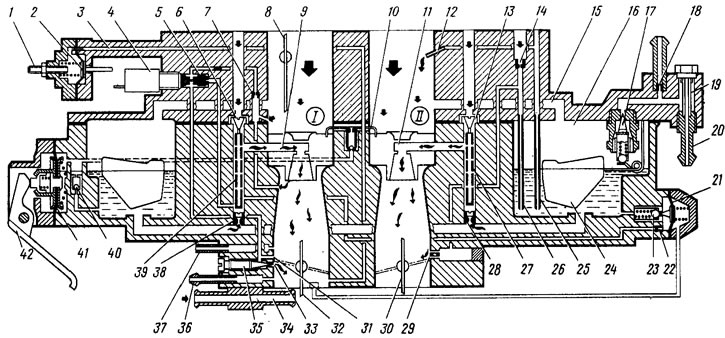
Figure 16. Carburetor operation diagram: 1 - starting device adjustment screw; 2 - diaphragm of the starting device; 3 - air channel of the starting device; 4 - electromagnetic shut-off valve; 5 - idle fuel jet; 6 - main air jet of the first chamber; 7 - idle air jet; 8 - air damper; 9 - sprayer of the main dosing system of the first chamber; 10 - accelerator pump nozzles; 11 - sprayer of the main dosing system of the second chamber; 12 - economizer sprayer; 13 - main air jet of the second chamber; 14 - air jet of the transition system of the second chamber; 15 - float chamber balancing channel; 16 - float chamber; 17 - needle valve; 18 - calibrated hole for fuel bypass into the tank; 19 - carburetor fuel filter; 20 - fuel supply pipe; 21 - power mode economizer diaphragm; 22 - fuel jet of the power mode economizer; 23 - power mode economizer ball valve; 24 - float; 25 fuel jet economizer with tube; 26 - fuel jet of the transition system of the second chamber with a tube; 27 - emulsion tube of the second chamber; 28 - main fuel jet of the second chamber; 29 - outlet openings of the transition system of the second chamber; 30 - second chamber throttle valve; 31 - first chamber transition system slit; 32 - first chamber throttle valve; 33 - idle system outlet; 34 - carburetor heating unit; 35 - adjusting screw for idle mixture quality (composition); 36 - crankcase gas suction pipe; 37 - branch pipe for supplying vacuum to the vacuum ignition regulator; 38 - main fuel jet of the first chamber; 39 - emulsion tube of the first chamber; 40 - accelerator pump ball valve; 41 - accelerator pump diaphragm; 42 - accelerator pump drive lever
The idle system provides the required composition of the combustible mixture at idle. In this case, throttle valves 30 and 32 are closed. Fuel from the emulsion well of the main metering system rises along the fuel channel, passes fuel jet 5, mixes with air from air jet 7 and the flow channel and then enters under screw 35 of the quality (composition) of the mixture into the throttle space.
The transition system of the first chamber ensures a smooth transition of the engine operation from idle to throttle modes. At the moment the throttle valve of the first chamber begins to open, the gap 31 of the transition system falls under vacuum; emulsion will also flow from it, ensuring a smooth transition.
When the ignition is turned off, the electromagnetic shut-off valve 4 is switched off, the needle closes the fuel jet 5 and does not allow the engine to operate with the ignition off.
The transition system of the second chamber ensures a smooth transition of the engine operation at the moment of the beginning of the opening of the throttle valve of the second chamber. At this moment, the holes 29 fall under vacuum; fuel from the float chamber rises up the tube through jet 26, air is mixed in from air jet 14 and the emulsion enters through the emulsion channel through the outlet openings under the throttle valve.
The econostat enriches the combustible mixture with fully open throttle valves at speeds close to maximum. With open throttle valves, the vacuum in the mixing chambers and sprayer 12 of the econostat increases significantly. Fuel from the float chamber enters through the jet 25 of the econostat and is sucked into the second mixing chamber through the sprayer.
The power mode economizer prevents a change in the enrichment degree of the mixture due to the pulsation of the vacuum under the throttle valve, especially when the crankshaft speed decreases, when the pulsation of the vacuum increases. The ball valve 23 of the economizer is closed while the diaphragm 21 is held by the vacuum under the throttle valve. When the throttle valve 32 is significantly opened, the vacuum decreases somewhat and the diaphragm spring opens the valve. Fuel passes through the valve, the jet 22 of the economizer, is added to the fuel passing through the main fuel jet 38 and equalizes the enrichment of the mixture.
The accelerator pump is of the diaphragm type, driven by a cam on the axis of the first chamber throttle valve. When the throttle valve is opened sharply, the cam presses the lever 42 and through the spring in the pusher acts on the diaphragm 41, overcoming the resistance of the return spring. The diaphragm supplies fuel through the ball supply valve and injects it through the sprayers 10 into the first and second mixing chambers. During the return stroke of the diaphragm, under the action of the return spring, fuel is sucked from the float chamber through the check ball valve 40 into the working cavity of the accelerator pump.
The starting device ensures the preparation of a rich combustible mixture when starting a cold engine. When turning the lever 4 (figure 17) the air damper control cable 8 opens the throttle valve 10 of the first chamber counterclockwise with its outer edge G behind the adjusting screw 9. At the same time, the expanding groove between the inner profiles A and B of the lever 4 releases the pin of the lever 6 of the air damper, and it will be held completely closed due to the return spring 7. The axis of the air damper 5 is offset, so the air damper after starting the engine can open slightly due to the air flow, stretching the spring 7, which ensures the leaner mixture.
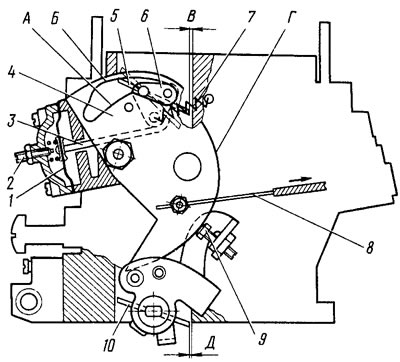
Figure 17. Carburetor starting device diagram
The vacuum from the throttle space acts on the diaphragm 1 and can slightly open the air damper by means of the rod 3. The adjusting screw 2 allows you to regulate the amount of opening of the damper.
The forced idle economizer disables the idle system at forced idle (when braking the car with the engine, when driving downhill, when changing gears), eliminating carbon monoxide emissions into the atmosphere. In forced idle mode at a crankshaft speed of more than 2100 rpm and with the carburetor limit switch closed (pedal released) the shut-off electromagnetic valve is switched off, the fuel supply is interrupted. When the crankshaft speed drops to 1900 rpm, the control unit switches on the electromagnetic shut-off valve (although the limit switch is closed), fuel supply begins and the engine gradually enters idle mode.
The throttle valve of the second chamber can be opened only when the air damper is fully open by the second chamber locking lever, which is pivotally mounted on lever 17 (see figure 15). When the air damper is closed, the outer edge of the air damper control lever 5 moves the second chamber locking lever beyond the pin 2. Only the first chamber throttle valve can open, the second chamber is locked.
Possible engine malfunctions, their causes and troubleshooting methods are given in table 3.