




Between building 9 (figure 78) and the rubber diaphragm 10 is clamped by the cover 11, the inner belt of the hole of which enters the annular groove of the valve body 21. The diaphragm together with the valve body divides the cavity of the vacuum booster into two chambers: vacuum A and atmospheric B. Chamber A is connected to the engine intake pipe through a tip and a hose. A vacuum valve is located in the tip of the hose to prevent the combustible mixture from entering the vacuum cavity A. A rubber flange is installed between them to seal the connection of the hose tip with the booster body.
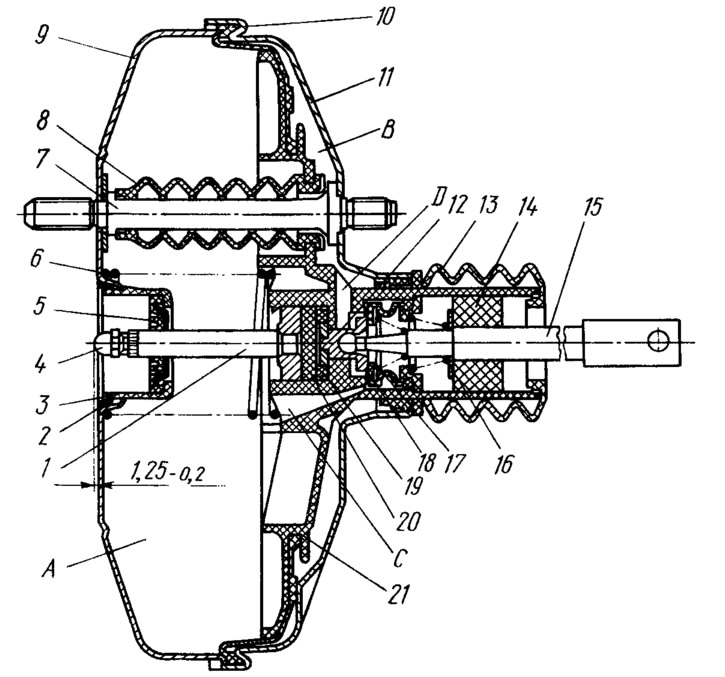
Figure 78. Vacuum amplifier:
1 - rod; 2 - master cylinder flange sealing ring; 3 - amplifier body cup; 4 - adjusting bolt; 5 - rod seal; 6 - diaphragm return spring; 7 - amplifier pin; 8 - sealing cover; 9 - amplifier body; 10 - diaphragm; 11 - amplifier housing cover; 12 - piston; 13 - valve body protective cover; 14 air filter; 15 - pusher; 16 - pusher return spring; 17 - valve spring; 18 - valve; 19 - valve body bushing; 20 - rod buffer; 21 - valve body; A - vacuum chamber; B - atmospheric chamber; D, C - channels.
In the amplifier cover, two studs 7 are rolled in, which perform several functions: they serve to fasten the vacuum booster and the master cylinder, are guides for the valve body 21 and provide the necessary rigidity and strength of the connection of the amplifier body 9 with the cover 11. The latter made it possible to reduce the weight of the booster by reducing the thickness of the walls of the body and the cover. At the exit from the body and the cover, the studs are sealed: on the body side, with rubber sealing washers put on the studs, on the other - by flaring the studs on the cover. Sealing boots 8 are put on the studs. On one side, they are tightly seated on the studs, on the other - they are connected to the movable valve body. The tightness of their connections is ensured by annular grooves of a certain profile, which cover the edges of the holes in the valve body. Due to this, chambers A and B are isolated from each other.
The valve body 21 is made of plastic. Under the action of the return spring 6, it is pressed together with the diaphragm towards the amplifier cover. The valve body tail at the outlet of the cover is sealed and simultaneously protected by a corrugated protective cover 13. The sealing part of the cover has a complex configuration, which forms several working edges adjacent to the tail. The front part of the cover is held in the amplifier cover by the edges of the cover, bent into the groove of the cover. The protective part of the cover closes the valve body tail and is held inside the tail by a ring.
The valve body contains the master cylinder drive rod 1 with a support sleeve, piston 12, valve body sleeve 19, rod buffer 20, valve 18, two springs 16 and 17, air filter 14 and pusher 15. The support sleeve is pressed onto the rod. It rests against the valve body through rubber buffer 20 and plastic sleeve 19. An adjusting bolt 4 with a spherical head is screwed into the end hole of the rod. This bolt regulates the rod exit from the amplifier body (1.25—0,2 mm). At the exit from the housing, the rod is covered by a seal 5. To seal the gap between the flange of the main cylinder and the housing of the vacuum booster, a rubber ring 2 is installed in the housing socket.
Piston 12 is rigidly connected to the valve body by rolling the disk on the piston end. The ball head of the pusher is compressed in the piston seat. Thus, the valve body, piston and pusher form a single non-separable unit. The rubber valve 18 is pressed to the piston end by spring 17. For rigidity, a steel washer is mounted in the valve head. The support sleeve is pressed to the rear end of the valve by spring 16. The other end of the spring rests against the washer of the air filter 14, made of polyurethane foam.
In the initial position of the brake pedal, the pusher 15 together with the valve body 21 and the rod 1 are pressed by the spring 6 to the extreme rear position. In this case, the valve head moves away from the valve body and communicates with each other through the resulting gap and channels C and K of chamber A and B. Therefore, when the engine is running, the vacuum from the engine intake pipe is transmitted through the vacuum valve to chamber A and through channels C w K and gaps to chamber B.
(View the original on the internet resource: vazbook.ru)
When the brake pedal is pressed, the plunger moves together with the piston and the valve body. Following the piston, the valve moves under the action of spring 17 until it stops against the valve body seat. When it touches the seat, the valve separates chambers A and B. With further movement of the piston, its end moves away from valve 18, and through the resulting gap, chamber B communicates with the atmosphere. In this case, air enters chamber B through filter 14, then through the resulting gap between the piston and the valve and then through drip K, creating pressure on diaphragm 10. Due to the difference in pressure in chambers A and B and the force of pressing the brake pedal, the valve body moves together with rod 1, which in turn acts on the piston of the main cylinder of the brake drive.
If the driver stops pressing the brake pedal further without removing his foot from the pedal and leaving it pressed in some middle position, then the valve body moves forward under the action of atmospheric pressure until the gap between the piston and the valve is selected, since the piston remains stationary. Therefore, air stops entering chamber B and further movement of the valve body will stop. At this moment, a gap is formed between the valve body seat and the valve and excess pressure from chamber B is transferred to chamber A, that is, the pressure in both chambers will be equalized and the servo action of the amplifier will stop.
When the brake pedal is released, it returns to its original position under the action of the return spring and pulls the pusher 15, piston 12 and valve body 21 along with it. Spring 6 also acts in the same direction. The rear end of the piston is pressed against the valve head, which leads to the cessation of the flow of atmospheric air, and then moves the valve away from the body seat. In this case, chambers A and B communicate with each other and, under the action of spring 6, the valve body with the rod returns to its original position.