




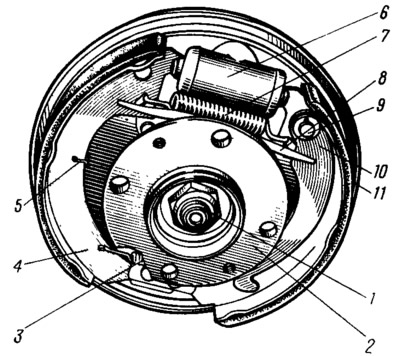
Figure 85. Rear wheel brake mechanism:
1 - hub mounting nut; 2 - wheel hub; 3 - lower brake shoe tension spring; 4 - brake shoe; 5 - guide spring; 6 - wheel cylinder; 7 - upper tension spring; 8 - expansion bar; 9 - parking brake lever finger; 10 - manual brake pad drive lever; 11 - brake mechanism shield.
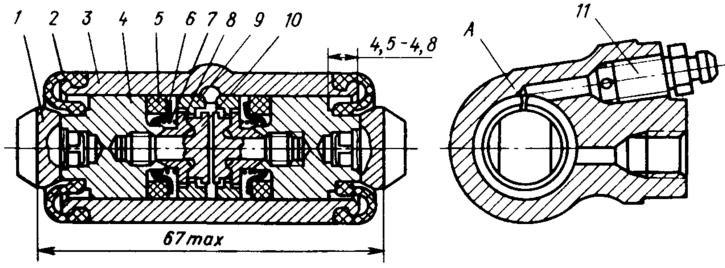
Figure 86. Wheel cylinder:
1 - brake shoe stop; 2 - protective cap; 3 - cylinder body; 4 - piston; 5 - seal; 6 - support plate; 7 - spring; 8 - crackers; 9 thrust ring; 10 - persistent pint; 11 - nipple; A - slot on the thrust ring.
The automatic clearance adjustment device is located in the wheel cylinder. Its main element is a split thrust ring 9 (see figure 86), mounted on piston 4 between the flange of thrust screw 10 and two crackers 8 with a gap of 1.25...1.65 mm. The thrust rings are installed in the cylinder with an interference fit that ensures a ring shear force along the cylinder surface of at least 35 kgf, which exceeds the force on the piston from tension springs 3 and 7 (see figure 85) brake pads. When the linings wear out, the gap of 1.25...1.65 mm is completely eliminated, the flange on the stop screw 10 (see figure 86) is pressed against the flange of ring 9, as a result of which the thrust ring shifts after the piston by the amount of wear. When braking stops, the pistons are shifted by the force of the tension springs until the crackers stop against the flange of the thrust ring. In this way, the optimum clearance between the shoes and the drum is maintained.