




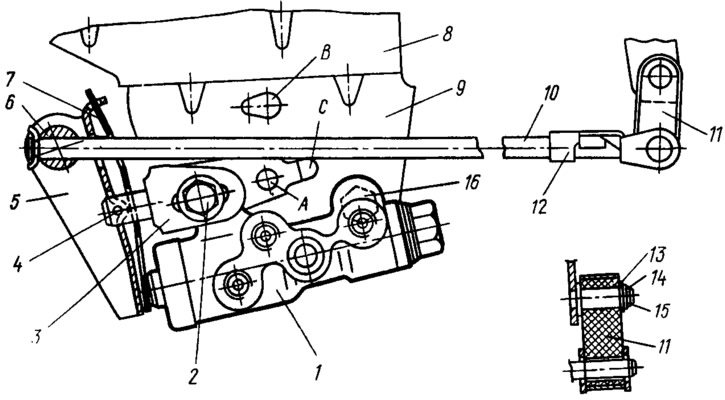
Figure 81. Pressure regulator drive:
1 - pressure regulator; 2, 16 - regulator mounting bolts; 3 - pressure regulator drive lever bracket; 4 - pin; 5 - regulator drive lever; 6 - lever axis; 7 - lever spring; 8 - body bracket; 9 - pressure regulator mounting bracket; 10 - elastic lever of the regulator drive; 11 - earring; 12 - earring brackets; 13 - washer; 14 - retaining ring; 15 - bracket finger; A, B, C - holes.
The pressure regulator is secured with two bolts to the shelf of bracket 9, which in turn is secured to bracket 8 of the body floor. In this case, the front, longer bolt 2 simultaneously secures the forked bracket 3 of the pressure regulator drive lever. To prevent bracket 3 from turning relative to bolt 2, its projection enters groove C of bracket 9. Due to this groove and the oval holes in bracket 3 for fastening bolt 2, bracket 3 together with lever 5 of the pressure regulator drive can be moved relative to the pressure regulator body when adjusting its drive.
A pin is welded to the fork bracket 3, which serves as a support for the lever 5. A pin 4 is pressed into the hole in the pin, relative to which the double-arm lever 5, which has a box-shaped section, can rotate. In the upper holes of its two shelves, an axis 6 is located, through the hole of which the end of the elastic lever 10 of the pressure regulator drive passes. The axis of the lever and the elastic lever are locked by a common lock. In order to prevent the transmission of vibrations and oscillations from the drive parts to the piston of the pressure regulator, a leaf spring 7 is installed on the support of the lever 5. Its upper end enters the gap of the bent end part of the lever 5, and the lower end adjoins the lower arm of the lever. The elastic lever 10 freely passes through the oval hole of the spring 7. The other end of the lever 10 is pivotally connected to the earring 11, which swings on the pin 15 of the bracket of the rear suspension arm. The earring is held on the finger by a lock washer 13 and is connected to the end of the elastic lever by a bracket 12.
When the rear suspension moves, the force with which lever 10 acts through lever 5 on the piston of the regulator changes. The more the rear suspension is loaded, the greater the force will be transmitted to the piston of the regulator. This is explained by the fact that the regulator is fixedly attached to the body, and receives the drive from the swinging arm of the suspension.
In building 1 (figure 82) the pressure regulator has a plug 16 with a sealing gasket 15 screwed into one end, and a bushing 5 installed on the other end, which is fixed in the housing by a retaining ring 4. A piston 2 is located in the bushing 5. At the exit from the housing, it is sealed by a protective cover 3. The piston head enters the bushing 7 with a gap. Spring 6 presses the sealing ring 23 to the end of the bushing 5 through washers 22, and the seal 21 to the bushing 7.
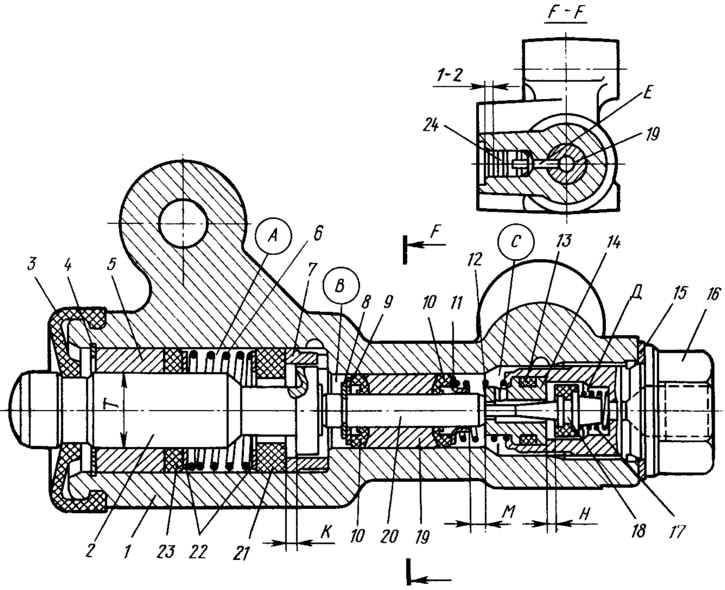
Figure 82. Pressure regulator:
1 - regulator body; 2 piston; 3 - protective cap; 4, 8 - retaining rings; 5 - piston bushing; 6 - piston spring; 7 - body bushing; 9, 22 - thrust washers; 10 - Pusher sealing ring; 11 - support plate; 12 - pusher bushing spring; 13 - valve seat sealing ring; 14 - valve seat; 15 - sealing gasket; 16 - cork; 17 - valve spring; 18 - valve; 19 - Pusher bushing; 20 - pusher; 21 - piston head seal; 23 - piston rod seal; 24 - plug; A, D - chambers connected to the master cylinder; B, C - chambers connected to the wheel cylinders of the rear brakes; K, M, H - gaps.
A rubber-metal valve 18 is installed in plug 16, pressed against seat 14 by spring 17. Sealing of seat 14 in plug is ensured by sealing ring 13. Seat is rolled into plug 16. Cylindrical tail of valve 18 rests against pusher 20, which is installed in sleeve 19 and sealed together with it by two rubber rings 10. Spring 12 through plate 11 presses sleeve 19 with sealing rings 10 against washer 9, which is held on pusher 20 by retaining ring 8. A radial hole is made in sleeve 19, which coincides with hole E of pressure regulator body. From the outside, this hole is closed by rubber plug 24. It should be deepened in the hole of pressure regulator body by 1...2 mm. If liquid leaks from under the plug or the plug is squeezed out of the hole, it means that the rings 10 do not ensure a tight seal.
Chambers A and D of the pressure regulator are connected to the main brake cylinder, and chambers B and C are connected to the rear wheel brake cylinders.
When the brake pedal is in its initial position, piston 2 is pressed by lever 5 (see figure 81) through the leaf spring 7 to the pusher 20 (see figure 82), and it in turn rests against valve seat 14. In this case, the pusher presses valve 18 from the seat and a gap 11 equal to 1.3...1.7 mm is formed between them, and a gap K equal to 1.6...2.4 mm is formed between seal 21 and the piston head. Through the resulting gaps, chambers A and D freely communicate with chambers B and C, respectively. When the brake pedal is pressed, fluid from the master cylinder flows through chamber A, gap K and chamber B to the right rear, and through chamber D, gap H and chamber C to the left rear wheel cylinder. With an increase in the force on the brake pedal, and consequently, the fluid pressure, the force on piston 2 will also increase, tending to push it out of the regulator housing. When the force on lever 5 from the fluid pressure exceeds the counteracting moment from the elastic lever, the piston begins to move out of the housing. Following the piston, under the action of springs 17 and 12, pusher 20 together with bushing 19 and rings 10 are displaced. In this case, gap M between plate 11 and seat 14 increases, and gaps Ya and K decrease. When gap H is completely selected and valve 18 isolates chamber D from chamber C, pusher 20 together with the parts located on it stops moving following the piston. From this moment, the pressure in chamber C will change depending on the pressure in chamber B. With a further increase in the force on the brake pedal, the pressure in chambers D, A and B will increase and the piston will continue to move out of the housing. At the same time, under the pressure of the liquid, bushing 19 together with sealing rings 10 and plate 11 will shift towards plug 16. In this case, gap M and the volume of chamber C will decrease. As the volume C decreases, the pressure in it, and therefore in the rear wheel brake drive, will increase and will almost always be equal to the pressure in chamber B.
When the gap K is completely selected, i.e. the piston head 2 touches the seal 21, the pressure in chamber B, and therefore in chamber C, will increase to a lesser extent compared to chamber A due to the throttling of the liquid when it flows between the piston head and the seal 21. The dependence of the pressure in chambers B and C on the pressure in chamber A is determined by the ratio of the difference in the areas of the head and the cross-section of the piston at diameter T to the area of the head.
As the vehicle load increases, the elastic lever 10 (see figure 81) will be loaded more by the rear suspension arm and the force on the piston from the arm 5 will increase. This means that the moment of contact of the piston head with the seal will be achieved with a higher pressure in the main brake cylinder. Thus, the relative efficiency of the rear brakes with an increase in the load on the car increases with the same force on the brake pedal as with a lower load.
If the "right front - left rear brake" circuit fails, the pressure in chamber C will drop, and the sealing rings 10 and bushing 19 will shift under the pressure of the fluid in chamber B toward plug 16 until plate 11 stops in seat 14. The pressure in the rear right wheel brake will be determined by the part of the regulator that includes piston 2 with seal 21 and bushing 7. The operation of this part of the regulator in the event of a failure of the said circuit is similar to the operation with a serviceable system. The nature of the pressure change at the regulator outlet is the same as with a serviceable system.
In case of failure of the "left front - right rear brake" circuit (when the pressure in chamber B drops) under the pressure of the brake fluid, the pusher 20 with the sleeve 19 and the sealing rings 10 are displaced towards the piston, pushing it out of the housing. The gap M increases, and the gap H decreases. When the valve 18 touches the seat 14, the pressure increase in chamber C stops, i.e. the regulator in this case works as a pressure limiter. However, the achieved pressure value is sufficient for reliable operation of the rear left wheel brake. It is equal to 17...21 kgf/cm². The response time of valve 18, i.e. its pressing against the seat 14, depends on the speed of braking and the rate of drop in fluid pressure in the damaged circuit.