




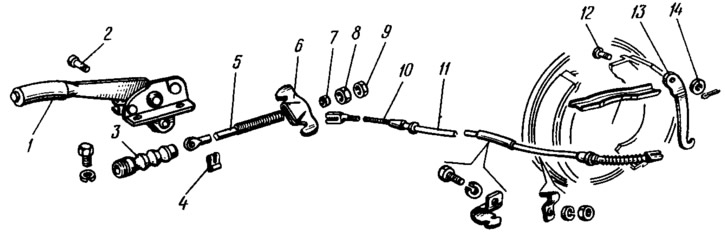
Figure 87. Parking brake (detailing):
1 - parking brake actuator lever assembled with bracket; 2 - traction finger; 3 - protective cover; 4 - locking bracket; 5 - traction; 6 - cable equalizer; 7 - washer; 8 - adjusting nut; 9 - lock nut: 10 - cable; 11 - cable sheath; 12 - lever axis; 13 - manual brake pad drive lever; 14 - washer.
Lever 10 (see figure 85) manual drive of the shoes is pivotally connected with the rear shoe of the brake mechanism by the pin 9. This lever on the pin is secured through the thrust washer with a cotter pin. The ribs of the rear shoe and the lever 10 rest against the groove of the expansion bar 8. The rib of the front shoe 4 enters the groove of the other end of the bar. The tip of the cable 10 is put on the lower end of the lever 10 (see figure 87). The other end of this cable is connected to equalizer 6, which is secured to rod 5 by adjusting nut 8 with washer 7. The position of the adjusting nut is fixed by lock nut 9. The front end of rod 5 is connected by pin to lever 1 of the parking brake drive. The connecting pin is locked by bracket 4. The front part of the rod is protected from water and dirt by rubber cover 3.
Lever 1 is mounted on a bracket together with a toothed sector. This unit is non-detachable. It is attached to the body floor. A latch is engaged with the toothed sector, which is switched off via a rod by the lever button. All parts are assembled in the internal cavity of lever 1. To switch off the parking brake indicator lamp, lever 1 has a stop acting on the switch rod.
Cable 10 is located in a multilayer casing 11, which has tips at the ends. The rear tip is attached to the brake mechanism shield, and the front tip enters the socket of the body bottom bracket. In addition, the cable is additionally supported by two brackets of the rear suspension arm and the body bracket. Multi-point supports of the cable casing ensure free, jam-free movement of the cable in its casing, and also protect the cable from damage. To return the cables to their original position when releasing the brakes, springs are installed on the rear ends of the cables.
When the parking brake lever 1 is moved upwards, the cables are tensioned and rotated on the pins 9 (see figure 85) levers 10 for manual control of the brake shoes. The spacer bars 8 press the front shoes to the drums. Further rotation of the levers on the fingers stops. Then they begin to rotate relative to the points of contact with the spacer bars and with their short arms press the rear shoes to the drums. When the parking brake is engaged, the latch freely jumps over the teeth of the sector until the shoes are fully pressed to the drums and in this position the lever is fixed by catching on the tooth of the sector. To release the brake, press the button of lever 1 to lift the latch and lower the lever.