




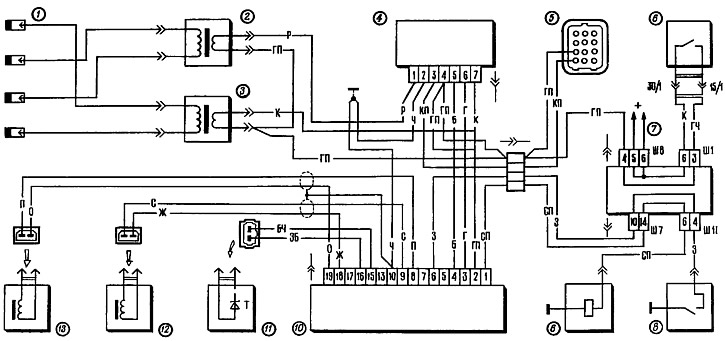
Figure 112. Digital ignition system diagram:
1 - spark plugs; 2— ignition coil of the 2nd and 3rd cylinders; 3 - ignition coil of the 1st and 4th cylinders; 4 - switch; 5 diagnostic socket; 6 - ignition switch; 7 - mounting block; 8 - carburetor limit switch; 9 - electromagnetic valve of the carburetor; 10 - controller; 11 - temperature sensor: 12 - angular pulse sensor; 13 - start counting sensor.
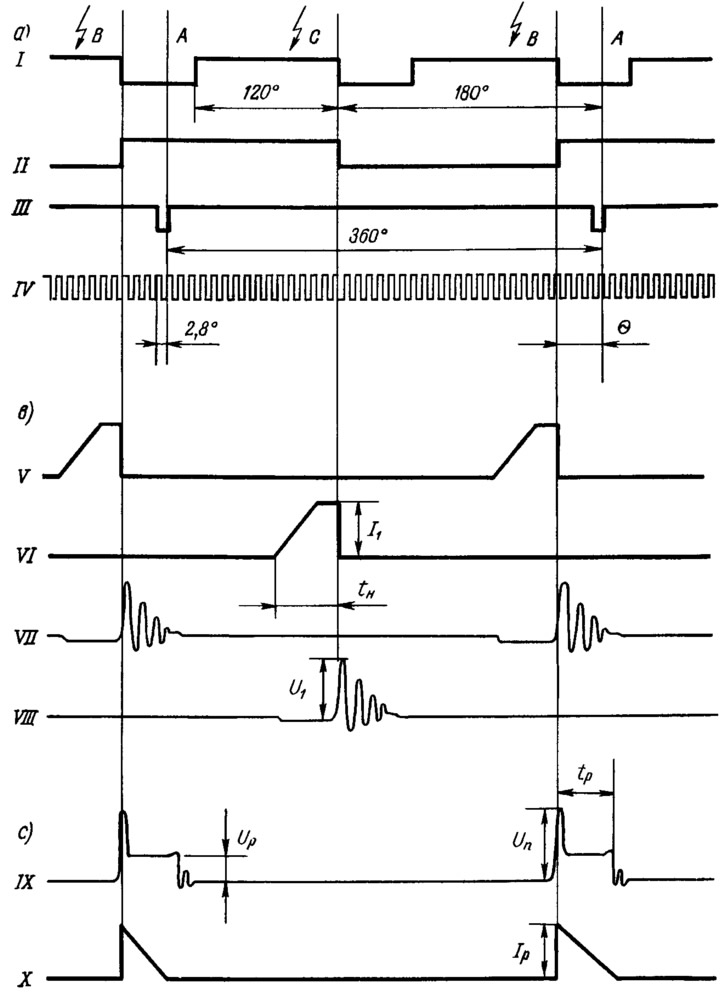
Figure 113. Oscillograms of voltage and current pulses acting at the controller outputs (a), switch (b) and in the secondary circuit of the ignition coil (c):
I — signal "Ignition moment"; II — signal "Channel selection", III — signal "Start of counting"; IV - signal "Angular impulses"; V — current pulses at the output of channel 1; VI — current pulses at the output of the 2nd channel; VII — voltage pulses at the output of the 1st channel; VIII — voltage pulses at the output of the 2nd channel; IX — voltage pulses; X — current pulses; A — TDC of pistons of 1st and 4th cylinders; B — ignition moment in 1st and 4th cylinders; C — ignition timing in the 2nd and 3rd cylinders; θ — ignition timing angle; U ₁ and I ₁ — current and voltage in the primary winding of the ignition coil; tn — current accumulation time; Up — spark plug gap breakdown voltage; Ir, Ur and tr - current, voltage and discharge time between the spark plug electrodes.
The controller takes into account the information received from the sensors, selects the optimal ignition timing angle 9 from the memory for the given conditions and generates the "Ignition Timing" (IT) and "Channel Selection" (CS) pulses, shown on oscillograms 1 and 11, Figure 113. The moment of spark formation of the ITC signal is determined by the pulse cutoff (transition from high to low level). The moment of spark formation of the VK signal corresponds in the 1st and 4th cylinders to the transition from a low signal level to a high one, and in the 2nd and 3rd cylinders - from a high level to a low one.
The switch smoothly increases the current in the primary windings of the ignition coils and, based on the signals from the controller SZ and VK, abruptly interrupts it. As a result, current pulses I ₁ of 8...10 A act in the primary windings of the ignition coils (oscillograms V and VI). In this case, the amplitude of the voltage pulses on the output transistors of the switch at the moment of current interruption reaches 350...400 V (oscillograms VII and VIII). Duration of current pulses tn (or current accumulation time) depends on the crankshaft speed and at a supply voltage of 14 V decreases from 8 ms at 750 rpm to 4 ms at 4500 rpm.
As with the contactless ignition system, when the current in the primary winding of the ignition coil is interrupted, a high voltage is induced in the secondary winding. The high voltage current is closed (using coil 2 as an example, figure 112) along the way: upper high-voltage terminal of the coil - spark plug of the 1st cylinder - "ground" - spark plug of the 4th cylinder - lower high-voltage terminal of the ignition coil. In this case, a spark discharge is created simultaneously at two spark plugs: the 1st and 4th cylinders. If in one of the cylinders (for example, in the 1st) at this time the end of the compression stroke occurs and the spark discharge ignites the working mixture, then in the other cylinder (in the 4th) at this time the release of exhaust gases is completed and the discharge in it does not ignite anything. Thus, in each cylinder during the working cycle (2 crankshaft revolutions) 2 spark discharges are created (one is working and the other is idle).
The text is copied from the online portal VAZBOOK
The controller controls the electromagnetic valve 9 of the carburetor depending on the crankshaft speed and the state of the limit switch 8 of the throttle valve. When the valve is closed (the limit switch is closed to ground), the controller switches off the valve at a speed above 1750 rpm and switches it on again when the speed drops to 1650 rpm. If the throttle valve of the carburetor is slightly open (the limit switch is not closed to ground), the valve does not switch off.
For diagnostic purposes, the following generated signals can be taken from the controller (rectangular pulses). From plug "5" - signal NO of the counting sensor, from plug "7" - signal UM of the control pulse sensor and from plug "13" signal SZ of the ignition moment (see oscillograms III, IV and I respectively in Figure 113).