




Contents: The indicator lamp does not light…↓ The control lamp lights up after the…↓ Generator low voltage ↓ Generator voltage is higher than…↓ Increased generator noise ↓
The faults that the car owner can detect and fix independently are listed. Works related to disassembling the generator (replacement of the rectifier unit), it is recommended to perform these tasks at a service station, but even experienced car enthusiasts can do them.
When checking the generator, as well as when operating the vehicle, it is necessary to follow a number of simple rules in order not to damage the generator:
- do not allow the generator to operate with the battery disconnected from the "30" terminal of the generator. Without a battery, dangerous surge voltages occur in the vehicle's on-board network when any consumers of electrical energy are disconnected. These surge voltages can damage the vehicle's electronic equipment, including the voltage regulator and the generator's rectifier block valves;
- do not check the generator's performance "for a spark" even by briefly connecting the "30" clamp of the generator to the "ground". In this case, a significant current flows through the valves and they are damaged. The generator voltage can only be controlled with a voltmeter;
- the "minus" of the battery must always be connected to the "ground", and the "plus" must be connected to the "30" terminal of the generator. Incorrect (reverse) connection of the battery will immediately cause an increased current to flow through the generator valves and they will fail;
- do not check the valves with a voltage higher than 12 V or with a megohmmeter, as it has too high a voltage for the valves and they will be broken during the test (a short circuit will occur). When checking the insulation of electrical wiring with a megohmmeter, it is necessary to disconnect all wires from the generator;
- it is necessary to disconnect all wires from the generator and from the battery when electric welding any body parts.
It is necessary to check the circuits and components of electrical equipment and troubleshoot problems with the engine not running and the battery disconnected.
The indicator lamp does not light when the ignition is turned on
In this case, two cases can be observed.
a) The control instruments are working and the voltmeter shows normal voltage when the engine is running.
Causes of the malfunction and ways to eliminate it:
- the control lamp has burned out or there is a break in the control lamp power supply circuit. Remove the instrument cluster and check the lamp. Replace the burned-out lamp. If the lamp is in good condition, check the reliability of the contact between the terminals of the lamp socket and the instrument cluster board, and also check the condition and reliability of the connection of the brown wire with a white stripe connecting the instrument cluster to the mounting block.
b) The control devices do not work.
Causes of the malfunction and ways to eliminate it:
- fuse #5 in the fuse box has blown. Check and replace the blown fuse;
- break in the instrument cluster power supply circuit. Check the condition and reliability of the connection of the orange and orange with a blue stripe wires connecting the instrument cluster to the mounting block.
The control lamp lights up after the engine starts
The voltmeter needle is in the red zone at the beginning of the scale. After pressing and releasing the throttle pedal, the indicator lamp goes out and the voltmeter shows normal voltage.
The malfunction is that the generator is not excited at low engine speeds due to the unsoldering of additional resistors 4 (see figure 98) in the mounting block. If the mounting block is of domestic production, then remove it, disassemble it and solder the desoldered resistors to the printed circuit board. The mounting block is made in the SFRY and is of a non-separable design. It cannot be repaired and must be replaced with a new one.
Generator low voltage
The voltmeter needle is in the red zone at the beginning of the scale when the engine is running or gradually deviates to the beginning of the scale. There are two possible options here.
a) The indicator lamp is on.
Causes of the malfunction and ways to eliminate it:
- alternator drive belt slippage. Adjust belt tension;
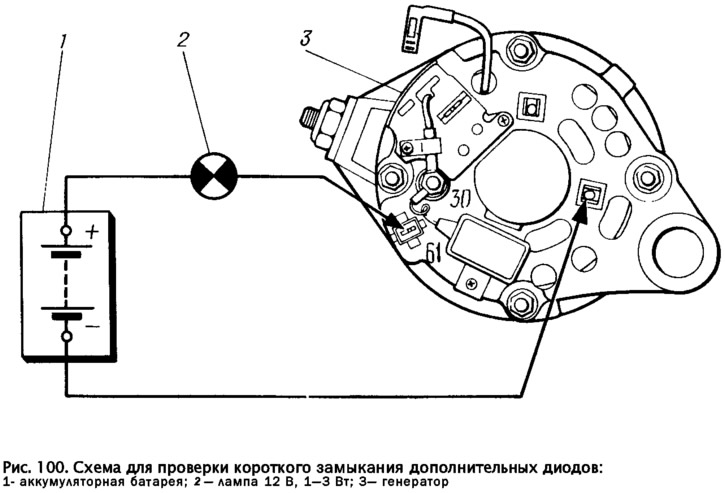
- open or short circuit ("breakdown") in diodes 14 (see figure 98), feeding the excitation winding. Check if there are any "broken" diodes (bidirectional) you can do it according to the diagram in Figure 100. In this case, you need to disconnect the wires from the generator, as well as the wire from the "B" terminal of the voltage regulator. If lamp 2 is on, then one of the diodes is "broken". Find the "broken" diode, as well as the diode with an open circuit (impermeable to current in both directions) possible, only by disassembling the generator, removing the rectifier block and checking each diode separately. Replace the damaged diode;
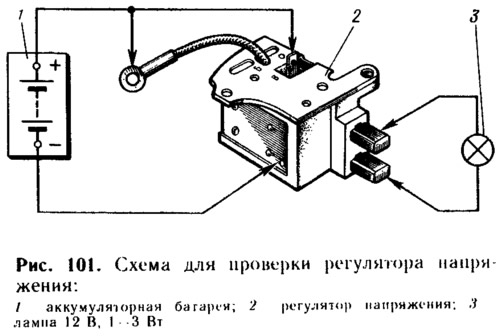
- the voltage regulator is damaged. Remove the voltage regulator with the brush holder and check it according to the diagram in Figure 101. Connect power source 1 to terminals "B", "C" and to the "ground" of the regulator, first with a voltage of 12 V, and then 15...16 V. If the regulator is in good condition, then in the first case lamp 3 should light, and in the second case it should go out. If the lamp lights in both cases, then there is a breakdown in the regulator. A. If it does not light in both cases, then either there is a break in the regulator, or there is no contact between the terminals of the brushes and the voltage regulator. To restore contact, clean the terminals of the brushes and the voltage regulator. Replace the damaged regulator;
- break in one or more valves of the rectifier unit. A broken valve can only be detected by disassembling the generator and checking each valve of the unit separately. Replace the rectifier unit with a new one with damaged valves;
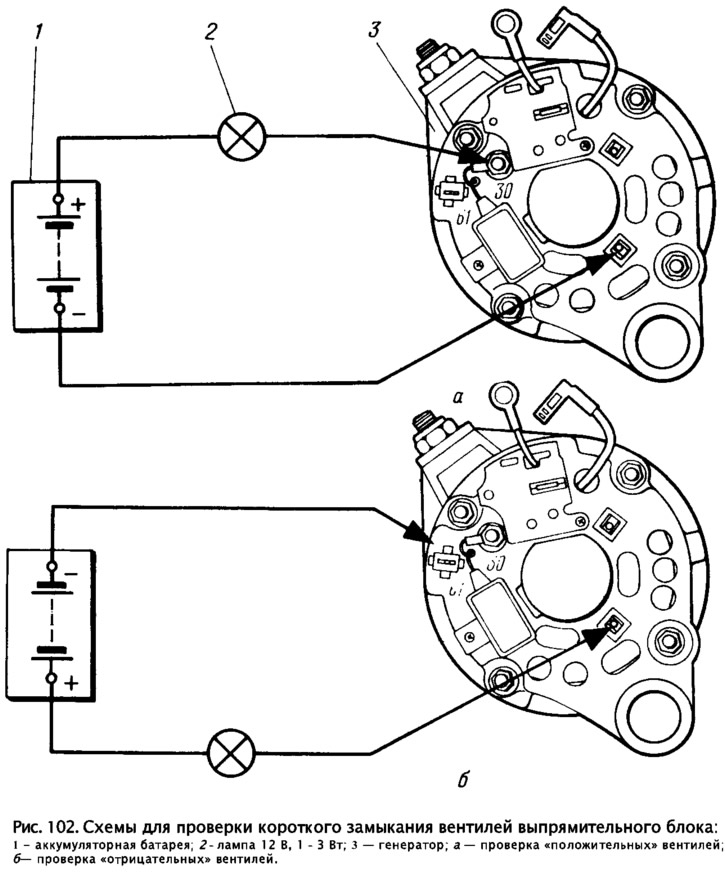
- short circuit ("breakdown") in the negative valves of the rectifier unit or short circuit of the stator winding to "ground". You can check using the diagram in Figure 102, b. The "minus" of the battery 1 is connected to the "ground" of the generator, and the "plus" through lamp 2 to any bolt of the rectifier unit. If lamp 2 lights up, then either the negative valve is "broken" or the stator winding is shorted to "ground". To specifically determine the cause, disassemble the generator and check with an ohmmeter whether the stator winding is shorted to "ground", and separately check the negative valves of the rectifier unit. If the winding is shorted to "ground", the generator stator is replaced, and if the negative valves are "broken", the rectifier unit;
- break or interturn short circuit in the stator winding. A break can be detected by checking each phase winding of the stator with an ohmmeter after disassembling the generator, and an interturn short circuit can only be detected with a special device at a service station. Replace the stator with a damaged winding;
- short circuit to ground of the generator excitation winding terminals. To check, remove the voltage regulator and use an ohmmeter or a lamp and a battery to check the resistance between the rotor contact ring and ground. Eliminate the short circuit or replace the generator rotor.
b) The control lamp does not light.
Causes of the malfunction and ways to eliminate it:
- there is no contact between the terminals of the voltage regulator and the terminals of the brushes. Remove the voltage regulator from the brush holder, disconnect them and clean the terminals of the brushes and the voltage regulator;
- brushes are worn or stuck, rotor slip rings are oxidized. Remove the brush holder with the voltage regulator from the generator, check if the brushes move freely in the brush holder. If the brushes are worn (brush protrusion less than 5 mm), then replace the brush holder with brushes. Wipe the contact rings with a rag soaked in gasoline, and if they are badly burnt, clean them with fine-grained sandpaper;
- the voltage regulator is damaged. Check the regulator according to the method described above using the diagram shown in Figure 101. Replace the damaged voltage regulator;
- the wire has come loose from the terminal "B" of the brush holder. Check and reconnect the wire;
- break in the chain between the plug "61" of the generator and the mounting block. The generator is not excited, since the current from the battery does not pass to the excitation winding. To check, connect a separate wire from the plug "61" to the clamp "30" of the generator or to the "plus" terminal of the battery and start the engine. If the voltmeter shows normal voltage, then, consequently, the brown wire with a white stripe connecting the plug "61" of the generator to the mounting block is damaged. Check the wire and its connections, replace the damaged wire;
- short circuit ("breakdown") in the positive valves of the rectifier unit. You can check it according to the diagram (figure 102, a). the "plus" of the battery is connected to the "30" terminal of the generator via lamp 2, and the "minus" is connected to any bolt of the rectifier unit. If lamp 2 lights up, then one of the positive valves is broken and the rectifier unit must be replaced;
- unsoldering the excitation winding terminals from the slip rings. Remove the voltage regulator and check the resistance between the slip rings with an ohmmeter. In case of a break, solder the winding terminals to the slip rings or replace the generator rotor.
The original is posted on Internet resource (vazbook.ru)
Generator voltage is higher than normal
The voltmeter needle is in the red zone at the end of the scale when the engine is running.
The cause of the malfunction is damage to the voltage regulator. Check it according to the above method according to the diagram in Figure 101. Replace the damaged voltage regulator.
Increased generator noise
Causes of the malfunction and ways to eliminate it:
- loosening the generator pulley mounting nut. Tighten the nut;
- damage to the generator bearings. Disassemble the generator and replace the damaged bearings;
- interturn short circuit or short circuit to ground in the stator winding, short circuit in one of the rectifier block valves. This causes a characteristic "howl" of the generator. Check the stator and rectifier block as described above.