




Contents: The engine won't start ↓ Engine runs rough or stalls at idle ↓ The engine runs unevenly and…↓ Engine misfires in all modes ↓ The engine does not develop full…↓
The VAZ-2108, 2109 family cars use a high-energy ignition system with extensive use of electronics. Therefore, in order to avoid injury and damage to electronic components, it is necessary to follow the following rules:
- when the engine is running, do not touch the ignition system components and do not check their functionality by "sparking" between the spark plug wire tips and the "ground". This is dangerous for the inspector and can lead to damage to the electronic components;
- do not run low voltage ignition system wires in the same harness with high voltage wires;
- monitor the reliability of the connection to the "ground" of the switch and controller (in a digital ignition system) through the mounting screws. This affects their smooth operation;
- do not disconnect the plug connector from the switch when the ignition is on, as this may cause voltage of up to 400 V to appear on individual elements of the switch circuit and the switch will be damaged.
Troubleshooting the ignition system is complicated by the use of electronic components such as a switch and a contactless sensor in the ignition distributor. For accurate diagnostics of these components, an oscilloscope and a rectangular pulse generator are required, which the vast majority of car enthusiasts do not have. Therefore, below are available methods for car enthusiasts to check the ignition system components using the simplest devices: a test lamp, a homemade indicator and a voltmeter. However, such devices cannot check the shape and parameters of the pulses (size and duration), issued by the switch. And they can seriously affect the engine operation, especially at high crankshaft speed. In this regard, an accurate and qualified check of the ignition system can only be performed at a car service station.
To check the functionality of the contactless sensor, you will need an indicator assembled according to the diagram in Figure 116. The indicator uses resistors of the MLT type, 1 W; capacitor C1 - type KLS1, and C2-type K53-14. The HL1 indicator lamp is an A12 automobile lamp with a power of up to 3 watts. Instead of the KT816B transistor, you can use a KT814B transistor. The indicator wires are soldered to a three-terminal block W1 of the same type that is attached to the ignition switch sensor on the car.
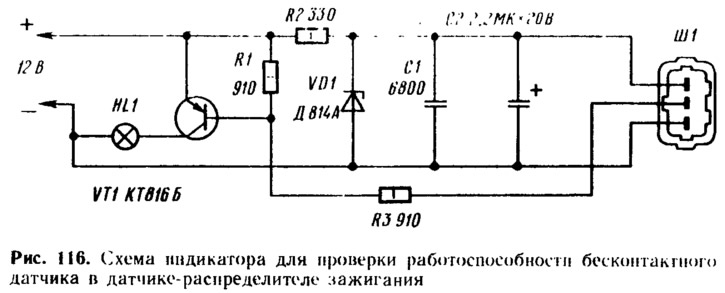
The indicator is connected to the ignition distributor sensor instead of the ignition system wiring harness. The engine is turned by the starter or a special key for the bolt on the crankshaft. If the HL1 lamp "blinks", then the contactless sensor is working properly.
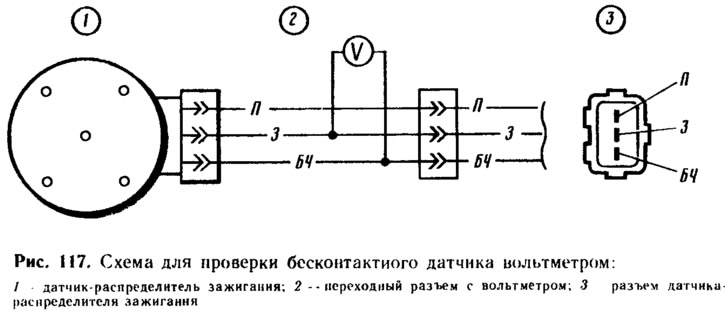
A more accurate check of the contactless sensor can be done using a voltmeter with a scale limit of at least 15 V and an internal resistance of at least 100 kOhm. Voltmeter 2 (figure 117) must be connected to the transition connector between the plug connector of the distributor sensor and the connector of the wire bundle going to the switch. Then turn on the ignition and, turning the crankshaft by the pulley mounting bolt, measure the magnitude of the voltage pulses emitted by the contactless sensor. Maximum voltage Umax (see figure 108, II) should be no more than 3 V less than the supply voltage. Minimum voltage Umin should be no more than 0.4 V.
To test high-voltage circuits, a simple arrester is required, consisting of two metal pointed rods, the gap between which can be adjusted. The rods are fixed to a plate made of electrically insulating material (plastic or ceramic).
The engine won't start
Having made sure that the starter and battery are performing their functions, that fuel is supplied to the carburetor, and that the carburetor electromagnetic valve is triggered when the ignition is turned on, we begin to search for faults in the ignition system.
First of all, using a 3 W A12 lamp, you need to check whether the switch produces current pulses to the ignition coil. To do this, disconnect the brown wire with red stripes from the ignition coil, going to terminal "1" of the switch, and connect the tip of the wire to the lamp. Connect the other terminal of the lamp to terminal "+B" of the ignition coil, turn on the ignition and turn the engine with the starter. In this case, two cases can be observed.
a) The control lamp does not "blink". Therefore, the switch does not output current pulses.
Causes of the malfunction and ways to eliminate it:
- break in the wires connecting the switch to the ignition distributor sensor. Clean the wire tips, replace damaged wires;
- break in the power supply wires to the switch. Disconnect the wiring block from the switch, connect the tip of the blue wire with the red stripe through the A12, 3 W lamp to the "ground" and turn on the ignition. If the lamp does not light, then check the wires and their connections from terminal "87" of the ignition relay to terminal "4" of the switch. Strip the wire tips, replace damaged wires;
- contacts "30/1" and "15/1" of the ignition switch or contacts "30" and "87" of the ignition relay do not close. In this case, the control devices and turn signals will also not work. It is necessary to remove the contact part of the ignition switch and check the closure of its contacts, and also check the ignition relay. Replace the damaged contact part or relay;
- break in the primary winding of the ignition coil. To check, disconnect the wires from the ignition coil and, through the A12, 3 W test lamp, connect the "+B" terminal of the ignition coil to the "plus" of the storage battery, and the other terminal to the "minus" of the battery. If the lamp does not light, then there is a break in the winding. Such an ignition coil must be replaced;
- the ignition distributor shaft does not rotate due to damage to the shaft coupling or the coupling locking pin falling out. Remove the ignition distributor cover and, by turning the engine with the starter, check whether the shaft rotates. If the shaft does not rotate, remove the ignition distributor and replace the damaged parts;
- the contactless sensor is faulty. Disconnect the wiring block from the ignition distributor sensor and connect an indicator assembled according to Figure 116 or an adapter connector with a voltmeter instead (see figure 117) Turn on the ignition and turn the engine crankshaft. If the lamp does not "blink" or the voltage pulse value measured by the voltmeter does not correspond to the norm, then replace the contactless sensor or the ignition distributor sensor;
- the switch is faulty. If the previous checks showed that the wires and the ignition distributor sensor are in good condition, then the switch is faulty and must be replaced.
b) The control lamp "blinks". Therefore, the low voltage circuit of the ignition system is in good condition, and the fault must be sought in the high voltage circuits.
First of all, you need to inspect the ignition wires and devices. They should be dry and clean. After washing the car or fording, there may be moisture on the ignition system wires and devices, as well as inside the cover and on the rotor of the ignition distributor sensor, which greatly complicates starting the engine. Therefore, they should be wiped dry with a clean chamois or other material that does not leave fibers. Remove the ignition distributor cover, wipe it inside, as well as the rotor. After making sure that all the wires and devices are dry and clean, you need to disconnect the wire tip from any spark plug and connect it to the spark gap electrode. Connect the second spark gap electrode to the car "ground" and set the air gap between the spark gap electrodes to 7... 10 mm. Turn the engine crankshaft with the starter. In this case, two cases can be observed.
a) The spark is strong and breaks through the gap.
Causes of the malfunction and ways to eliminate it:
- the order of connecting high-voltage wires to the sockets of the ignition distributor cover is violated. Check and connect the wires in accordance with the order of operation of the engine cylinders 1-3-4-2;
- the high-voltage wire tips are loose in their sockets or have come off. Check the wires and the reliability of their connection to the spark plugs and the ignition distributor sensor; replace damaged wires;
- incorrect ignition timing. Check and adjust ignition timing;
- the gap between the spark plug electrodes is not normal or the spark plugs are oiled. Clean the spark plugs and adjust the gap between the electrodes. The gap should be 0.7...0.8 mm. It is checked with a round wire feeler gauge. It is impossible to check the gap with a flat feeler gauge, since this does not take into account the notch on the side electrode, which is formed during operation of the spark plug. The gap is adjusted by bending only the side electrode of the spark plug. It is not allowed to bend the central electrode, since this can cause breakage of the ceramic insulator;
- spark plugs are damaged (cracks in the insulator, burnout of spark plug electrodes). Inspect the spark plugs, replace damaged ones with new ones.
b) There is no spark.
Causes of the malfunction and ways to eliminate it:
- current leakage through cracks or burnouts in the cover or rotor of the ignition distributor, wear, damage or sticking of the carbon electrode in the cover of the ignition distributor. In this case, there is no spark when all spark plug wires are connected to the spark gap, while when the central wire is connected to the spark gap, the formation is normal. Check the cover and rotor of the ignition distributor, the condition of the carbon electrode. Replace damaged parts;
- break in the secondary winding or internal discharges in the ignition coil. When the high-voltage wire from the ignition coil is connected to the spark gap, there is no sparking. Replace the ignition coil.
The article is copied from the website: VAZBOOK.ru
Engine runs rough or stalls at idle
The malfunction manifests itself in an uneven exhaust sound and sudden engine stops at idle. Causes of the malfunction and how to fix it:
- too early ignition in engine cylinders. Check, adjust ignition timing if necessary;
- large gap between spark plug electrodes. Check and adjust the gap between spark plug electrodes.
The engine runs unevenly and unstably at high crankshaft speeds
The cause of the malfunction is the weakening of the ignition timing regulator weight springs in the ignition distributor sensor. This cause of the malfunction can only be detected at a vehicle maintenance station by checking the characteristics of the centrifugal ignition timing regulator on a stand.
Engine misfires in all modes
The malfunction manifests itself in an uneven exhaust sound and a decrease in engine power both at low and high crankshaft speeds.
Causes of the malfunction and ways to eliminate it:
- the wires in the ignition system are damaged, the wire fastening is loose or their tips are oxidized; the interference suppression tips of the high-voltage wires are damaged. Inspect the wires, their connections, replace damaged wires. Check the high-voltage wires with a spark gap, as described above;
- oiling, carbon deposits or damage to the spark plug. A faulty spark plug can be detected by disconnecting the wires from the spark plugs one by one and starting the engine. If the engine misfires increase after disconnecting the wires (or he won't start at all), then this spark plug is in good condition. If you disconnect the non-working spark plug, the engine misfires will remain unchanged. In addition, a faulty spark plug can be found by the temperature of the insulator after the engine is stopped. The non-working spark plug will be noticeably colder than the working one. Remove the faulty spark plug, clean it and adjust the gap between the electrodes. Damaged spark plug (with cracks in the insulator, burnt-out electrodes) replace;
- cracks, contamination or burnouts in the rotor or cover of the ignition distributor sensor, inspect it and the rotor, clean from dirt and moisture, replace the damaged cover and rotor;
- wear or damage to the carbon electrode in the ignition distributor cover, weakening of the spring of this electrode, severe burning of the central contact of the ignition distributor rotor. Check whether the carbon electrode is broken and whether it moves easily in its seat, clean the central contact of the rotor. In case of damage or wear of the carbon electrode, replace the ignition distributor cover;
- the commutator is faulty - the pulse shape on the primary winding of the ignition coil does not correspond to the norm. This fault must be checked at a service station. The faulty commutator must be replaced.
The engine does not develop full power and does not have sufficient throttle response
This malfunction manifests itself in a decrease in the speed of movement and slow acceleration of the car.
Causes of the malfunction and ways to eliminate it:
- incorrect ignition timing. Check and adjust ignition timing;
- the ignition timing regulator weights are jammed in the ignition distributor sensor, the weight springs are weakened. It is necessary to contact a service station to check the characteristics of the centrifugal ignition timing regulator;
- the commutator is faulty - the pulse shape on the primary winding of the ignition coil does not correspond to the norm. Check the commutator at a service station, replace the faulty commutator.