




At the same time, the relay anchor moves the overrunning clutch with the gear through the lever. The hub of the overrunning clutch, turning on the helical splines of the starter anchor shaft, also turns the gear, which facilitates its engagement with the flywheel ring.
Current flows through the closed contacts of the traction relay, feeding the stator and anchor windings, and the starter anchor begins to rotate together with the hub and the outer ring of the overrunning clutch. Since the clutch rollers are displaced by springs into a shallower part of the groove of the outer ring 2 (figure 105), and the gear is braked by the flywheel ring, then the rollers are jammed between the outer 2 and inner 1 rings of the overrunning clutch and the torque from the armature shaft is transmitted through the clutch and gear to the flywheel ring. As a result of the gear braking, the clutch hub is unscrewed from the splines of the armature shaft and the gear is sent to the stop in ring 1 (see figure 103), fully engaging with the flywheel ring gear.
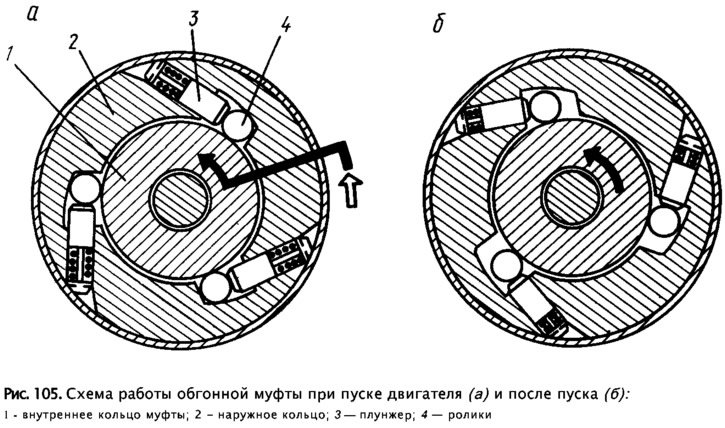
After the engine starts, the rotation speed of the pinion exceeds the rotation speed of the starter anchor. Inner ring of the overrunning clutch (combined with gear) draws the rollers into a deeper part of the outer ring groove (figure 105, b), compressing the plunger springs 3. In this part of the groove, the rollers rotate freely without jamming, and the torque is not transmitted from the engine flywheel to the armature shaft.
After returning the key to position I (Ignition), the power supply circuit of the auxiliary relay winding 6 (see figure 104) is interrupted and the relay contacts open. As a result, the power supply circuit of the traction relay windings is disconnected through the contacts of the auxiliary relay. Now the current through the traction relay windings goes from the lower contact bolt of the relay first through the pull-in II, and then through the holding I winding and to the "ground". Since the direction of the current in the turns of the windings is opposite, the magnetic fluxes created by the windings mutually compensate and the relay core is demagnetized. The relay anchor is pressed back to its original position by the spring. The relay contacts open, and the drive gear disengages from the flywheel ring gear.