If the ignition is too early, the working mixture burns prematurely and the gas pressure in the cylinder increases excessively even before the piston reaches TDC. As a result, the loads on the crank mechanism parts increase, knocking occurs, engine power decreases, it overheats and runs unstably at idle at low crankshaft speed.
To check the ignition timing on the car, there is a scale 1 (see figure 30) in the clutch housing hatch and mark 2 on the flywheel. One division of the scale corresponds to 1° of crankshaft rotation. When the mark on the flywheel is aligned with the middle (long) division of the scale, the pistons of the 1st and 4th cylinders are at TDC
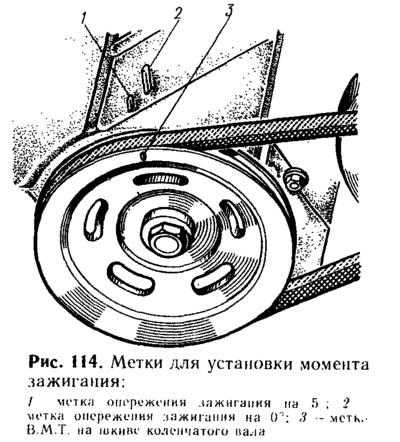
When running the engine on a stand at service stations, the ignition timing can be set using marks on the crankshaft pulley and on the front cover of the camshaft drive (figure 114).
You can check and set the ignition timing using a stroboscope in the following order:
- connect the "plus" clamp of the stroboscope to the "plus" terminal of the battery, and the "ground" clamp to the "minus" terminal. Connect the clamp of the stroboscope sensor to the high-voltage wire of the first cylinder;
- start the engine and direct the flashing beam of the strobe light into the clutch housing hatch; if the ignition timing is set correctly, then when the engine is idling, the mark on the flywheel should be one division short of the middle division of the scale 1 (see figure 30);
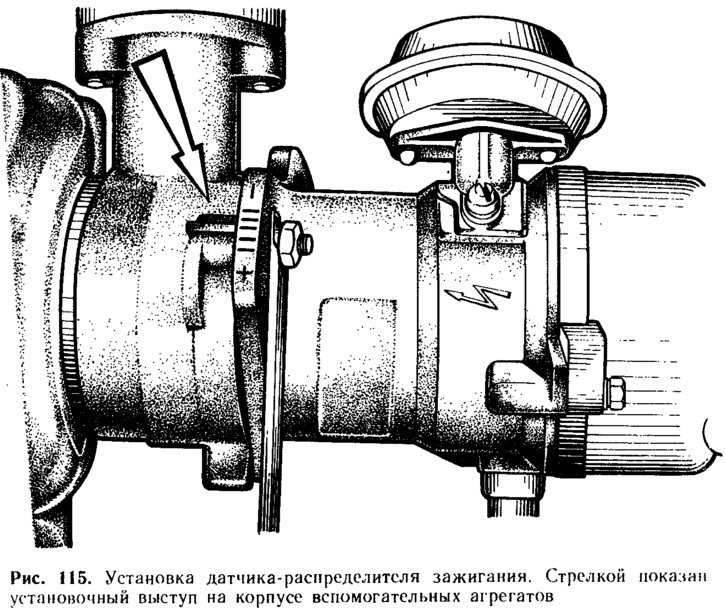
- to adjust the ignition timing, stop the engine, loosen the nuts securing the ignition distributor sensor and turn it to the required angle. To increase the ignition timing angle, turn the distributor sensor body clockwise, and to decrease it, turn it counterclockwise.
For ease of adjustment of the ignition timing, there are divisions and signs "+" and "-" on the flange of the ignition distributor sensor, and an installation protrusion on the body of the auxiliary units (figure 115). One division on the flange corresponds to eight degrees of crankshaft rotation.