




Open large image in new tab »
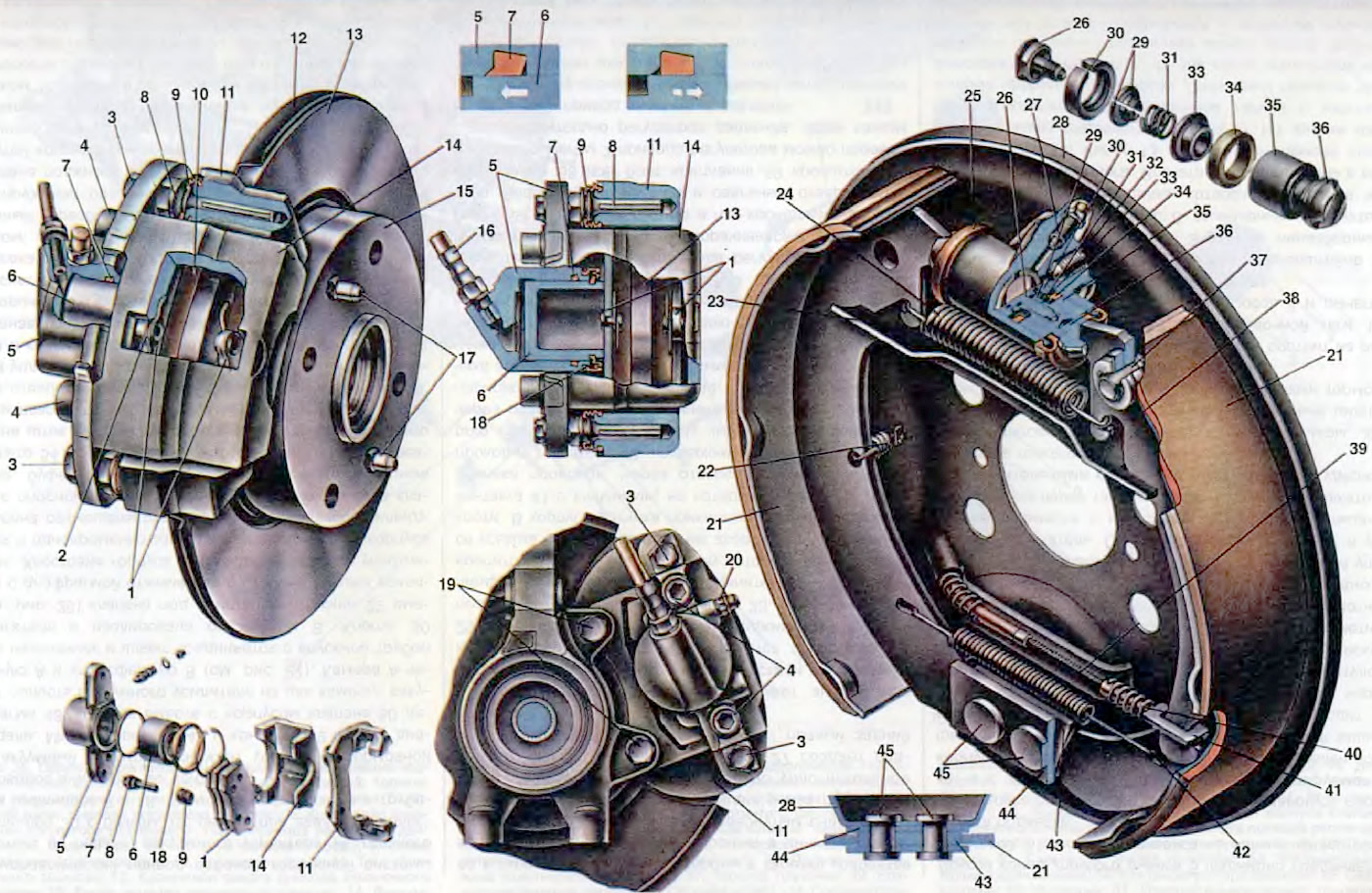
Figure 27. Wheel brake mechanisms: 1. Brake pads; 2. Brake shoe pressure spring; 3. Bolts for fastening the cylinder to the guide pins; 4. Bolts connecting the cylinder to the caliper; 5. Cylinder; 6 Piston; 7. Sealing ring; 8. Guide pin; 9. Finger Protective Cover; 10. Brake shoe lining, 11. Brake shoe guide; 12. Protective cover; 13. Brake disc; 14. Support; 15. Front wheel hub; 16. Brake cylinder hose; 17. Guide pins; 18. Piston protective cover; 19. Bolts for fastening the brake mechanism to the steering knuckle; 20. Brake mechanism bleed nipple; 21. Brake shoe; 22. Shoe guide spring; 23. Expansion bar; 24. Upper brake shoe tension spring; 25. Wheel cylinder protective cap; 26 Stop screw, 27. Brake mechanism drive bleeding nipple; 28 Brake shield; 29. Rusks; 30. Thrust ring; 31. Spring; 32. Liquid supply pipe nipple; 33. Support cup; 34. Seal; 35. Wheel cylinder piston; 36. Shoe stop; 37. Finger of the manual brake shoe drive lever; 38. Brake shoe manual lever; 39. Parking brake drive cable. 40. Cable spring; 41. Cable tip; 42. Lower brake shoe tension spring; 43. Brake shoe support plate; 44. Brake shoe guide plate; 45. Rivets for fastening plates.
The front wheel brake mechanism is a disc brake, consisting of a guide 11 of the pads, a support 14, two brake pads 1 and a brake disc 13. The guide of the pads is made of high-strength cast iron in the form of a bracket, which has four bosses. In two of them, threaded holes are made for bolts 19 fastening the guide of the pads to the steering knuckle, in the other two holes are drilled for the guide pins 8 of the support. The guide of the pads has a longitudinal groove through which the brake disc passes, and two openings for placing the brake pads. The configuration of the openings is made according to the shape of the brake pads. In addition, in the side openings there are two shelves, to which the brake pads 2 are pressed by springs. All this creates a tight fit of the brake pads in the guide and does not allow vibration of the pads. The support is cast from high-strength cast iron. It has a groove for brake shoes on top, and in the center - a through inspection window, in which the brake shoe bosses are located. Through this window, the condition of the brake shoe linings is visually determined. Springs 2 rest against the steps of the window, as a result of which they press the shoes to the guide and fix the shoes relative to the caliper. The caliper is attached with two bolts 4 to the flange of the wheel cylinder, forming a "floating" bracket.
To ensure joint "floating" of the caliper and wheel cylinder relative to the guide, they are connected to the shoe guide not rigidly, but with the help of pins 8, which are installed in the holes of the guide. The pins are fastened with bolts 3 to the flange of the wheel cylinder. During assembly, the pins are coated with grease, which protects this connection from corrosion, to ensure a constant force for moving the bracket regardless of the service life of the car. A protective cover 9 is put on the annular grooves of the pin and the guide, protecting the pin rod from environmental impact.
The brake pads are steel and have a shaped form, which ensures their tight fit to the pad guide. At the top, the pads have a lug, which is located in the caliper window. A spring 2 is attached to the pad using a pin. When installed, the caliper presses on the spring, ensuring that the pads are pressed against the guide. Friction lining 10 is glued to the pad. A lining wear indicator wire can be mounted in one of the pads.
The wheel cylinder is attached to the caliper and the shoe guide with bolts 3 and 4. A hollow piston 6 is installed in the cavity of the wheel cylinder 5, which is sealed in the cylinder by a rubber ring 7. This ring has a trapezoidal shape and is located in the groove of the cylinder. It tightly covers the surface of the piston. When the piston moves, it carries the ring along with it, twisting it in the groove of the cylinder. Due to the elasticity of the sealing ring, the piston returns to its original position when releasing the brakes. The cavity of the cylinder is protected by a rubber cover 18. Two holes are made in the cylinder, into one of which a nipple 20 is screwed for bleeding the brake mechanism drive, and into the other - a hose nipple 16 for supplying fluid.
Brake disc 13 is cast iron and is covered on the inside by a protective casing 12, which is attached to the steering knuckle.
The rear wheel brake mechanism is a drum brake with automatic adjustment of the gap between the shoes and the drum. It is mounted on a support shield 28, which is attached to the flange of the rear suspension arm together with the rear wheel axle. In the lower part of the shield, a pack of plates is attached with two rivets 45, one of which is a support 43 for the brake shoes 21. The other plates (44) guide the movement of the lower part of the shoes on the support plate, limiting their axial movement. In the upper part of the shield, the wheel cylinder is attached with two bolts. The brake shoes are pulled together by the upper 24 and lower 42 springs, which press the shoes to the lower support and to the stops 36 of the wheel cylinder pistons. Additionally, the shoes are held in the middle part by guide springs 22, which are connected at one end to the edge of the shoe, and at the other - to the pin of the support shield. Due to the non-rigid connection of the pads with the brake shield, they self-align at the moment of braking.
The automatic clearance adjustment device between the shoes and the drum is located in the wheel cylinder. Its main element is a split thrust ring 30 mounted on the piston 35 between the flange of the thrust screw 26 and two crackers 29 with a gap of 1.25-1.65 mm. The thrust rings are installed in the cylinder with an interference fit that ensures a ring shear force along the cylinder surface of at least 35 kgf, which exceeds the force on the piston from the tension springs 24 and 42 of the shoes. When the linings wear out, the gap of 1.25-1.65 mm is completely eliminated, the flange on the thrust screw 26 is pressed against the flange of the ring 30, as a result of which the thrust ring shifts after the piston by the amount of wear. When braking stops, the pistons are shifted by the force of the tension springs until the crackers stop against the flange of the thrust ring.
On the rear pads, the levers 38 of the manual brake pad drive are attached with pins 37.
The brake drum is cast from an aluminum alloy, its working surface is formed by a cast iron insert, poured inside the drum. The drum is attached to the flange of the rear wheel hub together with the wheel disk with four bolts.
(The original is available on the online resource: VAZbook.ru)