




Open large image in new tab »
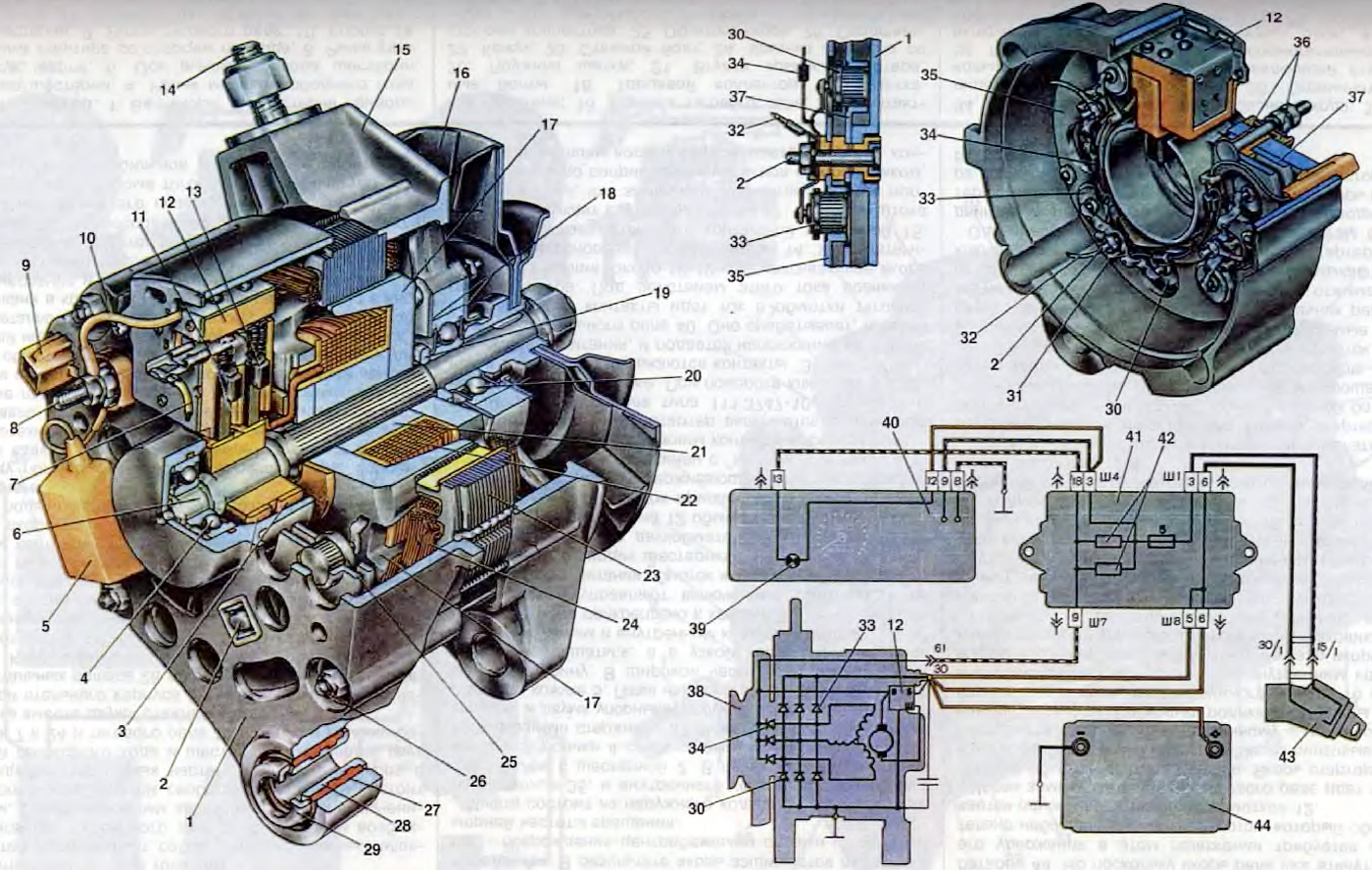
Figure 30. Generator: 1. Generator cover from the slip ring side; 2. Rectifier block mounting bolt; 3. Slip rings; 4. Ball bearing of the rotor shaft from the slip ring side; 5. Capacitor 2.2uF±20% for radio interference suppression; 6. Rotor shaft; 7. Common terminal wire of additional diodes; 8. Clamp "30" of the generator for connecting consumers; 9. Generator plug "61" (common terminal of additional diodes); 10. Wire of output "B" of voltage regulator; 11. Brush connected to terminal "B" of the voltage regulator; 12. Voltage regulator; 13. Brush connected to the output "W" of the voltage regulator; 14. Stud for fastening the generator to the tensioner; 15. Generator cover from the slip ring side; 16. Fan impeller with generator drive pulley; 17. Rotor pole piece; 18. Bearing mounting washers; 19. Distance ring; 20. Ball bearing of rotor shaft on drive side; 21. Steel bushing; 22. Rotor winding (excitation winding); 23. Stator core; 24. Stator winding; 25. Rectifier block; 26. Generator tie bolt; 27. Buffer bushing; 28. Bushing; 29. Pressure sleeve; 30. Negative diode; 31. Insulating plate; 32. Phase terminal of the stator winding; 33. Positive diode; 34. Additional diode; 35. Positive diode holder; 36. Insulating bushings; 37. Negative diode holder; 38. Generator; 39. Battery discharge indicator lamp; 40. Voltmeter; 41. Mounting block; 42. Additional resistors 100 Ohm, 2 W; 43. Ignition switch; 44. Battery.
The VAZ-2108 and VAZ-2109 vehicles use a three-phase alternating current generator type 37.3701 with a built-in rectifier unit and a microelectronic voltage regulator. It serves to supply consumers with electric current and to charge the battery. The maximum output current of the generator (at 13V and 5000rpm) is 55 A, and the adjustable voltage range is 14.1±0.5 V.
The main parts of the generator are: rotor, stator, cover 1 with rectifier block 25, cover 15 with bearing 20, pulley with fan 16 and brush holder with voltage regulator 12. The covers and stator are pulled together into a single unit by four tie bolts 26.
The generator rotor is a rotating electromagnet. Steel beak-shaped pole pieces 17 and bushing 21, pressed onto rotor shaft 6, form the electromagnet core. Between the pole pieces in a plastic frame is the rotor winding 22, called the excitation winding. Current is supplied to the winding through copper contact rings 3, to which the winding terminals are soldered.
The rotor shaft rotates in two ball bearings 4 and 20 installed in covers 1 and 15. The bearings are of a sealed type. The grease incorporated into them during manufacture is sufficient for the entire service life of the generator. The rear bearing 4 is pressed onto the rotor shaft, and its outer race is pressed by a rubber ring placed in a groove in the cover. The front bearing 20 is pressed into cover 15 and, for reliability, is clamped between two steel washers 18, tightened with four screws. The ends of the screws are punched. The inner race of this bearing, together with the spacer ring 19, is clamped by the pulley fastening nut between the pulley hub and the shaft step.
The generator stator consists of a core 23 with a winding 24. The core is assembled from electrical steel plates, connected in four places by electric welding. A three-phase stator winding is laid in the grooves of the core, the ends of which are connected in a star without a zero point.
The rectifier, which converts the alternating current of the generator into direct current, is made in the form of a rectifier block 25. It is two aluminum plates with six VA-20 type diodes pressed into them — semiconductor devices that pass current in only one direction. To simplify the design of the rectifier, diodes of different polarity are used — "positive" and "negative". The positive diodes on the body create a "plus" of the rectified voltage, and the negative ones — a "minus". Positive diodes are pressed into plate 35 of the rectifier block, and negative ones — into plate 37.
The rectifier unit is attached to the cover 1 with three bolts 2, insulated together with the plate 35 of the positive diodes from the cover with plastic bushings. The nuts of the bolts 2 simultaneously clamp the terminals of the diodes and the stator winding. The clamp "30" (8) of the generator, which is the "plus" terminal of the rectifier, is connected to the plate 35. The "minus" terminal is the generator mass.
Three additional diodes 34 are also installed on plate 35 of the rectifier block. The voltage taken from these diodes is used to power the excitation winding 22 and the generator health control circuit using the battery discharge control lamp 39.
The generator voltage is regulated by a microelectronic contactless voltage regulator 12, fixed with a screw on the cover 1. This is a non-separable and non-adjustable unit and it completely lacks any electromagnetic relays with contacts. The generator excitation winding power supply circuit is closed or opened by opening or closing a powerful output transistor in the regulator depending on the value of the control voltage at the regulator output "B".
A plastic brush holder with two brushes 11 and 13 is inserted into the groove of the voltage regulator, through which the generator field winding is fed. The brush 11 is connected to the output "B" of the voltage regulator, and the brush 13 is connected to the output "W". This pin is located on the inside of the controller and is not marked on its body.
Generator operation
When the ignition is turned on, contacts "15/1" and "30/1" of the ignition switch are closed, then contacts "30" and "87" of the ignition relay (not shown in the picture), and through the field winding of the generator, current begins to flow, closing along the path: "plus" of the battery-terminal "30" of the generator 38-mounting block 41-contacts "30" and "87" of the ignition relay-fuse "5" of the mounting block-additional resistors 42 and along a parallel circuit through the lamp 39-output "61" of the generator-output "B" of the voltage regulator 12-field winding 22-output "W", output transistor of the voltage regulator - "mass".
The battery discharge indicator lamp 39 lights up, indicating that the excitation winding is powered by the battery.
The current flowing through the excitation winding creates a magnetic flux around the rotor poles. After the engine starts, the generator rotor rotates, and under each stator tooth, either the south or north pole of the rotor passes. Therefore, the magnetic flux passing through the stator teeth changes in magnitude and direction. This alternating magnetic flux crosses the turns of the stator winding and creates an electromotive force in it.
The alternating voltage and current induced in the stator winding are rectified by the rectifier unit and the already rectified direct current taken from the generator terminal "30" is used to power the consumers. At the same time, the rectified voltage is taken from the common terminal of the additional diodes 34 to power the generator excitation winding.
In a working, serviceable generator, the voltage at terminal "30" and at the common terminal of the additional diodes (plug "61") are the same. Therefore, no current flows through the control lamp 39, and it does not light. In this case, the excitation winding of the generator is powered by a rectifier on three additional diodes, and the battery is charged by the generator.
[View the original on the internet resource: VazBook.ru]
If the control lamp 39 is on, this indicates a faulty generator, that it either does not provide voltage at all, or it is lower than the voltage of the battery. In this case, the voltage on the plug "61" (generator voltage) below voltage at terminal "30" (battery voltage). Therefore, a current flows in the circuit between them, passing through the control lamp, and it lights up.
As the rotor speed increases, the generator voltage increases. When it begins to exceed the level of 13.6-14.6 V, the output transistor in the voltage regulator 12 locks, and the current through the excitation winding is interrupted. The generator voltage drops, the transistor in the regulator unlocks and again passes the current through the excitation winding.
The higher the generator rotor speed, the longer the transistor lock time in the regulator, and therefore the more the generator voltage decreases. The described process of locking and unlocking the regulator occurs with a high frequency. Therefore, the voltage fluctuations at the generator output are unnoticeable and can practically be considered constant, maintained at a level of 13.6-14.6 V.