




Open large image in new tab »
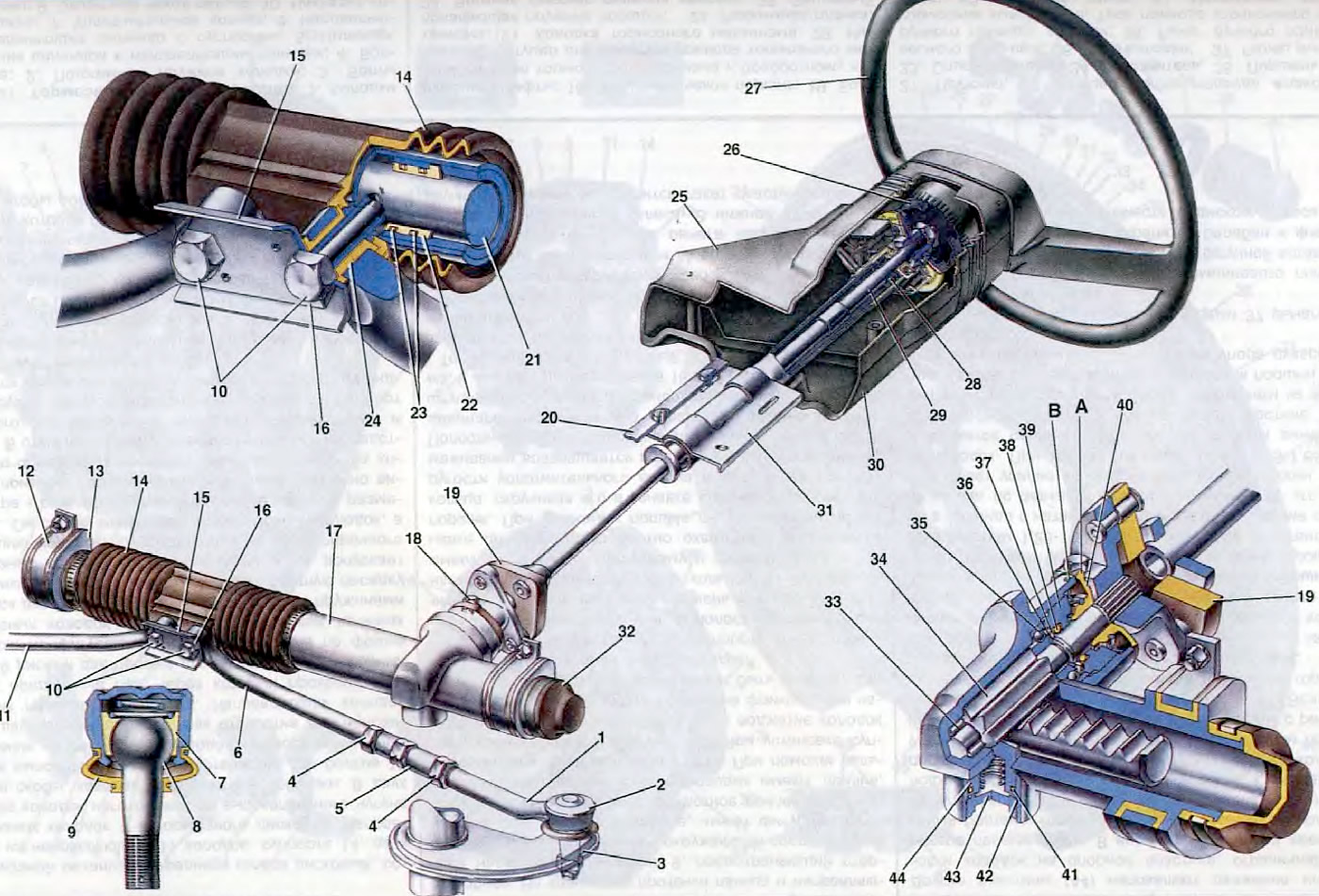
Figure 26. Steering: 1. Tie rod end; 2. Ball joint of the tip; 3. Telescopic stand pivot arm; 4. Nut; 5. Adjusting rod; 6. Left steering rod; 7. Ball joint insert; 8. Ball pin; 9. Protective cap; 10. Steering rod to rack mounting bolts; 11. Right steering rod; 12. Steering gear mounting bracket; 13. Steering gear support cushion; 14. Protective case; 15. Connecting plate; 16. Locking plate; 17. Steering gear housing; 18. Coupling tightening bolt; 19. Elastic coupling; 20. Steering column mounting bracket; 21. Rail; 22. Rack support sleeve; 23. Damping rings; 24. Rubber-metal hinge; 25. Upper part of the facing casing; 26. Steering wheel damper; 27. Steering wheel; 28. Ball bearing; 29. Steering shaft; 30. Lower part of the facing casing; 31. Steering shaft mounting bracket; 32. Protective cap; 33. Roller bearing; 34. Drive gear; 35. Ball bearing gear; 36. Retaining ring; 37. Protective washer; 38. Sealing ring; 39. Bearing nut; 40. Anther; 41. Rack stop sealing ring; 42. Stop nut retaining ring; 43. Stop nut; 44. Rack stop; A. Mark on the boot. B. Mark on the steering gear housing.
The steering system consists of a steering gear and a steering drive. The steering gear 17 is of the rack and pinion type. It is mounted in the engine compartment together with the steering drive rods to the front body panel with two brackets 12. Rubber cushions 13 are installed between the steering gear housing and the panel, as well as on both housing supports, to dampen vibrations. The steering gear housing is cast from an aluminum alloy together with the left support. The drive gear 34 is mounted in the housing cavity on two bearings. The ball bearing 35 is secured on the gear shaft with a retaining ring 36. The outer ring of the bearing is pressed against the end face of the housing socket with a nut 39 with a protective washer 37. The nut is locked in the housing with a washer and covered with a dust cover 40, which is mounted on the drive gear shaft and secured on it with a wire ring. To seal the gap between the pinion shaft and the nut, a sealing rubber ring 38 is installed in its groove. The housing and the dust cover are marked A and B for correct assembly of the steering gear. The drive pinion shaft has splines for fastening the elastic coupling 19, through which the pinion is connected to the steering shaft. The elastic coupling dampens shocks, vibrations, suppresses noise, allows relative movement between the steering gear 17 and the steering shaft 29. The coupling is fixed on the pinion shaft with a tightening bolt 18. The cylindrical roller bearing 33 is pressed into the socket of the steering gear housing. The lower end of the drive pinion rests on it, which is in engagement with the rack 21. The rack is pressed against the pinion by a metal-ceramic stop 44 by the force of the spring. The rack stop is sealed in the housing with a rubber ring 41. The spring is pressed against the stop by a nut 43 with a locking ring 42. This ring creates resistance to unscrewing the nut. When assembling the steering gear, the nut is installed so that a gap of up to 0.12 mm is provided between it and the stop. This gap is necessary to compensate for the thermal expansion of the parts, so that the steering gear does not jam. Additionally, the nut is fixed by punching it in two opposite places. Due to the spring-loaded stop 44, gap-free engagement of the gear along the entire length of the latter is ensured. One end of the rack rests on the stop 44, and the other on the split plastic bushing 22, sealed in the housing with rubber rings 23. A protective cap 32 is put on the steering gear housing on the left side, and a pipe with a longitudinal groove is pressed on the right. Bolts 10 pass through the groove of the pipe and the holes of the protective cover 14, fastening the rods 6 and 11 of the steering gear to the rack. The bolts are connected to each other by a plate 15. Both bolts pass through rubber-metal hinges 24, pressed into the heads of the rod ends. The bolts are fixed by a locking plate 16, the edges of which are bent to the edge of the bolt head. The crankcase cavity is protected from contamination by a corrugated cover 14, which is fastened with two plastic clamps, and a rubber cap 32.
The steering shaft 29 is connected to the drive gear 34 by an elastic coupling 19, which consists of two flanges and a rubber coupling, connected to each other by rivets. The holes in the coupling for the rivets are reinforced with cord bundles and metal bushings. The upper part of the shaft 29 rests on a ball bearing with a plastic bushing. The bearing is pressed into the tube of the bracket 31, which is attached at four points to the body bracket. Splines are cut on the upper end of the shaft, on which the steering wheel 27 is attached through the damping element 26. It is made of plastic reinforced with a steel frame. The connector of the steering column switch is attached to the tube of the bracket 31, and the contact part of the horn is attached to the lower end of the damping element. The steering column switch and horn are covered by a protective casing consisting of an upper 25 and lower 30 parts connected together with screws.
The steering gear consists of two transverse rods 6 and 11 and pivot arms 3 of the telescopic struts of the front suspension. Each rod is composite, consisting of two tips connected to each other by a tubular rod 5. It is screwed onto the tips and locked with nuts 4. On the left rod, these nuts have a left-hand thread and, for distinction, slots on the edges of the nuts. Such a connection allows changing the length of the steering rods, which is necessary when adjusting the toe-in of the front wheels. A rubber-metal hinge 24 is pressed into the head of the inner tip, consisting of a rubber and metal bushing. A bolt for fastening the rod to the rack 21 of the steering gear passes through the latter. In the head of the outer joint, there are parts of the ball joint, consisting of an insert 7, a ball pin 8, a spring and a protective cap 9. The plastic insert together with the pin is constantly pressed by a spiral spring to the conical surface of the bore of the tip. Due to the longitudinal cut in the insert, the gap between the insert and the pin is automatically selected. The other end of the spring rests against a washer rolled into the tip. The cavity of the hinge is sealed with a protective cap 9, one end of which goes into the bore of the tip, and the other is tightly placed on the pin 8. The pivot arm 3 is welded to the body of the front suspension strut. A bushing with a conical hole for the pin 8 of the ball joint is mounted in it. The nut securing the pin of the hinge is cotter-pinned.