




Open large image in new tab »
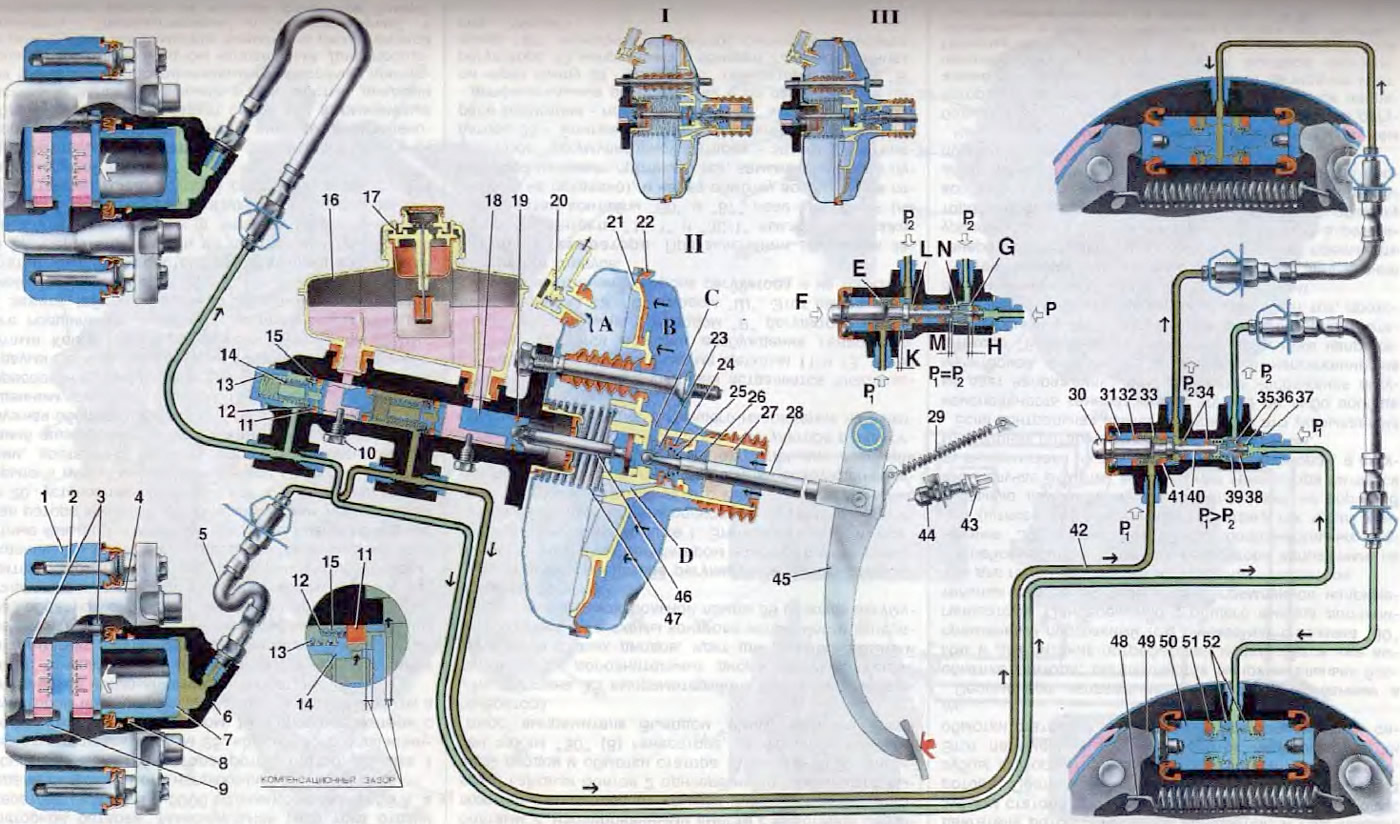
Figure 29. Scheme of operation of the braking system: 1. Shoe guide; 2. Guide pin; 3. Front brake pads; 4. Support; 5. Left front and right rear brake drive circuit hose; 6. Front brake wheel cylinder; 7. Wheel cylinder piston; 8. Piston sealing ring; 9. Brake disc; 10. Piston stroke limiting screw; 11. Sealing ring; 12. Stubborn cup; 13. Piston return spring; 14. Piston of the drive of the right front and left rear brakes; 15. Sealing ring spring; 16. Master cylinder reservoir; 17. Liquid level alarm sensor assembly; 18. Left front and right rear brake actuator piston; 19. Seal; 20. Vacuum booster; 21. Valve body; 22. Diaphragm; 23. Piston; 24. Vacuum booster valve; 25. Valve spring; 26. Pusher return spring; 27. Air filter; 28. Pusher; 29. Brake pedal release spring; 30. Pressure regulator piston; 31. Piston bushing; 32. Seal; 33. Piston spring; 34. Pusher sealing rings; 35. Valve seat; 36. Valve spring; 37. Cork; 38. Valve; 39. Valve seat sealing ring; 40. Pusher; 41. Piston head seal; 42. Pipeline of the circuit "left front and right rear brakes"; 43. Brake light switch; 44. Brake light switch tip; 45. Brake pedal; 46. Rod; 47. Valve body return spring; 48. Brake shoe tension spring; 49. Rear brake shoe; 50. Rear brake wheel cylinder piston; 51. Piston seal; 52. Thrust rings; A - vacuum cavity; B - atmospheric cavity; C - a channel connecting the atmospheric cavity with the internal cavity of the valve; D - channel connecting the vacuum cavity with the internal cavity of the valve; F - the force of pressure on the piston from its drive parts; P₁ - liquid pressure in the master cylinder; P₂ - fluid pressure in wheel cylinders; E, G - pressure regulator chambers connected to the master cylinder; L, N - pressure regulator chambers connected to wheel cylinders; K, M, H - gaps; I. The pedal is not pressed; II. Braking; III. Disinhibition.
When the brake pedal is pressed, it moves away from the tip 44 of the brake light switch, and the lamp circuit is closed, as a result of which the brake light lamp lights up. At the same time, the pusher 28 moves together with the piston 23 and the valve body 21. Following the piston, the valve moves under the action of the spring 25 until it stops against the valve seat. When it touches the seat, the valve disconnects chambers A and B. With further movement of the piston 23, its end moves away from the valve 24 and through the resulting gap, chamber B communicates with the atmosphere. Therefore, atmospheric air enters chamber B through the filter 27, through the resulting gap between the piston and the valve and then through channel C. Atmospheric air creates pressure on diaphragm 22.
Due to the difference in pressure in chambers A and B and the force applied to the brake pedal, the valve body moves together with rod 46, which in turn acts on piston 18 of the master cylinder. When piston 18 moves, the spacer ring moves away from locking screw 10, and sealing ring 11 is pressed by spring 15 to the end face of the piston groove. The compensation gap is closed, and the master cylinder and reservoir are disconnected. With further movement of piston 18, fluid pressure is created in the working cavity of the "left front - right rear brake" drive, which is transmitted through pipelines to the wheel cylinders of the brake mechanisms. It also acts on floating piston 14, which, moving, creates pressure in the "right front - left rear brake" circuit. Under increasing fluid pressure, high-pressure rings 11 begin to expand and fit more tightly to the cylinder walls and to the end of the grooves, which improves the sealing of the pistons in the cylinder.
With increasing pressure in the circuits, the force on piston 30 of the pressure regulator increases, which tends to move it out of the regulator housing. When the force from the fluid pressure begins to exceed the force from the elastic lever, the piston begins to move out of the housing. Following the piston, under the force of the spring of the pusher bushing and spring 36, the pusher 40 moves together with the bushing and rings 34. In this case, the gap M between the plate and the seat 35 increases, and the gaps H and K decrease. When the gap H is completely selected and the valve 38 isolates chamber G from chamber N, the pusher 40 together with the parts located on it stops moving following the piston. From this moment on, the pressure in chamber N will change depending on the pressure in chamber L. With a further increase in the force on the brake pedal, the pressure in chambers E, G and L increases, and the piston will continue to move out of the housing.
At the same time, under the pressure of the liquid, the tappet bushing together with the sealing rings 34 and the tappet bushing spring plate will shift towards the plug 37. In this case, the gap M and the volume of chamber N will decrease. With a decrease in the volume of chamber N, the pressure in it, and therefore in the rear wheel drive, will increase and will almost always be equal to the pressure in chamber L. When the gap K is completely selected, that is, the piston head 30 touches the seal 41, the pressure in chamber L, and therefore in chamber N, will increase to a lesser extent compared to chamber E and only due to throttling of the liquid between the piston head and the seal 41. The dependence of the pressure in chambers L and E is determined by the ratio of the difference in the areas of the head and the piston rod to the area of the head.
As the load on the vehicle increases, the elastic lever 5 (see figure 26) is loaded more, and the force on the piston from the lever 7 increases. This means that the moment of contact of the piston head with the seal will be achieved with higher pressure in the main cylinder. Therefore, the efficiency of the rear brakes increases with increasing load on the car.
Under liquid pressure, pistons 7 and 50 (see figure 27) wheel cylinders of the front and rear brakes move. In this case, pistons 7 press inner brake shoes 3 to disk 9, and the wheel cylinder assembled with caliper 4 moves in the opposite direction under the force of the reaction that has arisen. The movable bracket presses the outer shoe to the brake disk. When pistons 50 move, part of the gap is selected (1.25-1.65 mm) between the flanges of the thrust screws and rings 52. In this case, the shoes 49 are pressed against the brake drum, creating a braking torque on the wheels. When the linings wear out, the gap of 1.25-1.65 mm is completely selected, and the thrust screws press on the flanges of the thrust rings 52 with a force that ensures the shift of the rings along the cylinder mirror by the amount of wear of the linings. That is, the rings 52 will take a new position in the cylinders, again restoring the optimal gap between the shoes and the drum.
If one of the circuits fails, the pressure regulator will operate with part of its chambers, disconnecting the faulty circuit. Thus, if the "right front - left rear brakes" circuit fails, the sealing rings 34 and the tappet bushing 40 will shift under fluid pressure toward the plug 37 until the tappet bushing spring plate rests against the valve seat. The pressure in the rear brake will be regulated by the part of the regulator that includes the piston 30 with the seal 41 and the housing bushing into which the piston head enters. This part of the regulator will operate in the same way as with a functioning system.
When the "left front - right rear brake" circuit fails, the fluid pressure moves the pusher 40 together with its bushing and sealing rings 34 toward the piston 30, pushing it out of the housing. In this case, the gap M increases, and the gap H decreases. When the valve 38 touches the seat 35, the pressure in the chamber N stops growing, i.e. the regulator operates as a pressure limiter.
When releasing the brakes, the brake pedal and all the parts of the vacuum booster take their initial position under the action of the springs, which leads to the cessation of the flow of atmospheric air into chamber B, and when valve 24 moves away from the seat, chambers A and B communicate with each other. Pistons 18 and 14 of the main cylinder are pressed against the stop screws 10 under the action of the return springs. In this case, the spacer rings, resting against the screws 10, move the sealing rings 11 away from the ends of the piston grooves, as a result of which compensation gaps are formed through which the working cavities of the cylinder communicate with the tank, i.e. the pressure in the circuits drops to atmospheric.
Chambers E and G of the regulator communicate with chambers L and N. The springs of the rear brakes move the shoes away from the drums by the amount of the gap between the crackers and the flanges of the thrust rings 52, and the pistons of the wheel cylinders of the front brakes are moved away from the shoes due to the elasticity of the sealing rings.