




Open large image in new tab »
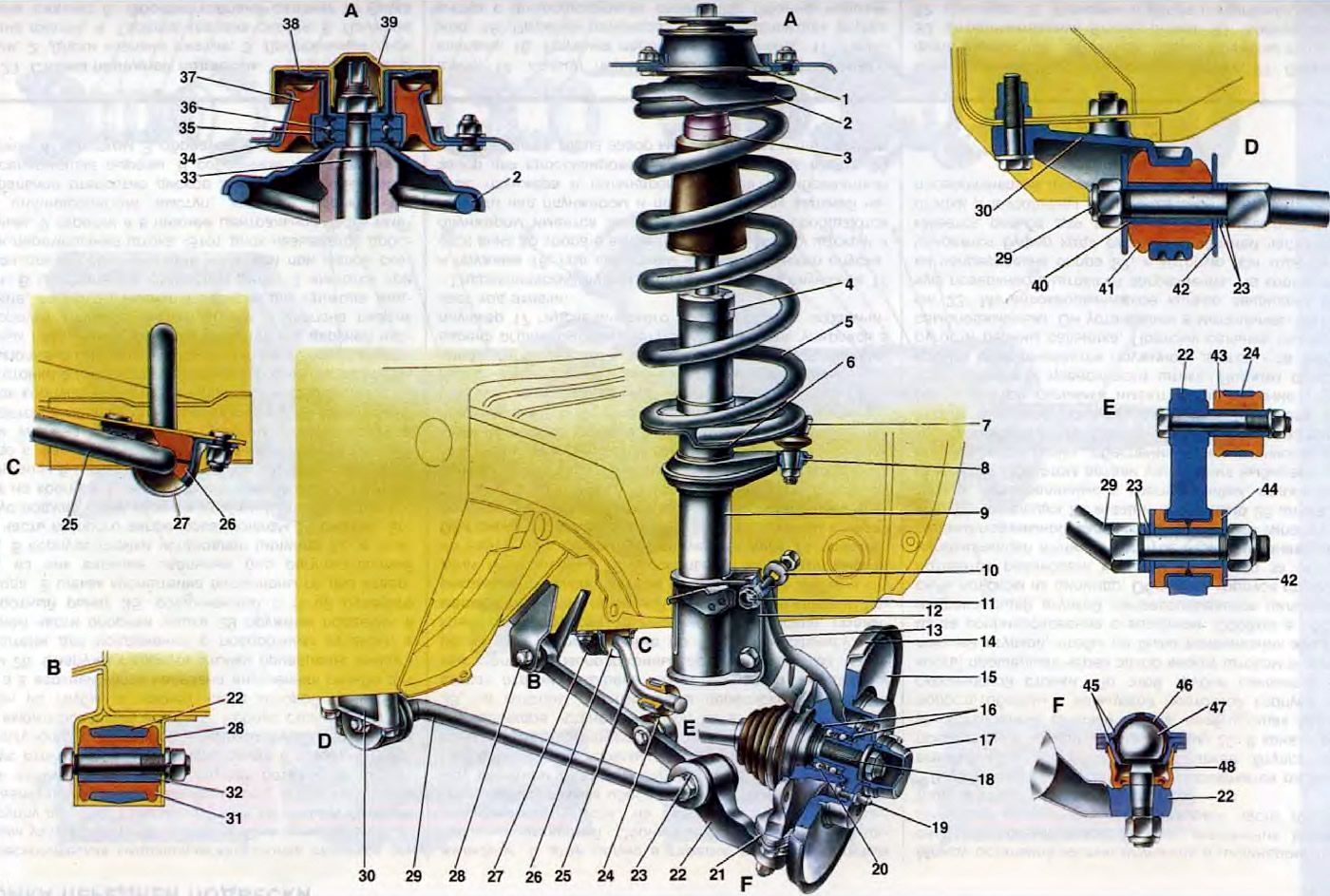
Figure 22. Front suspension: 1. Upper support of the telescopic stand; 2. Upper support cup of the suspension spring; 3. Compression stroke buffer assembly with protective cover; 4. Compression buffer support; 5. Suspension spring; 6. Lower support cup of suspension spring; 7. Steering rod ball joint; 8. Pivot lever; 9. Telescopic stand; 10. Eccentric washer; 11. Adjusting bolt; 12. Rack bracket; 13. Steering knuckle; 14. Disc protective cover; 15. Brake disc; 16. Retaining rings; 17. Hub cap; 18. Splined tailpiece of the outer joint housing of the wheel drive; 19. Guide pin; 20. Wheel hub bearing; 21. Ball joint of the suspension arm; 22. Suspension arm; 23. Adjusting washers; 24. Crossbar stabilizer bar; 25. Transverse stability stabilizer bar; 26. Stabilizer bar cushion; 27. Stabilizer bar mounting bracket; 28. Body bracket for mounting the suspension arm; 29. Suspension arm extension; 30. Stretch mount bracket; 31. Rubber bushing of the suspension arm joint; 32. Suspension arm joint spacer bushing; 33. Strut rod; 34. Outer housing of the upper support of the rack; 35. Inner housing of the upper support of the rack; 36. Upper support bearing; 37. Rubber element of the upper support; 38. Upper support travel limiter; 39. Protective cap of the upper support of the rack; 40. Front tie rod hinge bushing; 41. Front strut joint cushion. 42. Washers; 43. Stabilizer link joint; 44. Rear tie rod hinge; 45 Ball joint housing; 46. Ball joint bearing; 47. Ball pin; 48. Ball joint protective cover.
The suspension consists of a guide device, elastic and damping elements. The guide device of the suspension determines the movement of the wheels relative to the body, and also transmits forces and moments from the wheels to the body. The guide device includes the lower arm 22 of the suspension and the telescopic strut 9, connected to each other by the steering knuckle 13. The telescopic strut additionally performs the functions of a damping element. The guide device also includes the anti-roll bar, which simultaneously performs the role of the suspension arm stretcher.
The lower arm 22 of the suspension is forged from steel. It is attached to the bracket 28 of the body with a bolt with a nut and a spring washer. A rubber-metal hinge consisting of a rubber 31 and metal 32 bushings is pressed into the head of the arm, through which the fastening bolt passes. When the arm swings, elastic deformation of the rubber bushing occurs. Rotation of bushings 31 and 32 relative to each other or the rubber-metal hinge on the arm head and relative to the fastening bolt is not allowed. To stabilize the suspension arm, it is expanded on one side by a brace 29, and on the other by a rod 25 of the anti-roll bar. The brace is connected to the arm through two rubber-metal hinges pressed into the holes of the arm. The rubber bushing 44 of the hinge is pressed between two metal bushings, and both hinges are clamped in the hole of the lever with a self-locking nut between two washers 42. The other end of the tie rod is connected to the bracket 30, which is attached to the body with three bolts. A rubber-metal hinge consisting of a rubber 41 and a metal 40 bushing is pressed into the bracket of the tie rod. The hinge is clamped on the tie rod with a self-locking nut between washers 42. Adjusting washers 23 are installed on both sides of the tie rod, which adjust the longitudinal angle of inclination of the pivot axis. On one side of the tie rod there is a hexagon, on the other side there are flats for a key for holding the tie rod when turning the tie rod nuts.
The anti-roll bar 25 is connected to the suspension arm by means of a short strut 24, which has two heads. A rubber-metal hinge is pressed into the lower head, through which the bolt for fastening the strut to the suspension arm passes. A rubber bushing is pressed into the other head, through which the end of the anti-roll bar passes. The middle (torsion) part of it is attached to the body side members by two brackets 27, in which cushions 26 are located. The holes in the brackets for the mounting bolts are made oval, which facilitates the installation of the rod on the car. The outer end of the suspension arm is connected through a ball joint 21 to the steering knuckle 13. The pin of the joint enters the conical hole of the arm and is secured with a self-locking nut.
The ball joint consists of a one-piece housing 45, in which a bearing 46 made of low-friction Teflon fabric is filled with a special resin. It covers the ball head of the pin 47. The internal cavity of the joint is sealed with a protective reinforced cover 48. When assembling the joint, the cover is filled with ShRb-4 grease, designed for the entire service life of the joint, provided that the cover remains sealed. The joint housing is attached from below with bolts to the steering knuckle 13.
The upper part of the steering knuckle is attached to the bracket 12 of the telescopic strut with two bolts. The upper bolt 11 has an eccentric belt and a chamfer on which the eccentric washer 10 is installed. Both eccentrics rest against the flange of the bracket cheeks, and the cylindrical part of the bolt passes through the holes of the bracket and the steering knuckle. Such fastening ensures the movement of the steering knuckle relative to the strut bracket when turning the upper bolt. This adjusts the camber of the front wheels. A double-row ball bearing 20 of the closed type with "eternal" lubrication is installed in the cavity of the steering knuckle. It is fixed in the steering knuckle with two retaining rings 16. The hub of the front wheel rotates on the bearing, which is connected with the tailstock 18 of the wheel drive hinge housing by means of splines. The hub is fastened with a nut, under which a thrust washer is installed. The hub cavity is closed from the outside by a cap 17. From the inside, the fist cavity is protected from contamination by mud-deflecting rings, one of which is welded to the joint housing, and the other to the steering knuckle. Due to the overlap of the rings, a labyrinth seal is formed. The protective casing 14 of the brake disc 15 is bolted to the knuckle bosses. The disc is connected to the hub by two mounting pins 19.
The upper part of the telescopic hydraulic strut 9 is elastically connected to the body, and the lower part is connected to the steering knuckle. The following are installed on the telescopic strut: spring 5, polyurethane foam buffer 3 of the compression stroke and upper support 1 assembled with mounting bolts. The spring is installed between the upper 2 and lower 6 support cups. The lower cup is welded to the suspension strut, the upper one is attached together with support 1 to the strut rod. Buffer 3 is installed on the rod assembled with a protective casing, which protects the rod from mechanical damage.
Original source is on the resource (vazbook.ru)
The upper support 1 provides an elastic connection of the rack with the body and is one of the points relative to which the wheel axis rotates. The support consists of an outer 34 and an inner 35 housing, between which wear-resistant rubber 37 is clamped. A thrust ball bearing 36 is pressed into the inner housing of the support. The upper support assembled with a limiter 38 is fastened to the rod with a self-locking nut.