
English Русский
Български
Беларускі
Український
Српски
Hrvatski
Română
Polski
Slovenský
Magyar
| Articles | Contacts | Sitemap |   
Repair and maintenance Lada Repair and maintenance Mazda Repair and maintenance Mitsubishi Repair and maintenance Toyota Repair and maintenance Land Rover Repair and maintenance Hyundai Repair and maintenance Nissan
VAZbook.ru


Main     1111   2101   2105   2106   2107   2109   2110   2115   2121  
VAZ-2108 (1984-2003) VAZ-2109 (1984-1997) VAZ-21099 (1990-2004)
  • Main
  • «Sputnik»
  • VAZ-2109
  • Transmission
  • Gearbox and drive
  • Front wheel drive device

Front wheel drive device (VAZ-2109)

            0

A front-wheel drive vehicle is characterized primarily by the fact that the front steerable wheels are also the driving wheels. To drive the front wheels, the shafts (half-axles) are provided with hinges that must allow the wheels to turn without changing their rotation speed. This condition is satisfied by constant velocity cardans (synchronous ball joints). A conventional joint quickly fails under these conditions, since deviations of its driving and driven links create an uneven angular velocity transfer of rotation to the driven link. This causes overload of the drive shafts and rapid wear of the cardan joint.

Modern front-wheel drive vehicles use semi-axles with two synchronous ball joints to drive the front wheels: the drive wheel is of a rigid type (with angular degree of freedom), and the power unit is of a universal type (with angular and axial degrees of freedom).

The front wheel drive used in cars is compact and reliable. Its durability, with proper operation of the car, is high. This is ensured by the perfection of the design of the hinges, the selection of improved materials, the precision of the parts, good tightness of the hinges and the use of special lubrication.

Torque from gearbox 3 (figure 67) power is transmitted to the front wheels through the right 1 and left 2 wheel drives, each of which consists of two constant velocity joints and a shaft, which is made of a rod for the left wheel drive and of a pipe for the right wheel drive.
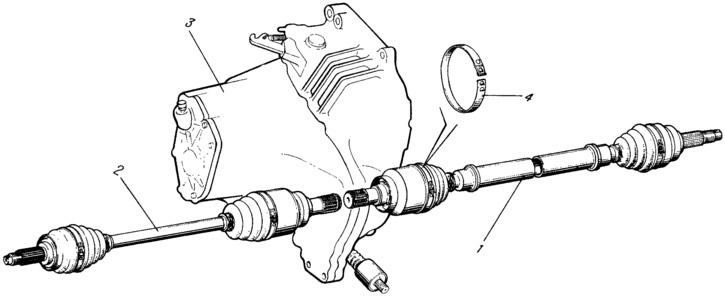
Figure 67. Front wheel drive:

Figure 67. Front wheel drive:
1 - right front wheel drive; 2 - left front wheel drive; 3 - gearbox; 4 - cover clamp.


The outer hinge consists of a housing 1 (figure 68), separator 4, inner race 3 and six balls. Grooves for placing balls are made in the hinge housing and in the race. The grooves in the longitudinal plane are made along the radius, which provides an angle of rotation of the outer hinge of up to 42°. The inner race is mounted on the splines of the shaft 9 and is held on it by a retaining ring 2. On the other side of the race, a thrust ring 8 is installed in the shaft groove. To protect the internal cavity of the hinge from contamination, a corrugated protective cover 7 is fastened to the hinge housing and to the shaft with clamps 6 and 10. To ensure the tightness of the cover, grooves are made in the places of its fastening on the hinge housing, into which the cover is pressed when the clamp is tightened. On the other side, grooves are made in the cover itself. They create a labyrinth seal. The clamps are made of steel tape on which three nests and one locking tooth are stamped. Two sockets are used to tighten the clamp with a special device, the third one is used to insert the clamp's locking tooth. The splined end of the hinge housing is inserted into the hub and secured with a nut.
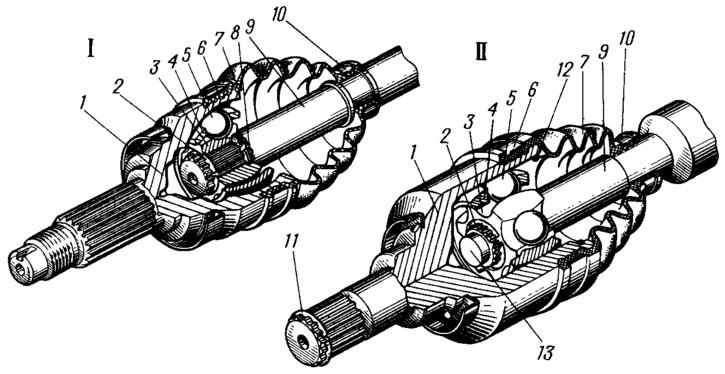
Figure 68. Wheel drive joints:

Figure 68. Wheel drive joints:
I - external hinge; II - internal hinge;
1 - hinge housing; 2 - retaining ring of the clip; 3 - hinge sleeve; 4 - separator; 5 - ball; 6 - outer clamp of the cover; 7 - hinge protective cover; 8 - thrust ring; 9 - wheel drive shaft: 10 - inner boot clamp; 11 - axle gear retaining ring; 12 - inner hinge lock; 13 - shaft buffer.


The inner joint differs from the outer joint in that the tracks for the balls in both the housing and the sleeve 3 are made straight, not radial, which allows the joint parts to move in the longitudinal direction. This is necessary to compensate for movements caused by vibrations of the front suspension and the power unit. The longitudinal movement of the sleeve in the joint housing is limited on one side by a wire retainer 12, on the other - by a plastic buffer 13. The retainer is installed in the groove of the joint housing, and the buffer in the end of the wheel drive shaft. The splined tip of the joint housing is connected to the axle gear and is fixed in it by a locking ring 11. The joint parts are protected from contamination by a rubber cover 7.

The article is copied from the website (www.vazbook.ru)

The outer and inner joint parts are lubricated with SHRUS-4 grease, which is placed in the joints during assembly and does not change during vehicle operation if the covers ensure the joints are sealed,

Balls of the same sorting group are installed in the outer and inner hinges. Replacement of any one part is not allowed; the hinges are replaced as a whole.


This article is available at russian, bulgarian, belarusian, ukrainian, serbian, croatian, romanian, polish, slovak, hungarian
The text was reviewed by the specialist: Grigory Vologodtsev

Share with friends:

Previous articles
VAZ-2109: Gearbox and drive
Next articles

Main faults of gearbox and ways to eliminate them
Transmission maintenance
Gearbox operation
Design features of a five-speed gearbox
Gear shift drive
Front Wheel Drive Maintenance
Front wheel drive faults

More articles from other manuals on VAZ cars:
➠ Features of the front wheel drive device VAZ-1111 (1988-1996)
➠ Front wheel drive device VAZ-2115 (1997-2012)
➠ The device of the front wheel brake mechanisms VAZ-2105 (1979-2010)
➠ Gearbox replacement of front wheel drive seals VAZ-2110 (1995-2007)
➠ Front wheel drive components VAZ-21214 (1994-2006)
Link in different formats to this page


Visitor comments

No comments yet


How much will 28 + 35 ?


VAZ-21099 (1990-2004) 
  • General information
  • Specifications
  • User manual
  • Maintenance
  • Car care
  • Troubleshooting
  • Power unit
  • Engine repair
  • Cooling and lubrication system
  • Power and exhaust system
  • Transmission
  • Car gearbox
  • Clutch and drive shafts
  • Chassis
  • Car suspension
  • Steering
  • Brake system
  • Body
  • Exterior
  • Interior
  • Doors and locks
  • Electrical equipment
  • Equipment and devices
  • Lighting and signaling
  • Engine electrics
  • Ignition system


VAZ-2109 (1984-1997) 
  • General information
  • Vehicle operation
  • Vehicle device
  • Power unit
  • Engine repair
  • Cooling and lubrication system
  • Supply system
  • Transmission
  • Clutch
  • Gearbox and drive
  • Chassis
  • Car suspension
  • Steering
  • Brake system
  • Body
  • Body elements
  • Electrical equipment
  • Engine electrics
  • Equipment and devices


VAZ-2108 (1984-2003) 
  • General information
  • Introduction to guide
  • Power unit
  • Engine repair
  • Cooling and lubrication system
  • Power and exhaust system
  • Transmission
  • Clutch and drive shafts
  • Car gearbox
  • Chassis
  • Front suspension
  • Rear suspension
  • Steering
  • Brake system
  • Body
  • Exterior
  • Interior
  • Doors and glass
  • Electrical equipment
  • Equipment and devices
  • Engine electrics
  • Ignition system


VAZbook.ru © 2017 · Mobile version · Contact with administration · Sitemap: EN BG BY UA RS HR RO PL SK HU · Site search · News and articles VAZ-1111 · VAZ-11113 · VAZ-2101 · VAZ-21011 · VAZ-2104 · VAZ-2105 · VAZ-21051 · VAZ-2106 · VAZ-21061 · VAZ-2107 · VAZ-21099 · VAZ-2109 · VAZ-2108 · VAZ-2110 · VAZ-2112 · VAZ-2114 · VAZ-2115 · VAZ-2121 · VAZ-21213 · VAZ-21214 ·
The site stores technical data using cookies to improve the service.