




- bore gauge;
- piston ring mandrel.
Disassembly
1. Remove the piston rings from the piston (see "Piston rings - replacement").
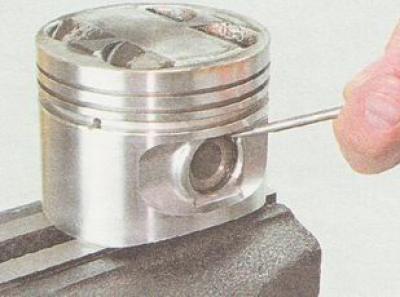
2. Using an awl, pry up the piston pin retaining ring...
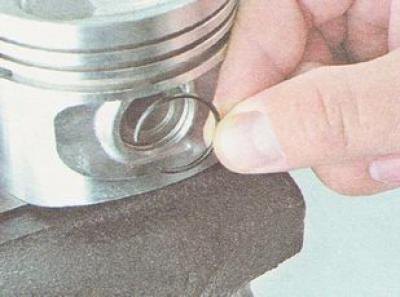
...and remove the retaining ring from the groove.
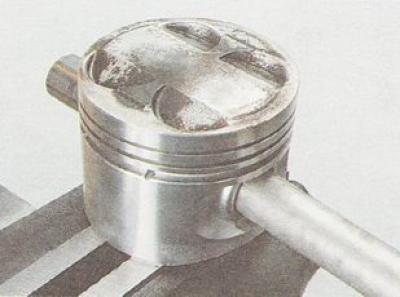
3. Using a soft metal rod of suitable diameter, push the piston pin out of the piston.
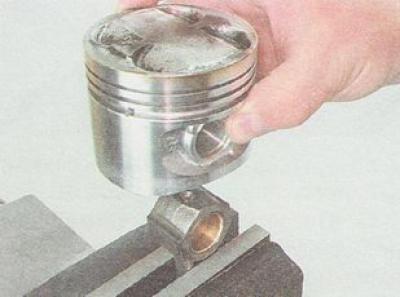
4. Remove the piston from the connecting rod.
Selection of pistons and cylinders for the block
In new engines installed on cars, the gap between the piston and the cylinder is 0.025-0.045 mm and is set by installing pistons of the same class as the cylinders.
Note: To use the bore gauge correctly, please refer to the instructions supplied with the instrument.
We use a bore gauge to check the wear of the engine cylinder walls.
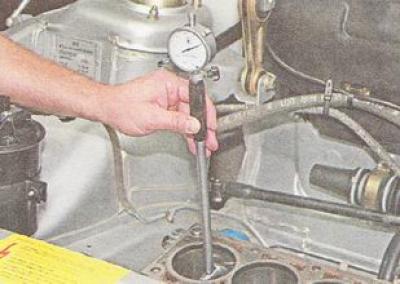
We take measurements in four zones (5, 12, 62 and 112 mm from the top edge of the cylinder) in the longitudinal and transverse directions of the engine. The cylinder does not wear out in the upper belt. Based on the difference in bore gauge readings in different belts, we determine the degree of wear of each cylinder.
Engine cylinder diameters are divided into five size classes (see table 8.1.31.1). The class of each cylinder is stamped on the lower mating surface of the cylinder block.
Recommendation: Slight uniform wear of the cylinder (within 0.05 mm) you can try to compensate by installing a piston of a different class with a larger diameter.
If the maximum cylinder wear is 0.15 mm or more, the cylinders need to be bored and pistons of a repair size installed.
It is possible to bore cylinders by 0.4 mm and 0.8 mm to suit the dimensions of repair pistons.
The designations on the piston bottom indicate where:
2 - piston pin hole class;
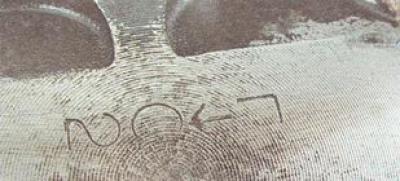
C — piston class;.