




Contents: Removal ↓ Installation ↓
To perform repair work on replacing piston rings, you will need a special mandrel.
Removal
1. Remove the cylinder head from the car (see "Cylinder head - removal and installation").
2. Remove the engine oil pan (see "Engine Oil Pan - Removal")
3. Remove the oil receiver (see "Oil receiver - removal").
4. Turning the crankshaft by the bolt securing its pulley with a 17 mm wrench, set the piston of the first cylinder to the lower position.
5. Using a 14 mm socket wrench, unscrew the two nuts securing the connecting rod cover of the first cylinder.
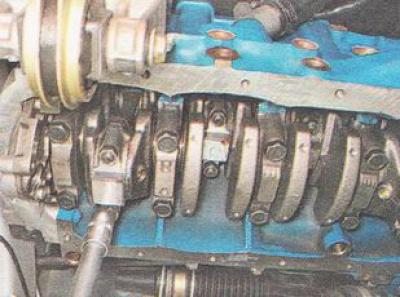
6. Remove the connecting rod cover of the first cylinder.
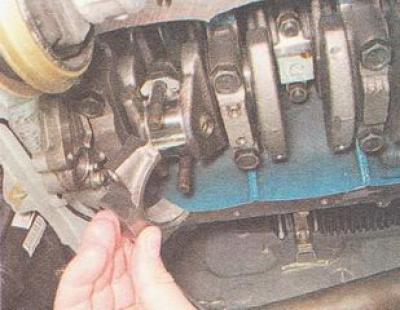
7. Press the hammer handle against the piston and push it upward.
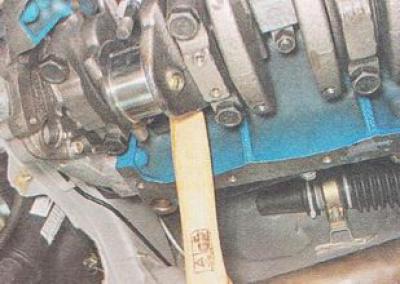
8. Remove the piston from the cylinder.
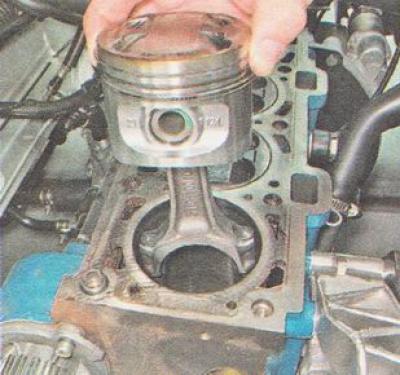
9. Remove the connecting rod bearings from the connecting rod and cap.
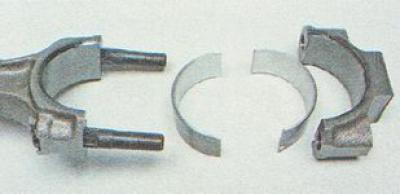
Warning: When disassembling the connecting rod, do not press out the bolts from it.
If the crankshaft connecting rod journals show signs of severe wear, the engine must be removed and the crankshaft must be repaired (see "Engine - repair with complete disassembly").
10. Fix the piston by the connecting rod in a vice.
11. Slightly moving the ring lock apart, remove the upper compression ring.
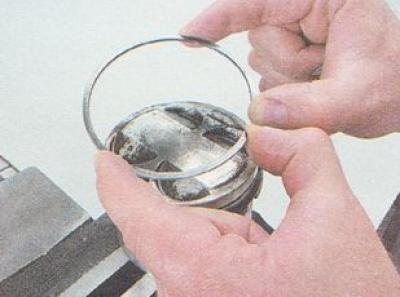
12. Remove the lower compression ring in a similar manner.
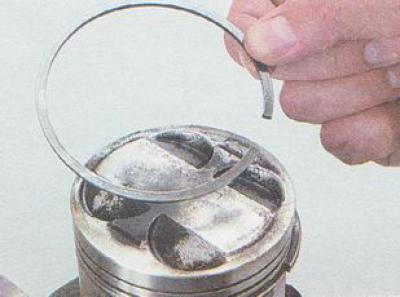
13. Remove the oil scraper ring...
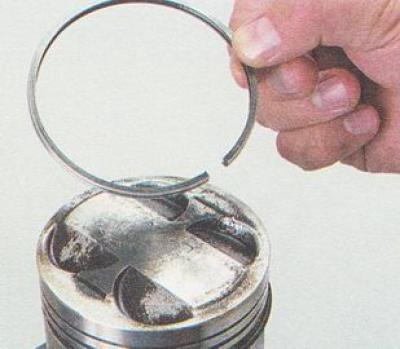
...and its expander.
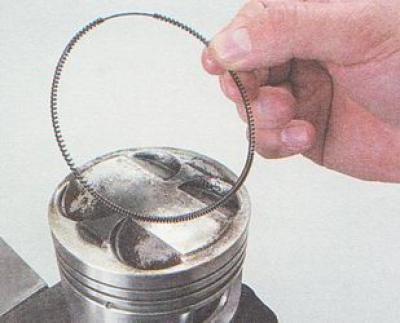
Warning: The advisability of replacing rings depends on the degree of wear of the cylinders and pistons (see "Piston and connecting rod - replacement").
Installation
1. Carefully clean the piston from carbon and deposits. Inspect the piston, connecting rod and pin. Cracks on them are unacceptable.
2. We select new rings in accordance with the piston class (see point 5 "Piston and connecting rod - replacement").
Note: There are no markings on the nominal size piston rings; repair piston rings are increased in diameter by 0.4 or 0.8 mm and are marked "40" and "80" respectively.
3. Before installing new piston rings, use a set of feeler gauges to measure the gap between the piston ring and the wall of the piston groove into which the ring will be installed.
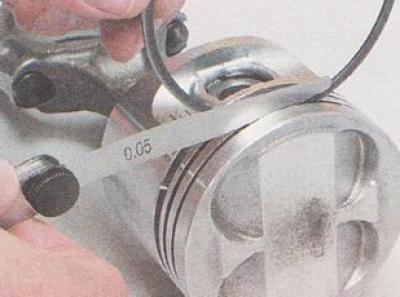
If the gap exceeds the maximum allowable value, the piston must be replaced.
Oil scraper piston ring...
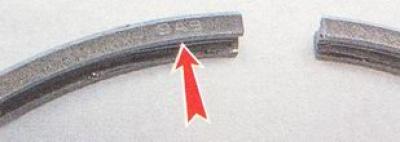
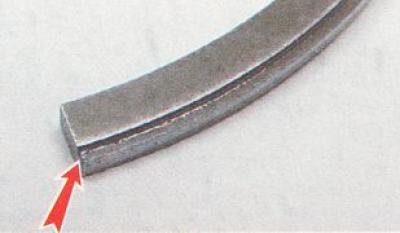
...and we install the upper compression ring with the inscription "VAZ" or "TOR" facing up.
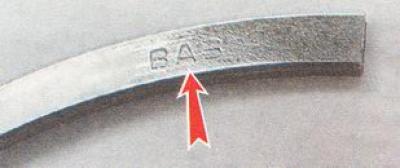
We orient the lower compression ring so that its groove is directed downwards.
4. We put the piston rings on the piston as follows: by moving apart the piston ring lock (no more than is required to fit the piston ring onto the piston), we first place the lock on the piston, and then the back part of the piston ring.
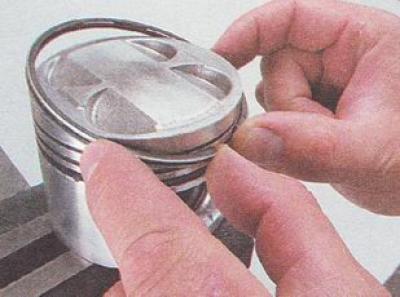
We install new piston rings on the piston, starting with the oil scraper ring expander. After installing the oil scraper ring, the expander lock should be turned 180° relative to the piston ring lock.
After installing the piston rings on the piston, we turn them with their locks so that the lock of the upper compression ring is located at an angle of 45° to the axis of the piston pin, the lock of the lower compression ring is turned by 180°, and the lock of the oil scraper ring by 90° relative to the lock of the upper compression ring.
5. Lubricate the piston, rings and cylinder bore with fresh engine oil.
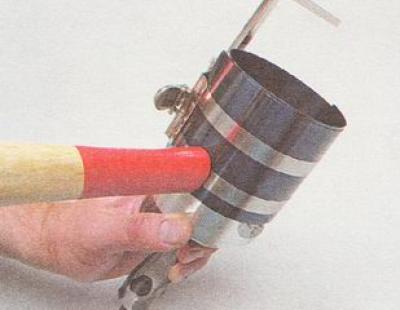
6. Place the mandrel on the piston and use it to compress the rings, periodically tapping the mandrel lightly with the hammer handle to ensure the piston rings are self-installed.
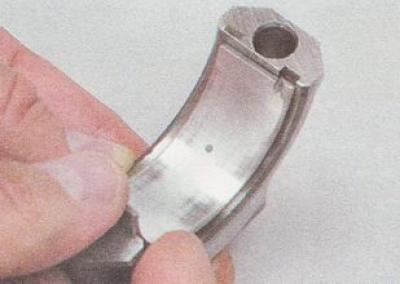
7. Wipe dry the connecting rod bearing beds in the connecting rod and cover and install the bearings in the lower connecting rod head.
The information is published on the website: www.vazbook.ru
Note: The selection of connecting rod bearings for crankshaft journals is shown below (see table 8.1.34). If the crankshaft has not been bored, it is advisable to replace the connecting rod bearings with new ones of the nominal size.
8. Lubricate the inner surface of the connecting rod bearings and the connecting rod journal of the crankshaft with clean engine oil. Turning the crankshaft, move the journal to the extreme lower position.
9. Install the piston on the block and orient it so that the arrow on the bottom of the piston is directed towards the crankshaft pulley (see "Piston and connecting rod - replacement").
10. Pressing the mandrel against the block and tapping the bottom of the piston with the hammer handle, we press it into the cylinder, while simultaneously monitoring the movement of the connecting rod toward the crankshaft journal.
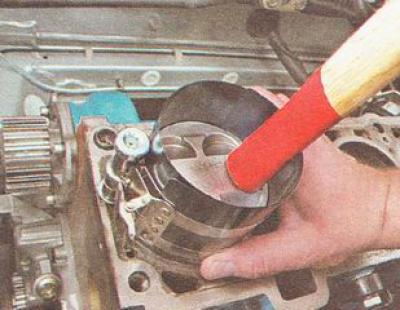
11. Install the cover on the connecting rod and tighten the nuts to a torque of 43.3-53.5 N·m (4.4-5.5 kgf·m).
Warning: Connecting rod caps are not interchangeable. The connecting rod and its cap indicate the cylinder number in which the connecting rod should be installed. On the assembled connecting rod, the numbers should be on the same side.
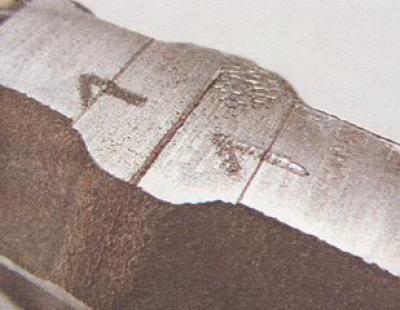
12. Replace the piston rings of the other three pistons in the same way.
13. After installing all the pistons, assemble the engine in the reverse order of its disassembly.
Table 8.1.34. Repair dimensions of crankshaft journals
| Crankshaft journal dimensions | Crankshaft main journals | Crankshaft connecting rod journals |
|
Denomination 1 repair (- 0.25) 2 repairs (- 0.50) 3 repairs (- 0.75) 4 repairs (- 1.00) |
50,799 - 50,819 50,549 - 50,569 50,299 - 50,319 50,049 - 50,069 49,799 - 49,819 |
47,83 - 47,85 47,58 - 47,60 47,33 - 47,35 47,08 - 47,10 46,83 - 46,85 |