




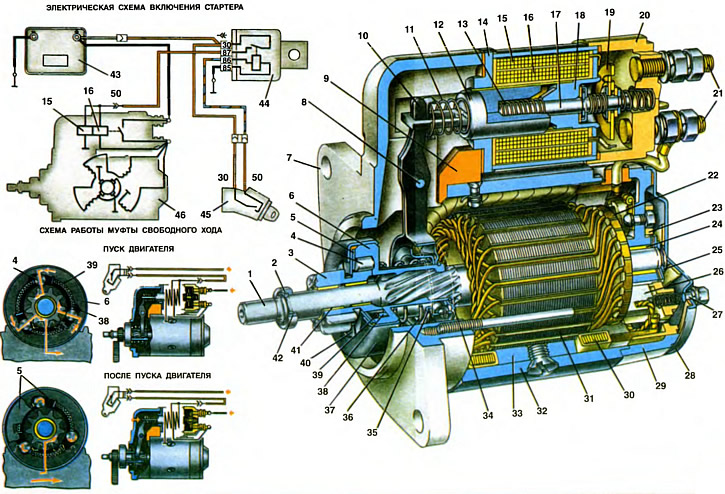
1. Anchor shaft. 2. Retaining ring. 3. Drive pinion. 4. Freewheel clutch roller. 5. Plate with bent petals. 6. Freewheel clutch hub with drive race. 7. Front cover. 8. Gear drive lever axle. 9. Plug. 10. Drive lever. 11. Anchor spring. 12. Solenoid relay anchor. 13. Return spring. 14. Solenoid relay housing (yoke). 15. Solenoid relay holding winding. 16. Solenoid relay pull-in winding. 17. Contact disk rod. 18. Solenoid relay core. 19. Contact disk. 20. Solenoid relay cover. 21. Contact bolts. 22. Commutator. 23. Brush holder. 24. Armature shaft sleeve. 25. Lock washer. 26. Brush. 27. Tie bolt. 28. Casing. 29. Rear cover. 30. Stator winding. 31. Armature core. 32. Housing. 33. Stator pole. 34. Stop ring. 35. Pressure ring. 36. Buffer spring. 37. Overrunning clutch casing. 38. Pusher. 39. Pusher spring. 40. Half ring. 41. Toothed wheel sleeve. 42. Stop ring. 43. Storage battery. 44. Auxiliary starter relay. 45. Starter switch. 46. Starter.
Technical specifications:
- Nominal power, kW — 0.9
- Current consumption at rated power, A — 230
- Direction of rotation (from the gear side) - Left
- Starter weight, kg — 5
To spin the engine crankshaft to the speed at which the engine will start to run (i.e. to start the engine), a starter of type 39.3708 is used. It turns the crankshaft with a gear for the toothed ring of the flywheel. The starter is installed on the left side of the engine (in the direction of the vehicle's movement) and is attached to the clutch housing on one side with a nut and on the other with a bolt. The bolt passes through the clutch housing and is screwed into the engine cylinder block.
The interchangeable starters 1111-3708010-05 made in Belarus and AZE-1517 made in Slovenia can also be used. But only the starter 39.3708 is described here as the main one for Oka cars.
Starter 39.3708 is a four-pole DC electric motor with compound excitation, with remote electromagnetic switching and roller freewheel clutch. It consists of the following main parts: housing 32 (stator), anchor with freewheel clutch and gear 3 drive, two covers 7 and 29 and traction relay. The housing and covers with casing 28 are connected together by two tie bolts.
The housing 32 of the starter is made of soft strip steel, rolled into a ring and welded at the joint. Four steel poles 33 with excitation winding coils are fixed with screws inside the housing. The housing with the poles and winding is the stator of the starter. Three winding coils (series) are connected to the armature winding in series, and one (shunt) is connected in parallel. Therefore, the excitation of the starter is called mixed. It allows obtaining a high torque in the braked state and a relatively low rotation frequency of the armature at idle, which reduces the wear of the bearing bushings and facilitates the operating conditions of the freewheel clutch.
The same current flows through the stator series coils as through the anchor winding, i.e. the main current consumed by the starter. And under severe starting conditions it can reach 310 A. Therefore, the series coils are wound with copper tape with a large cross-sectional area. A comparatively small current flows through the shunt coil. Therefore, it is wound with copper wire in enamel insulation. The coils are braided with cotton tape and impregnated with varnish.
An anchor, assembled on shaft 1, rotates between the stator poles. The anchor core 31 is assembled from electrical steel plates pressed onto the middle part of the shaft. Along the circumference of the core there are longitudinal grooves, insulated with cardboard, in which the anchor winding is located, made of copper tape. The ends of the winding are soldered to the plates of the collector 22.
A special feature of the starter 39.3708 is the end collector 22, pressed onto the rear part of the anchor shaft. Such a collector has the form of a disk with contact sectors, to which the brushes are pressed in the direction of the starter axis. The end collector contributes to more stable and long-term operation of the brush contact. In addition, the use of such a collector made it possible to reduce the length and weight of the starter, as well as the consumption of scarce copper.
The armature shaft rotates in two metal-ceramic bushings. The rear bushing* 24 is pressed into cover 29, and the front one is located in the clutch housing and the front end of the armature shaft enters it when the starter is installed in the clutch housing socket. The armature shaft is secured from axial movement by a lock washer 25, which is placed in a groove on the rear end of the shaft.
At the front end of the armature shaft there is a freewheel clutch with a 3-drive gear. The purpose of the clutch is to transmit torque from the starter armature shaft to the flywheel ring gear when starting the engine, and after starting, to disconnect the armature shaft and the drive gear, since after starting the engine begins to rotate the armature shaft at a high frequency and can damage it.
The freewheel clutch consists of a hub 6 with a driving collar and a driven ring, which is integral with the gear 3. In the driving collar there are three grooves, profiled along the radius, in which hardened steel rollers 4 are located. In the wide part of the groove the rollers can rotate freely, and in the narrow part they are wedged between the driving collar and the driven ring. Springs 39 through L-shaped pushers 38 press the rollers towards the narrow part of the groove. The other end of the spring rests against the bent petals of plate 5. Two thrust half rings 40 hold the driven ring inside the driving collar. Half rings 40 together with plate 5 and driving collar 6 are rolled in steel casing 37.
On the coupling hub there are two rings installed - pressure 35 and limiting 34, pressed by buffer spring 36 to the locking ring on the hub. Between rings 35 and 34 there are fingers of lever 10 of the drive. The coupling hub has internal screw splines and can, by turning, move along the screw splines of the armature shaft, simultaneously moving gear 3 of the drive on the front end of the armature shaft.
Covers 7 and 29 are cast from an aluminum alloy. In cover 7, on axis 8, a steel stamped lever 10 of the drive is fixed, transmitting the traction force from the anchor 12 of the relay to the pressure ring 35. A plastic brush holder 23 with four copper-graphite brushes is attached to cover 29. The terminals of two brushes are connected to the cover (i.e. with mass). These are the "negative" brushes. The output of the series coils of the stator winding is connected to the other two brushes. These are the "positive" brushes, through which current is supplied to the armature winding. The cover 29 is closed from the outside by a stamped steel casing 28.
The traction relay is attached with two screws to the cover 7. It is used to remotely control the starter. The relay closes the power supply circuit of the anchor and stator windings, and also through the lever 10 engages the gear 3 with the flywheel ring. The relay is a two-winding relay, has a pull-in 16 and a holding 15 winding, wound in one direction. The beginnings of the windings are soldered to the plug "50" on the relay cover. The end of the holding winding is welded to the relay flange (i.e. connected to ground), and the end of the pull-in is connected to the lower contact bolt of the relay.
The relay design is non-separable. The coil with windings and the core with the relay flange are rolled into a steel housing 14. The relay contacts are made in the form of two powerful copper bolts 21, secured with nuts on a plastic cover 20. The stator winding terminals are connected to the lower contact bolt, and the battery wire is connected to the upper one. The contact bolts are closed by a copper contact disk 19.
Starter operation
The starter is switched on by means of auxiliary relay 44 type 113.3747-10, installed on the left under the instrument panel near the fuse box. The relay design is described on sheet 35. It relieves contacts "30" and "50" of the ignition switch from the large current consumed by the windings of the traction relay. Due to this, the reliability of the ignition switch operation increases and its service life is increased.
When the key is turned to position II ("Starter"), contacts "30" and "50" of ignition switch 45 are closed and current begins to flow through the winding of auxiliary relay 44, which acts in the circuit: "plus" of the storage battery - plug "30" of the auxiliary relay - closed contacts "30" and "50" of the ignition switch - plug "85", winding and plug "86" of auxiliary relay 44 - ground.
The contacts of the auxiliary relay close under the action of the current in its anchor, and current flows through them to the windings of the starter traction relay along the circuit: "plus" of the storage battery - plug "30" contacts and plug "87" of the auxiliary relay - plug "50" of the starter. Here the current path bifurcates into two parallel branches. One passes through the holding winding 15 of the traction relay and to ground, and the second - through the pull-in winding 16, through the stator and anchor windings also to ground.
Under the action of the current flowing through the windings of the traction relay, a magnetic force arises (about 10 kgf), pulling in the anchor 12 of the relay until it contacts the core 18. The anchor is pulled in and pushes the rod 17 with the contact disk 19, which closes the contact bolts 21. The dimensions of the rod are selected so that the closing of the contact bolts occurs even before the relay anchor contacts the core and with further movement of the anchor the spring of the contact disk is compressed, pressing it more strongly against the contact bolts.
At the same time, the relay anchor moves the freewheel clutch with gear 3 forward with lever 10. While moving, the clutch hub rotates on the helical splines of the anchor shaft and turns gear 3. Due to the rotation of the gear and the chamfers on its teeth, as well as the transmission of force through buffer spring 36, the impact of the gear on the flywheel ring is softened and its engagement is facilitated. The dimensions of the relay and drive components are calculated in such a way that the closing of the contact bolts occurs when gear 3 has only partially engaged with the flywheel ring.
When the contact bolts are closed, the pull-in winding of the relay is de-energized, since both its ends are connected to the "plus" of the storage battery 43. But since the relay anchor is already pulled in, then to hold it in this position, a relatively small magnetic flux is required, which is provided by one holding winding 15.
Current flows through the closed contacts of the traction relay, feeding the stator and anchor windings. As a result of the interaction of magnetic fields created by this current, the starter anchor begins to rotate. Its rotation is transmitted through the screw splines to the hub and the leading collar 6 of the clutch. Since the rollers 4 are displaced by springs into the narrow part of the groove of the leading collar, they are wedged between the collar and the driven ring of the clutch. Therefore, the torque from the anchor shaft is transmitted through the clutch and the gear to the flywheel ring. At the same time, as a result of braking the gear and rotation of the anchor, the clutch hub is unscrewed from the splines of the anchor shaft and the gear is pushed forward until it stops in the limiting ring 42, completely engaging with the flywheel ring.
After the engine starts, its excess torque accelerates the flywheel, as a result of which the rotation frequency of gear 3 begins to exceed the rotation frequency of the starter anchor. Clutch slave ring (combined with a gear wheel) draws the rollers into the wide part of the groove of the drive collar 6, compressing the springs 39. In this part of the groove, the rollers rotate freely without jamming, and the torque from the engine flywheel is not transmitted to the starter armature shaft.
After the key is returned to position 1 ("Ignition"), auxiliary relay 44 is switched off. Its contacts open, and the power supply circuit of the starter traction relay from the auxiliary relay is interrupted. Now the current goes along the following circuit: "plus" of the storage battery - closed contacts of the traction relay - pull-in 16, and then holding 15 windings of the traction relay - ground. Since the direction of the current in the turns of the windings is opposite, the magnetic fluxes created by the windings compensate each other and the relay core is demagnetized. The relay anchor is pressed back to its original position by return springs and the relay contacts open, disconnecting the power supply to the anchor and stator windings of the starter.
At the same time, the anchor of the traction relay with the lever 10 moves the freewheel clutch back and disengages the pinion from the flywheel ring. The anchor of the starter is slowed down by the friction forces of the brushes on the collector and quickly stops.
The starter is designed for short-term operation. Therefore, to prevent the traction relay winding from overheating, it is recommended to turn on the starter for no more than 10...15 sec when starting the engine. Usually the engine starts on the first try, but if this does not happen, then the starter should be turned on again after 20...30 sec. If the engine does not start after three starts of the starter, then you should check the power supply or ignition system and eliminate the malfunction that prevents the engine from starting.