




Contents: On the removed levers ↓ By car ↓
On the removed levers
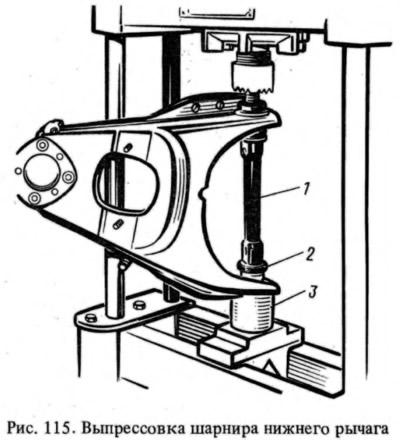
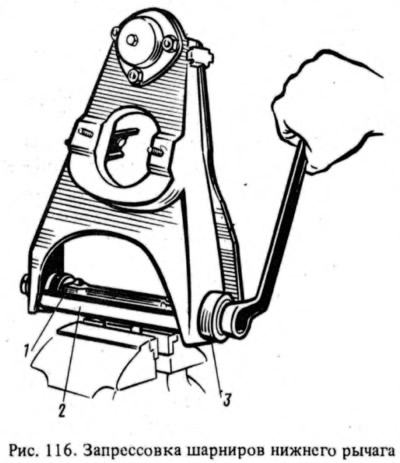
The lower arm is mounted on mandrel 3 (Fig. 115) and the press punch is used to press on axle 1 of the arm until joint 2 is pressed out of the hole. To press out the second joint, turn the arm over and repeat the operation. The joints of the lower arms are pressed in using spacer sleeve A.74177/2 (2 — Fig. 116) clamped in a vice and device A.74177/1 (5). The arm with axle 1 is mounted on device 2, the joint is placed on the axle and pressed into the joint socket using device 3. Then, using the same techniques, the second joint is pressed in.
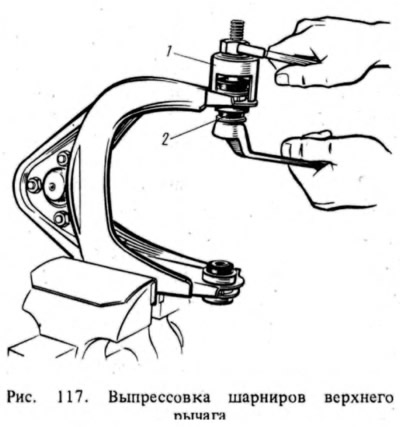
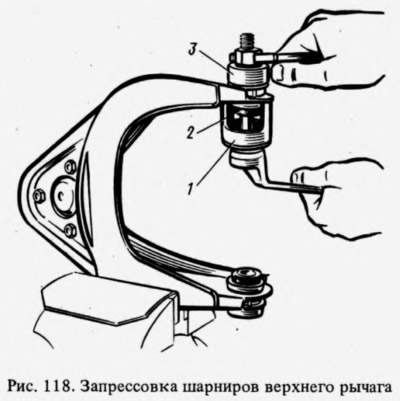
The A.47046 device (1 — Fig. 117) is installed on the upper arm when pressing out the joints so that the head of the device screw is directed inward. By tightening the screw of the device, the joint 2 is pressed out. To press in the joint, the same device is used only in combination with cap 3 (Fig. 118). Having installed joint 2 in the socket of the arm, screw in the screw of device 1 until the joint is completely pressed in.
By car
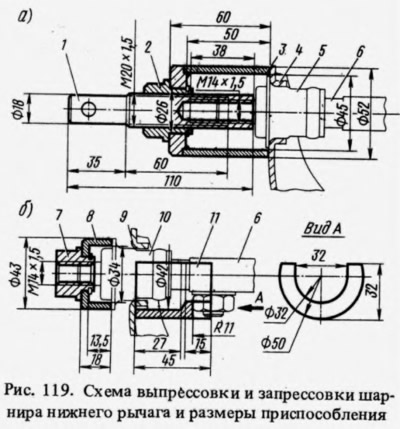
Place the car on a lift or inspection pit and hang the front part of the car on the side where the replacement will be made. Remove the wheel. Unscrew the nut, press out the ball joint pin of the steering rod with the puller A.47052 and move the free end of the side rod back. Unscrew the nuts securing the suspension arm to the axle and remove the washers from both ends of the axle. Install the cup 3 (fig. 119, a) attachment 02.7823.9500 on the shelf of the lever 4 and screw the screw 1 onto the end of the axis 6. Holding the screw 1 with a ratchet and turning the nut 2, move the eye of the lever from the outer race of the hinge. Remove the device and press out the hinge 5 from the axis of the lever. Giving the eye of the lever a position concentric with the axis of the lever with a crowbar or a mounting blade, insert the new hinge into the hole in the eye and put it on the axis. Put ring 8 on the end of the axis (fig. 119, b) fixture 02.7823.9501 and install a stop between shelf 9 and the nearest nut securing the axle to the front suspension crossmember. Rotating nut 7 and holding stop 11, press new hinge 10 into the lever eye. Then remove the fixture, install the washer and nut securing the lever to the axle. Do not tighten the nut. Replace the other rubber-metal hinges of the lower suspension arms in the same way. After replacing the hinges, connect the steering rod to the steering knuckle lever, tighten and cotter the nut of the steering rod ball pin, install and secure the wheel.
The replacement of the upper suspension arm joints is carried out using the A.47046 device in the same way as on the removed arms in the following order:
- place the car on an inspection pit or lift and hang up the front part of the car where the replacement will be made, then remove the wheel;
- unscrew the nut of the upper arm axle and, having removed the axle, turn the arm with the lugs outward;
- install the glass of the device A.47046 on the lever (see fig. 117) with a nut and a bolt with the head inside the lever. By turning the nut, press out the hinge and remove the device and the hinge. Insert a new hinge into the lever eye, install the device A.47046 (see fig. 118) so that the cap of the device is under the nut. By turning the nut, the hinge is pressed in and the device is removed.
The other upper suspension arm joints are replaced in a similar manner.
After replacing the hinges, turn the upper arm with its eyes toward the front pillar, slide it onto the pillar, insert the upper arm axle, install the washer and axle nut without tightening it completely. Then install the wheels, lower the car and tighten the axle nuts of the arms, observing all the operations described in Section 3.1.4 "Removal and installation the front suspension". After replacement, the rubber-metal hinges should be "warmed up" by performing a test run of 15-20 km, after which the front wheel alignment angles should be checked and, if necessary, adjusted.