




Contents: Coolant temperature gauge ↓ Fuel level indicator ↓ Speedometer ↓ Coolant Temperature Gauge Sensor ↓ Fuel level indicator sensor ↓ Oil Pressure Warning Light Sensor ↓
All control and measuring instruments and control lamps are located in the instrument cluster installed on the instrument panel. The KP191 instrument cluster combines a fuel gauge, a coolant temperature gauge, a speedometer, and seven control lamps, one of which (fuel reserve) installed in the fuel level indicator.
On cars 21011 and 21013 the external design of the instrument cluster is slightly different from the instrument cluster of the 2101 car, but its structure is the same.
The instrument cluster is installed in a socket on the instrument panel and secured with two spring holders located on the sides.
Coolant temperature gauge
Magnetoelectric, type UK191, is used together with the TM106 sensor. There are two marks and a red zone on the indicator scale. The first mark corresponds to 30°C, the second to 60°C, and the beginning of the red (dangerous) zone is 108°C.
The pointer operates on the principle of a logometer. The total magnetic flux created by two coils located at an angle of 90° acts on a permanent magnet mounted on the axis of the pointer. Depending on the strength of the current flowing through the windings of the coils, the magnet of the pointer is deflected to the corresponding position.
If the sensor resistance is 1000-5000 Ohm, the pointer should be at the beginning of the scale, and if the resistance is 98-110 Ohm, it should be at the beginning of the red zone (at a pointer temperature of 20°C).
Fuel level indicator
Type UB191, just like the coolant temperature indicator, is magnetoelectric and has the same design and operating principle. It differs in winding data and some other details. The indicator is used in pairs with a sensor of type BM150 or BM154 (on cars 2102 and 21021). With a sensor resistance of 285-335 Ohm, the arrow should be at the beginning of the scale, with a resistance of 100-135 Ohm - in the middle of the scale, and with a sensor resistance of 7-25 Ohm - it should deviate to the end of the scale (4/4 mark).
Speedometer
Type SP 191, consists of a pointer indicator of the vehicle speed (km/h) and a final counter of the distance (km) traveled by the vehicle. The speedometer scale has divisions from zero to 160 km/h every 10 km/h, as well as three red marks corresponding to speeds of 37; 62 and 96 km/h. These marks indicate the maximum speeds in I, II and III gears.
The speedometer mechanisms are driven by a flexible shaft from a gearbox mounted on the rear cover of the gearbox. The torque for driving the speedometer does not exceed 50 gf cm.
The speedometer calibration data are as follows: at a drive shaft rotation speed of 250 rpm, the speedometer readings should correspond to 14÷16.5 km/h, at 500 — 30-32.5; at 750 - 45-48; at 1000 - 60-63.5; at 1250 - 75-79; at 1500 - 90-94.5; at 1750 - 105-110; at 2000 - 120-125.5; at 2250 - 135-141; at 2500 rpm - 150-156.5 km/h.
Coolant Temperature Gauge Sensor
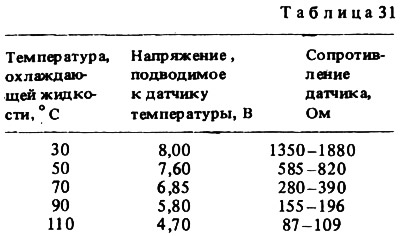
Type TM106, screwed into the cylinder head on the left side of the engine. The sensor has a thermistor that changes its electrical resistance depending on the coolant temperature. The data for checking the sensor are given in Table 31.
Fuel level indicator sensor
Type BM150 (BM154 for cars 2102 and 21021), is installed in the fuel tank. The sensor has a variable resistor made of nichrome wire. The resistor's movable contact is controlled by a lever with a float. At the short end of this lever there is also a movable contact that turns on the fuel reserve indicator lamp if there are 4-6.5 liters (5-7.5 liters for 2102 and 21021 vehicles) of gasoline left in the tank.
When the tank is empty, the sensor resistance should be 315-345 Ohms, with the tank half full, 108-128 Ohms, and with a full tank, no more than 7 Ohms.
Oil Pressure Warning Light Sensor
Type MM120, screwed into the engine cylinder block on the left side. The sensor has a diaphragm, which is affected by oil pressure. The diaphragm is connected to a movable contact. If the pressure in the engine lubrication system is below 0.4-0.8 kgf/cm², then the movable contact is pressed by a spring to the fixed contact, the power supply circuit of the control lamp is closed and the lamp is on. As soon as the oil pressure exceeds 0.4-0.8 kgf/cm², it bends the diaphragm and, overcoming the resistance of the spring, presses the movable contact away from the fixed contact with a pusher. The power supply circuit of the control lamp is opened, and the lamp goes out.
Until 1976, exhaust sensors were triggered at a pressure of 0.2–0.6 kgf/cm².