

Anyone who actively operates a car should be able to find the cause of a malfunction in lighting and alarm devices so as not to be in a position where you yourself can’t see where you’re going, and even worse, when no one sees you. You must always have a set of lamps, light bulbs and fuses and be able to replace those that failed to work.
The main reason for the failure of any of the above lighting and signaling devices is a violation of the contacts between the lamp and the cartridge, plugs and terminals. Wire breaks do occur, but there must be special circumstances for this, such as contact of wires with metal objects, parts with sharp edges, etc.
Since everyone should know about these malfunctions, let's dwell on them in a little more detail.
Headlights
- A) burn weakly when the engine is not running or running at a low speed of the engine crankshaft. In these modes, the only source of power for any consumer, including headlights, is the battery. In it, you need to look for the cause. The test will show that the battery is low and needs urgent help;
- b) burn weakly in all engine operating modes. To find the cause, it is most convenient to use the scheme. If this is the left headlight, then you need to move away from it, and along the way, check all the plug connections, the contact of the headlight itself with the ground. A large voltage drop in the lamp power circuit may be the result of poor contact, i.e. loose connection, corrosion and oxides. By stripping the contacts and sealing the connections, the defect will be eliminated.
The exception is the case when water enters the cavity of the headlight. Premature aging of the reflector occurs. It darkens and the headlight becomes dim. Such a headlight or its optical element is changed.
On VAZ-2101, VAZ-2102, VAZ-21011 cars, this operation is performed in the following order: unscrew the screw securing the facing rim with a screwdriver; remove this bezel, disengaging it from the bracket; then loosen the fixing rim fastening screws, turn it counterclockwise and remove it together with the optical element.
On cars VAZ-2103, VAZ-2106 and VAZ-2121 first, the screws for fastening the frame or decorative cladding are unscrewed, the frame or cladding is removed, the screws for fastening the rim of the optical element of the headlight are loosened, the rim is turned counterclockwise, removed and the optical element is taken out. When installing a new element, make sure that the brackets of the optical element fit into the sockets of the inner rim of the headlight;
- V) one of the filaments of the headlights does not light up. There is no other reason other than a fuse failure. Why the fuse blew, you need to find out. To avoid trouble during the test, it is better to disconnect the battery for a while. It is advisable to do this if any fuse fails;
- G) one of the headlights does not light up. Usually the problem is caused by the failure of the lamp. To replace the lamp, you must remove the optical element (see item b.). The exception is car headlights VAZ-2107 and VAZ-2105. To replace them, it is enough to turn the headlight housing lock from the engine compartment and remove it, and then remove the cartridge with the lamp;
- d) headlight bulbs often burn out. This defect is especially noticeable when driving on a road with an uneven, wavy surface. As a result of vibrations that occur when moving a large number of small irregularities, poorly fixed lighting devices are shaken and the lamps burn out. The only way to eliminate such malfunctions is to strengthen the lamps in the cartridges, the optical elements in the headlights, the headlights on the body.
Outdoor lighting
- A) tail lamp does not light up. The most probable reason: the lamp burned out or poor contact of the lamp with the ground. To replace a burned-out lamp, the lamp diffuser must be removed. Lenses, depending on the design, are mounted either outside or inside the luggage compartment. Poor contact with the mass is eliminated by tightening the mount;
- b) left front and right rear do not light up (right front and left rear) clearance lights. First of all, with this malfunction, you need to pay attention to the included control lamp (Green colour) turn on side lights. If this lamp does not light up, then the fuse is blown (Or the bulb has a bad connection), protecting the circuit; left headlight (side light) - right rear lamp - license plate lamp - engine compartment lamp - control lamp for switching on the side lighting. As in all such cases, you must first find the cause of the failure of the fuse and only then install a new fuse;
- V) All outdoor lights are off. This can happen if the side light switch itself malfunctions or the circuit is open (jumped off the wire from the switch terminal). To determine the cause, the switch must be removed from the socket (gently pry with the blade of a screwdriver), reinstall the jumped wire, and if it is in place, connect the black and black with white strips of wire together, removing them from the H and D terminals of the switch, respectively. The outdoor lights that turn on will tell you that the switch is to blame and needs to be replaced.
Instrument lighting lamps
Instrument lamps do not light up. This is usually the result of a failed instrument light switch or burnt out bulbs. To check the switch, it is removed from the socket in the instrument panel, with the side lights on, the switch terminals are connected to each other. The switched on light will confirm the reason: the switch is faulty and must be replaced. If «guilty» a burnt out lamp, then it is changed by first removing the instrument panel from the panel. How to remove the shield on cars VAZ-2101, VAZ-2102, VAZ-21011, VAZ-2105, VAZ-2107 is already known.
Direction indicators
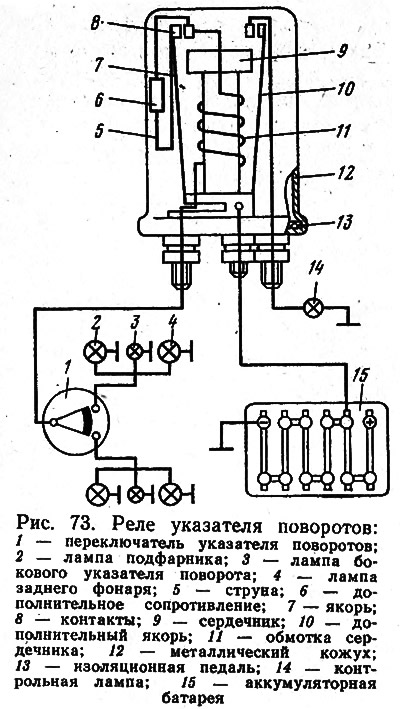
- A) when the turn signal is turned on, the lamps of the lamps are constantly on. The reason for this persistence is a faulty turn signal relay (pic. 73). The relay is located behind the instrument panel. To find it, you need to remove the shield from the socket. If the direction indicators do not flash, the relay is best replaced. However, a new relay is not always at hand, so you can try to restore the functionality of the existing one. It must be removed and disassembled. The relay can still be repaired if contacts 8 are closed. They are separated and cleaned. Relays with open contacts are not restored, they are replaced;
- b) When the turn signal is turned on, the headlights do not light up. Such «behavior» lamps is caused by a fuse failure. This is confirmed by the inactivity of instrumentation and a number of other consumers;
- V) One of the turn signal lights does not light up. There is only one reason - the lamp burned out. Unlike headlights and sidelights to replace a burned out turn signal bulb (lateral) diffuser does not need to be removed. True, such benefits are provided only to owners of VAZ-2101, VAZ-2102, VAZ-21011, VAZ-2106 and VAZ-2121 cars. The lamps are replaced from the inside of the wing after removing the protective rubber cap with the socket complete with the lamp. On VAZ-2103 vehicles, lamps can only be replaced after the diffuser has been removed;
- G) the blinking frequency of the control lamp has changed when the direction indicators are working. This malfunction occurs, as a rule, for two reasons: the lamp in one of the lamps has burned out; chain is damaged: relay - turn signal breaker - control lamp. In both cases, it is necessary to check the condition of the circuits and eliminate defects.
Stop lights
A) The brake lights do not turn on when the brake pedal is pressed. There are two known reasons:
- the fuse has blown. This can be confirmed by non-working dashboard devices, since the brake lights and devices have the same fuse;
- brake light switch defective. The switch is located at the top of the brake pedal lever. Jump wires supplying the switch and check if the brake lights turn on. If turned on, then the switch must be replaced;
b) one brake light does not light, most likely the lamp has burned out. To replace it, you need to remove the diffuser, which is attached differently on different models of VAZ cars.
Lights signaling an open front door
- A) Both lights are not working. To accurately determine the cause, press the horn switch. Silent beeps confirm fuse #1 is blown (16A). Find out the cause, eliminate it and install a new fuse;
- b) one of the lights is not working. Check the condition of the lamp, for which unscrew the screws, remove the housing with the cartridge from the case, disconnect the cartridge from the housing and remove the lamp.