

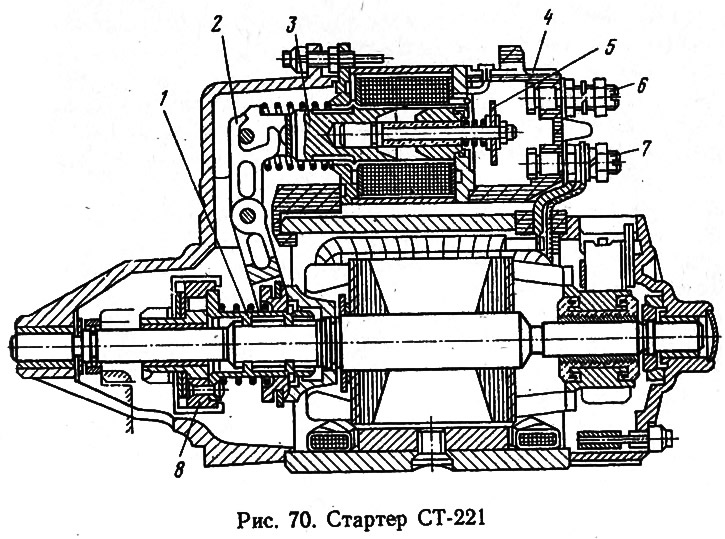
Experience suggests that, despite the difficult working conditions, the ST-221 starter reliably performs its functions. In cases where the starter refuses to work, there are significant reasons, for the most part independent of the starter itself, namely:
1. When the starter is turned on, the armature does not rotate, the traction relay does not work. This type of error may occur for the following reasons:
- the battery is defective or completely discharged;
- the battery terminals and wire terminals are oxidized or the wire terminals are not tight enough. Defects are eliminated by cleaning, lubricating and tightening the fastening;
- faulty ignition switch (the circuit does not close between the plugs «30» and «50»), The malfunction is eliminated by stripping the contacts or replacing the contact plate or, in the worst case, the ignition switch;
- wire end disconnected from plug «50» traction relay or ignition switch. The defect is eliminated by restoring the circuit;
- there is an interturn short circuit in the winding of the traction relay, its short circuit to ground or its open circuit. In this case, change the traction relay. You can remove it without dismantling the starter, but it’s quite difficult to get access to the starter and its traction relay, as the exhaust pipe of the muffler, the corrugated paper air cleaner hose, and the starter screen interfere. It is necessary to unscrew the nut on the lower contact bolt 7 (see fig. 70) traction relay and disconnect the output of the starter winding. Then unscrew the nuts securing the traction relay and remove it.
2. When the starter is turned on, the armature does not rotate or rotates too slowly, the traction relay is activated. This defect occurs most often if the battery is faulty or the terminals are oxidized and loose. It happens that the wires on the contact bolts of the traction relay are oxidized or poorly tightened.
Other reasons for the absence or slow rotation of the armature include:
- violation of the contact of the brushes with the collector;
- open circuit or interturn circuit in the armature or stator windings.
To troubleshoot, the starter must be removed, and it is better to entrust this to specialists, since removing it is quite inconvenient.
3. After turning off the starter with the ignition switch, the starter does not turn off. This is due to the fault of the ignition switch, its plugs «30» and «50» do not open. You know how to get to the contact plate of the lock. By cleaning the contacts or replacing the contact plate, you will eliminate the defect.