




Lubrication of rubbing parts along with the selection of materials and the type of treatment of their surfaces increases the durability of the engine. Cleaning of circulating oil from mechanical and other impurities is provided by an oil filter with a paper filter element.
The engine oil has a complex of additives that provide high lubricating properties of the oil, resistance to oxidation and the ability to operate in a wide range of temperatures.
The oil reserve required for normal engine operation is located directly in the oil sump 20 (figure 36) engine. Oil is added to the engine crankcase through the oil filler neck, hermetically sealed with cover 2. The oil level is controlled by the marks on the indicator. Used oil is drained from the system through an opening closed by a threaded drain plug 19. The capacity of the lubrication system is 3.5 liters.
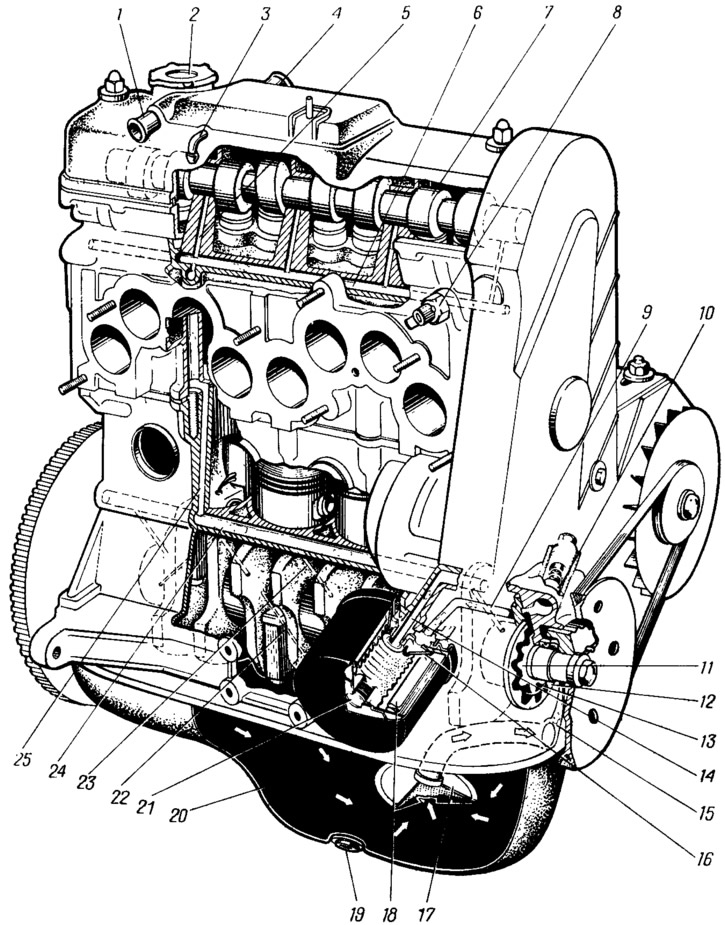
Figure 36. Lubrication system:
1 - branch pipe for discharge of charter gases into the air filter housing; 2 - oil filler cap: 3 - crankcase gas suction pipe into the carburetor throttle space; 4 - exhaust hose branch; 5 channel of oil supply to the camshaft bearing; 6 - oil line in the cylinder head; 7 - camshaft; 8 - Oil pressure warning light sensor; 9 - oil supply channel from the pump to the filter; 10 - pump pressure reducing valve; 11 - oil pump drive gear; 12 - driven gear of the oil pump; 13 - crescent-shaped protrusion between gears; 14 - oil supply channel from the filter to the main oil line: 15 - oil supply channel from the oil receiver to the pump; 16 - anti-drain valve; 17 - oil receiver; 18 - filter element; 19 - drain plug; 20 - oil pan; 21 - bypass valve; 22 - oil supply channel from the main bearing to the connecting rod; 23 - oil supply channel to the crankshaft main bearing; 24 - main oil line; 25 - channel for supplying oil from the main line to the cylinder head line.
The engine lubrication system is combined, in which some parts are lubricated under pressure, some by gravity, and some by splashing. The main and connecting rod bearings of the crankshaft, and the camshaft supports are lubricated under pressure. The cylinder walls, pistons with piston rings, piston pins in the piston bosses, camshaft cams, valve tappets, and valve stems in their guide bushings are lubricated with oil flowing out of the gaps and splashed by the moving parts.
The lubrication system includes an oil pan 20, an oil receiver 17 with a filter screen, an oil pump and a pressure reducing valve 10, a system of oil channels in the block and cylinder head, a crankshaft, a full-flow oil filter with a filter element 18, a bypass valve 21 and an anti-drain valve 16, an oil level indicator and an oil filler neck.
All system units on the vehicles under consideration are interchangeable. The minimum oil pressure in the system is monitored by sensor 8, which is screwed into the hole in oil line 6 in the cylinder head, connected to the main oil line 24 in the cylinder block. The oil pressure should be no less than 0.8 kgf/cm² at 750... 800 rpm. When the oil pressure drops below the permissible level, one of the control lamps of the "Stop" light panel on the instrument panel lights up red.
(The original is available on the website VAZBOOK.ru)
Oil circulation during engine operation occurs as follows. The oil pump, located at the front end of the crankshaft, sucks oil through the filter screen of the oil receiver 17, the receiving tube and the channel in the pump housing and supplies it through channel 9 in the cylinder block to the full-flow oil filter. In the filter, the oil is cleaned of mechanical impurities and resinous substances. The filtered oil enters the main oil line 24 through channel 14, which runs along the cylinder block, and from there through channels 23 in the partitions of the cylinder block it is supplied to the main bearings of the crankshaft. There are two holes in the main bearing shells, through which oil penetrates into the annular grooves on the inner surface of the shells. From these grooves, part of the oil goes to lubricate the main bearings, and the other part through channels drilled in the journals and cheeks of the crankshaft, to the bearings of the lower heads of the connecting rods. From the side opening of the connecting rod bearing, a stream of oil hits the cylinder mirror at the moment the bearing opening coincides with the channel in the connecting rod journal. The oil, removed from the cylinder walls by the oil scraper ring, is diverted through the openings in the piston into the piston and lubricates the piston pin bearings in the piston bosses.
In the connecting rod journals of the crankshaft, centrifugal cleaning of oil from foreign inclusions contained in the oil also occurs, which accumulate in inclined channels under the action of centrifugal forces in the space from the holes in the connecting rod journal to the plug of the crankshaft oil channel.
From the main oil line, oil is also supplied via vertical channel 25 in the block and cylinder head to oil line 6 of the cylinder head, and from there via channels 5 to the camshaft bearings. The oil flowing out of the camshaft bearings lubricates the working surfaces of the cams and valve tappets. The oil collecting under the cylinder head cover flows to the left side of the engine and drains into the oil sump through windows in the head and channels in the cylinder block.
The oil pressure on a warm engine at medium crankshaft speed is 3.5...4.5 kgf/cm².
In order to ensure the required oil pressure in the line during engine operation in any mode, and also to compensate for the increasing oil consumption as the engine wears out, the oil pump has excess capacity.