




The gap is measured with a feeler gauge on a cold engine (at a temperature of +20°C) between the camshaft cam (the cam must be directed upwards from the pushrod) and the valve tappet adjusting washer.
The nominal clearance for the inlet valve is (0.2±0.05) mm, for the outlet valve — (0.35±0.05) mm. Clearances are adjusted by selecting the thickness of the adjusting washers. Washers with a thickness of 3 to 4.5 mm in 0.05 mm increments are supplied as spare parts.
Counting from the camshaft drive belt, the 1st, 4th, 5th and 8th valves are exhaust valves, the 2nd, 3rd, 6th and 7th are intake valves.
The order in which the gaps are adjusted does not matter.
You will need: a device for adjusting clearances in the valve drive, a set of feeler gauges for checking clearances, adjusting washers.
1. Remove the cylinder head cover (see "Replacing the cylinder head cover gasket").
2. Set the piston of the first cylinder to TDC of the compression stroke. To do this, turn the crankshaft so that the mark on the camshaft pulley coincides with the mark (antenna) on the rear cover of the camshaft drive. Then turn the crankshaft another 40-50° - the cams of the camshaft will turn away from the tappets.
Warning! Turn the crankshaft only by the bolt that secures the pulley to it (it is prohibited to turn the crankshaft by the camshaft pulley).
Helpful Hints: It is inconvenient to turn the crankshaft by the pulley mounting bolt, so to set the camshaft cams to the upper position, engage any gear (preferably IV) and slowly roll the car until the cams take the desired position. If it is not possible to move the car, jack up any front wheel and, engaging any gear, set the cams by turning the jacked wheel.
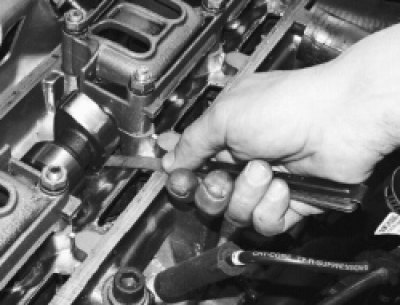
3. Using a set of feeler gauges, measure the clearances in the drive of those valves whose cams are directed upwards from the tappets (in this case these are the 4th, 6th, 7th and 8th valves). It is necessary to replace the adjusting washers of those valves whose clearances differ from the nominal ones. Record the measured clearances.
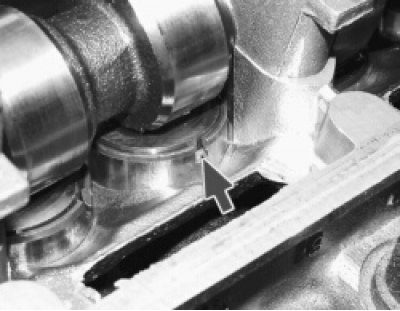
4. To make it easier to remove the adjusting washer, there are two grooves in the pusher. Using a screwdriver, turn the pusher by the groove so that it is convenient to pry the washer. For ease of operation, remove the oil from the upper part of the cylinder head (around the pushers).
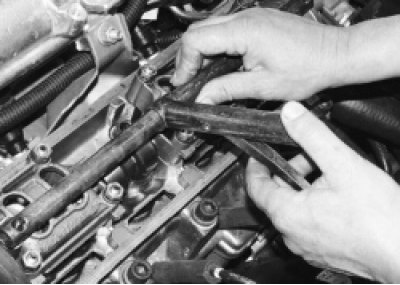
5. Install a special device for compressing the valve springs on the cylinder head cover mounting studs.
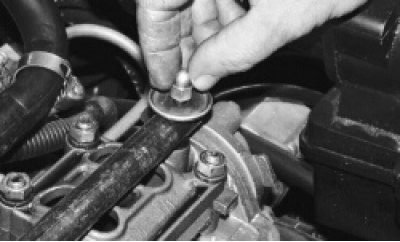
6. Place washers on the studs, turning them over so as not to crush the flange on them, and tighten the cap nuts.
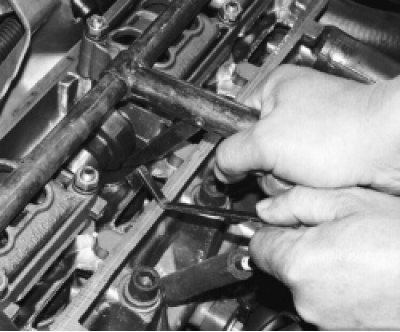
7. By pressing the lever of the device down, press the pusher on which the adjusting washer is being replaced, and insert the retainer under the camshaft so that…
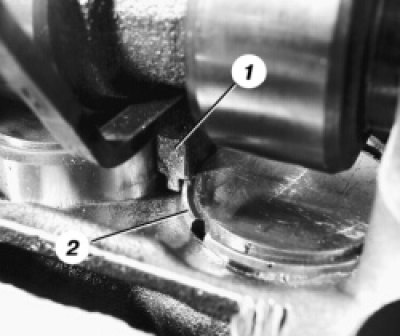
8. …the protrusion on the retainer 1 fixed the pusher 2 in the recessed position.
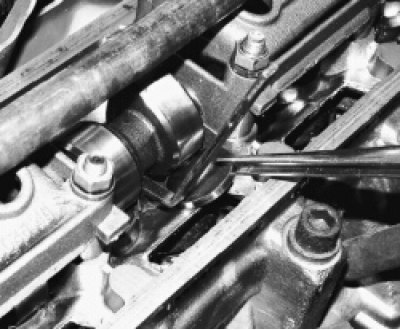
9. Use a screwdriver to pry up the adjusting washer and, using tweezers, for example, remove the washer from the pusher.
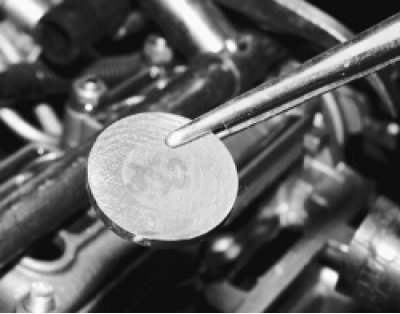
10. Write down the thickness of the adjusting washer - it is marked on one of its sides. If the inscription is not visible, measure the thickness of the washer with a micrometer.
11. Calculate the thickness of the new adjusting washer using the formula (all values in mm) H = B+A-C, where
A - the value of the measured gap;
B is the thickness of the old washer;
C — nominal clearance;
H is the thickness of the new washer.
For example (for intake valve):
A=0.26 mm, B=3.75 mm, C=0.2 mm, then H=3.75+0.26-0.2=3.81 mm.
The article is copied from the website VAZBOOK.RU
Within the clearance tolerance (±0.05 mm), we select the closest 3.8 mm washer in thickness.
12. Install a new washer with the thickness calculated according to the formula into the pusher with the inscription facing down (to the pusher). Press the plunger with the tool and remove the retainer.
13. Check the gap with a feeler gauge. If it differs from the nominal value, repeat the adjustment.
14. Turn the crankshaft one revolution (360°) and adjust the clearances in the drive of the 1st, 2nd, 3rd and 5th valves in the same order. Then pour oil into the upper part of the cylinder head, if it was removed.
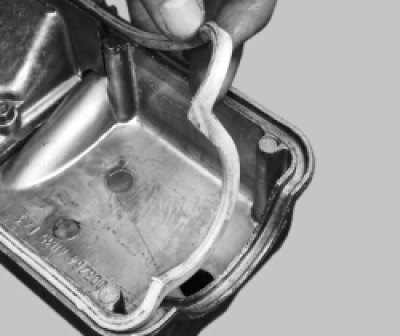
15. Check the condition of the cylinder head cover gasket; replace it if necessary.
16. Install the removed parts in the reverse order of removal.