




The door trim is made of PVC film, which is welded by dielectric welding to a 2.5 mm thick wood fiberboard panel. A layer of synthetic wool is placed between the film and the panel to obtain a decorative pattern. The trim has decorative overlays, in the upper part it is attached with a stainless steel holder riveted to the door, and elastic plastic holders in other places along the perimeter.
The 2102 and 21021 cars have a similar design for the tailgate trim and rear side trim.
Door opening limiters
They do not allow the end of the door to rest against the body pillar when opening. The limiters are made of spring wire. The bent ends enter the eye welded to the body pillar. The limiter goes inside the door and covers the plastic roller. When the door is opened to the limit, the roller unclamps the branches of the limiter and enters the widened section, limiting the opening of the door and holding it in the open position.
Door window lifters
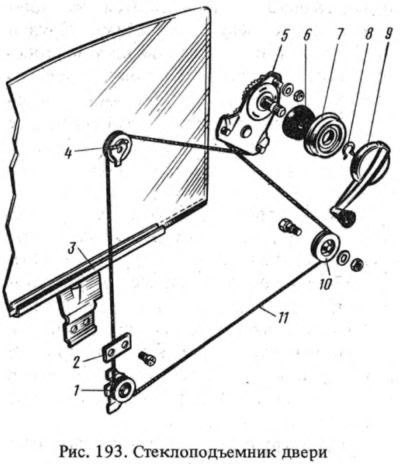
Cable, secured to the inner door panel with three nuts. The cable embraces three rollers 1, 4, 10 (Fig. 193) and is wound onto the drum of the mechanism 5. The drum gear is engaged with the drive gear. The action on the cable is transmitted by handle 9 through the drive roller, spring brake, drive gear and further to the driven gear with the drum. The spring brake does not allow the glass to lower spontaneously. The glass is secured in a holder 3, which in turn is secured to the cable 11 by plate 2 with two screws. Handle 9 of the window regulator is installed on the splined end of the drive roller. Spring 8 enters the groove of the roller and locks the handle of the window regulator. The cable is tensioned by shifting the tension roller 10 assembled with a bolt secured to the inner door panel. The axis of handle 9 is sealed with gasket 6, closed by cover 7.
Door locks
The teeth of rotor 2 (Fig. 194), mounted on central shaft 13, when closing the door run onto the tooth of housing 1 of the lock and turn shaft with ratchet 16. The projection of lever 17 of the external drive under the action of the spring locks the shaft with the rotor by the teeth of the ratchet. The teeth of the ratchet ensure preliminary and complete locking of the lock.
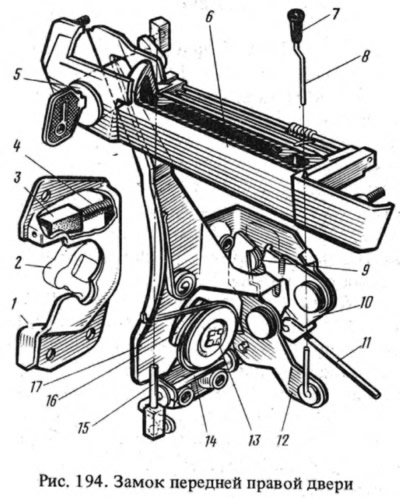
The lock can be blocked by button 7 to prevent access to the passenger compartment from the outside. When the button is pressed with the door closed, rod 8 turns lever 12 equipped with a spiral spring 9, which blocks lever 17 of the external drive with a projection. The blocked front door lock can be released by lifting the button or pulling the inner handle, or by switch 5 of the lock when turning the key. When turning the switch key, the switch leash acts through rod 15, shaft 14 on lever 12 of the lock lock and unlocks or locks the lock.
Unlike the front doors, the rear door locks can be locked both when the doors are closed and when they are open (the button can be pressed when the door is open and then closed). The lock can only be unlocked by lifting the lock button. This ensures the safety of passengers.
There is a special washer on the lock (not shown in the picture), which, when the door is closed, comes into contact with the cracker 3 of the lock, pressed by the spiral spring 4. The lock cracker selects the gap between the upper edge of the washer and the lock housing and eliminates vertical movement of the door when the car is moving. In the event of a collision or rollover of the car, the washer simultaneously prevents the door from opening spontaneously due to deformation of the door or body pillars. The washer goes behind the walls of the lock housing and prevents such movement of the lock. The lock retainer is fastened with bolts to the body pillar. Due to the enlarged holes in the pillar, the retainer can be adjusted in depth to ensure normal compression of the door seals and avoid the door sinking or protruding relative to the surface of the body, as well as in height to ensure the door is closed.