




Coolant pump
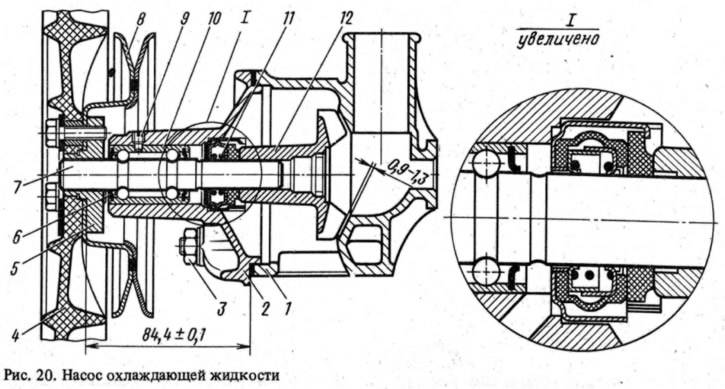
Centrifugal type (Fig. 20), housing 1 and cover 2 made of aluminum alloy. Bearing 10 in the cover is locked with screw 9. Double-row bearing, non-separable, without inner race, sealed with washers 6. Impeller 12 and hub 5 of pulley 8 of fan 4 and pump drive are pressed onto shaft 7. A sealing ring made of graphite composite is pressed against the end of the impeller, hardened by high-frequency currents to a depth of 3 mm. Pump gland 11 is non-separable, pressed into the pump cover. The latter is fastened to the pump body with nuts 3.
Fan
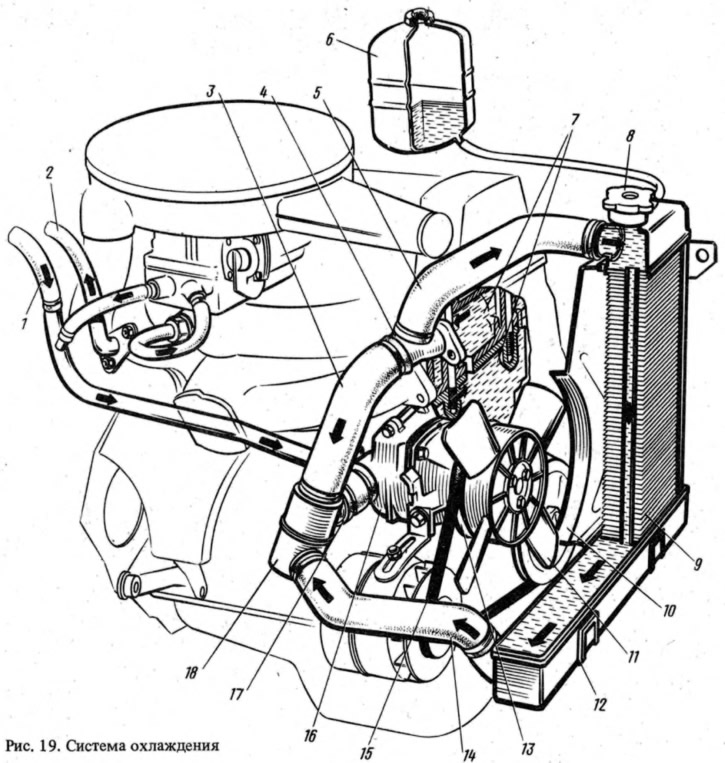
Four blade plastic fan 11 (see fig. 19) is installed in casing 10 and is secured with three bolts to the pump shaft hub together with drive pulley 13. The fan is driven from the crankshaft pulley by V-belt 15.
Radiator and expansion tank
Radiator 9 is mounted on two rubber cushions 12 and is secured to the front of the body with four bolts. It consists of upper and lower tanks, two rows of tubes and tinned cooling plates. The radiator filler neck is closed with plug 8 and connected with a hose to expansion tank 6.
The radiator cap has an inlet and outlet valve through which the radiator is connected by a hose to the expansion tank. The inlet valve is not pressed against the gasket (gap 0.5-1.1 mm) and allows the inlet and outlet of liquid into the expansion tank during heating and cooling. Liquid enters the heater radiator from the cylinder head through hose 2 and returns through hose 1.
Operation of the cooling system
At a coolant temperature below 80°C, the main thermostat valve is closed and the bypass valve is open. The coolant circulates from the cooling jacket 7 through the branch pipe 4 along the bypass hose 3, through the thermostat bypass valve and hose 17 into the pump 16 and then into the cooling jacket (in a small circle), bypassing the radiator 9. This ensures rapid warming up of the engine.
If the liquid temperature is above 94°C, the liquid circulates in a large circle: from the cooling jacket through hose 5, the radiator, hose 14, thermostat 18 and the pump it enters the cooling jacket.
In the temperature range of 80-94°C, the liquid circulates in both the large and small circles (the thermostat valves are in an intermediate position). Increasing the degree of opening of the main valve ensures gradual mixing of the liquid cooled in the radiator and maintains the best thermal operating mode of the engine.
When the liquid boils or the temperature rises sharply, the liquid does not have time to pass through the inlet valve of the filler cap into the expansion tank and closes it, disconnecting the system from the expansion tank. The pressure can increase to 0.5 kgf/cm² until the outlet valve opens and part of the coolant flows into the expansion tank. The tank is closed with a plug with a rubber valve that operates at a pressure close to atmospheric.