




Contents: Carburetor 2105-1107010-20 ↓ Main dosing systems ↓ Econostat ↓ Idle system ↓ Transitional system ↓ Accelerator pump ↓ Starting device ↓ Secondary chamber throttle valve…↓ Carburetor control drive ↓ Carburetor 2101-1107010-03 ↓ Carburetors 2101-1107010 and…↓
Since the beginning of the production of cars, as the design was improved, the following types of carburetors were installed: instead of the 2101-1107010 carburetor, 2101-1107010-02 began to be installed in 1974; since 1977 — 2.101-1107010-03; and since 1979, carburetors of the "Ozone" type 2105-1107010-20 have been installed on VAZ-2101, -21011, -21013, -2102, -21021 vehicles together with new ignition distributors that have a vacuum ignition timing regulator. With old ignition distributors (without vacuum regulator) they install carburetor 2105-1107010-10, which comes in spare parts and differs from 2105-1107010-20 mainly by the absence of vacuum extraction for the vacuum regulator.
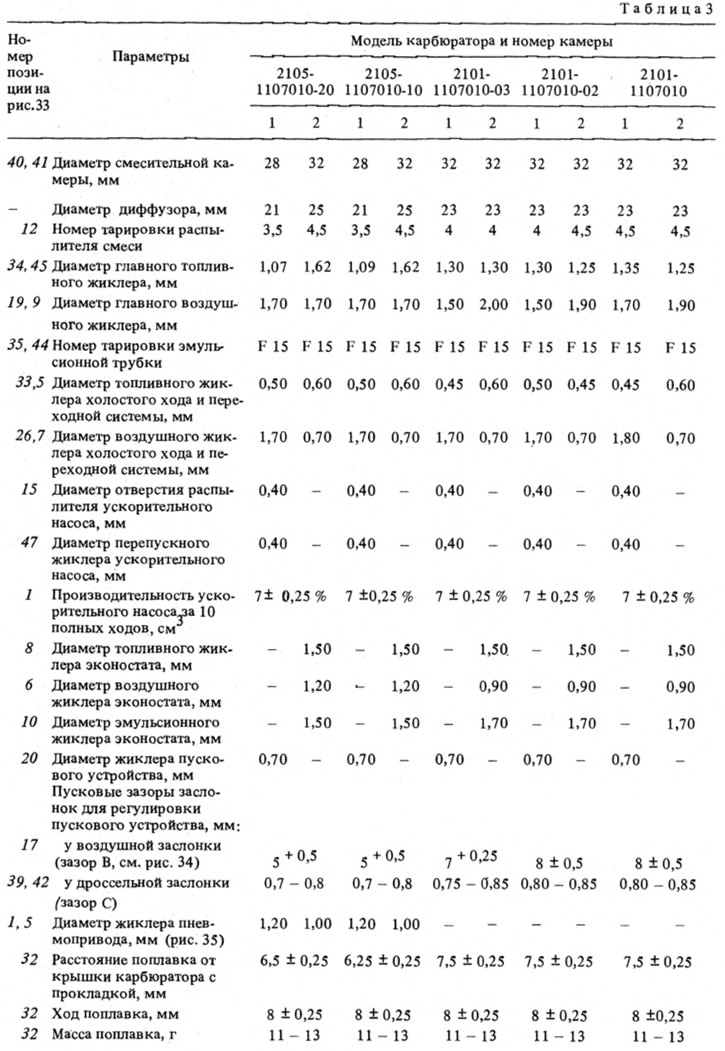
The carburetors with the corresponding ignition distributors are interchangeable with each other. The main data are given in Table 3.
Carburetor 2105-1107010-20
Emulsion type, two-chamber, with a falling flow (Fig. 32). It has a balanced float chamber, main dosing systems, enrichment device (econostat), idle system, transition system, diaphragm starting device, spool device for crankcase gases suction, pneumatic drive of the secondary chamber throttle valve.
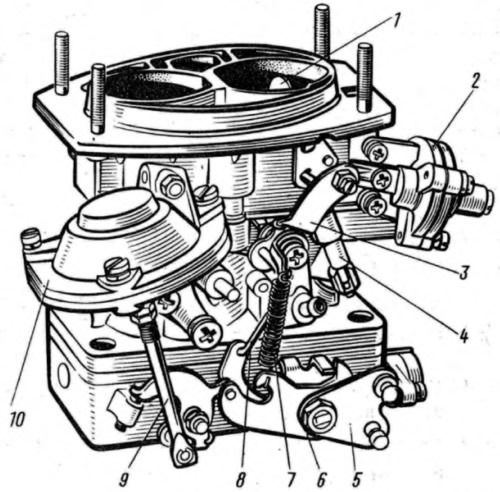
Fig. 32. Carburetor 2105-1107010-20:
1 - air damper; 2 - diaphragm trigger; 3 - three-arm lever; 4 - telescopic rod; 5 — first chamber throttle actuator lever; 6 - lever limiting the opening of the secondary chamber throttle valve; 7 - return spring; 8 - rod connecting the primary chamber throttle valve with the three-arm lever; 9 — pneumatic drive rod; 10 — pneumatic drive of the secondary chamber throttle valve.
Main dosing systems
Designed to prepare a combustible mixture of the required composition in throttling modes (low and medium engine loads), Fuel enters float chamber 4 through needle valve 28 (Fig. 33). Float 32 maintains the required fuel level. From the float chamber, fuel enters emulsion wells through main fuel jets 34 and 45, mixes with air exiting emulsion tube openings 35, 44 and entering them through main air jets 9 and 19. Then, through sprayers 12, the emulsion enters small and large diffusers of the carburetor.
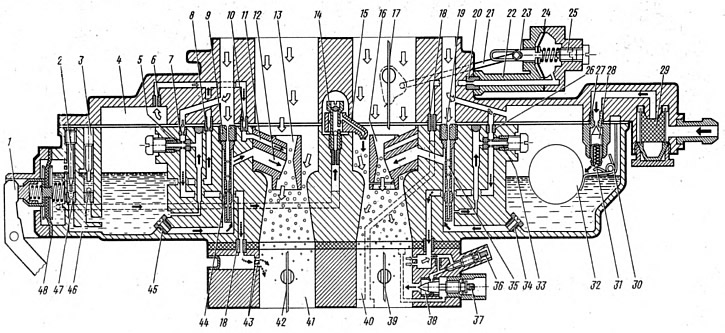
Fig. 33. Carburetor diagram:
1 - accelerator pump lever; 2 - adjusting screw; 3 - cork; 4 - float chamber; 5 - fuel jet of the transition system; 6 - economizer air jet; 7 - air jet of the transition system; 8 - fuel jet economizer; 9 - secondary chamber main air jet; 10 - emulsion jet of economizer; 11 - economizer nozzle; 12 - sprayer of the main dosing system of the secondary chamber; 13 - small diffuser of the secondary chamber; 14 - accelerator pump valve screw; 15 - accelerator pump nozzle; 16 - small diffuser of the primary chamber; 17 - air damper; 18 - transition bushings; 19 - main air jet of the primary chamber; 20 - starting device jet; 21 - starting device drive rod; 22 - starting device housing; 23 - rod; 24 - diaphragm of the starting device; 25 - starting device adjustment screw; 26 - idle air jet; 27 - needle valve seat; 28 - needle valve; 29 - filter; 30 - bracket with stop; 31 - damper ball; 32 - float; 33 - idle fuel jet; 34 - main fuel jet of the primary chamber; 35 - primary chamber emulsion tube; 36 - mixture quality adjustment screw; 37 - mixture quantity adjustment screw; 38 - mixing sleeve; 39 - primary chamber throttle valve; 40 - primary mixing chamber; 41 - secondary mixing chamber; 42 - Secondary chamber throttle valve; 43 - non-adjustable holes of the transition system; 44 - secondary chamber emulsion tube; 45 - secondary chamber main fuel jet; 46 - accelerator pump check valve; 47 - accelerator pump bypass jet; 48 - accelerator pump diaphragm.
The main fuel jets are 34 and have markings stamped on the side surface of the head (for example, 107 or 162), which indicates the diameter of the nozzle hole (1.07 or 1.62 mm). The main air jets 9 to 19 have markings on the upper plane (for example, 170 or 190) and also indicate the diameter of the jet holes (1.70 or 1.90 mm). The cylindrical surface of emulsion tubes 35 and 44 is marked with a marking indicating the calibration number of the tube (for example, 15). Small diffusers 13, 16 also have markings (for example, 3.5 and 4.5), indicating the calibration number of the nozzle hole 12.
Econostat
Enriches the combustible mixture at maximum engine speeds, is included in the secondary chamber. Fuel from the float chamber 4 (see fig. 33) through fuel jet 8 of the economizer it enters the channels located in the carburetor cover, where air is mixed in from jet 6.
The fuel-air emulsion passes through the emulsion jet 10 and enters the diffuser through the atomizer 11. The economizer starts working at speed modes close to the maximum, with the throttle valves fully open.
Idle system
Prepares a rich hot mixture at idle speed of the engine. Fuel from the emulsion well goes to jet 33 (see fig. 33) idle speed and mixes with air entering through air jet 26. Then, in the form of an emulsion, it passes through the emulsion channel and exits through the holes in the throttle space. The emulsion outlet is regulated by screw 37 of the mixture quantity and screw 36 of the mixture quality. The outlet opening above the screws ensures the absence of "dips" in the engine operation at the moment the throttle valve is opened. To prevent violation of the factory idle speed adjustment, plastic limiting bushings are pressed onto screws 36, 37, allowing the adjusting screws to be turned only half a turn. Blue bushings are installed at the factory, and red ones at service stations.
Transitional system
Ensures the absence of "dips" in engine operation at the beginning of opening the throttle valve of the secondary chamber and enriches the combustible mixture at maximum engine speed (throttle valves open). Under the action of vacuum at the outlet openings 43 (see fig. 33) fuel from the emulsion well through the fuel channel, fuel jet 5 of the transition system, mixing with air from jet 7, through the channel through the holes enters the throttle space. On the cylindrical belt of jet 5 there is a marking indicating the diameter of the jet hole.
Accelerator pump
Enriches the fuel mixture when the throttle valve is opened sharply, ensuring good throttle response. When the throttle valve is opened sharply 39 (see fig. 33) the cam on the valve axis presses the lever 1 and acts on the diaphragm 48 via the pusher, overcoming the resistance of the return spring. The diaphragm feeds fuel through the channel and injects it through the sprayer 15 into the primary mixing chamber. Some of the fuel is bypassed through the bypass jet 47 back into the float chamber. The bypass jet is selected in such a way that when the throttle valve is smoothly opened, all the fuel is bypassed into the float chamber. The cam profile ensures double injection. The second injection coincides with the beginning of the opening of the throttle valve of the secondary chamber.
There is a marking on the sprayer 12 (for example, 40), indicating the diameter of the nozzle opening (0.40 mm).
Starting device
Provides cold engine starting. Consists of air damper 2 (Fig. 34) above the primary mixing chamber, three-arm lever 1, telescopic rod, rod 7 of the throttle valve drive and a diaphragm device. Lever 1 is connected by a rod to the manual control button in the passenger compartment under the instrument panel. When the button is pulled, the three-arm lever opens the throttle valve of the primary chamber via rod 7, and the telescopic rod, turning the air damper lever, closes the air damper. Rod 3, connected to the air damper lever, moves along the groove of rod 4 and occupies the extreme left position.
The text is on the website: VAZbook.ru
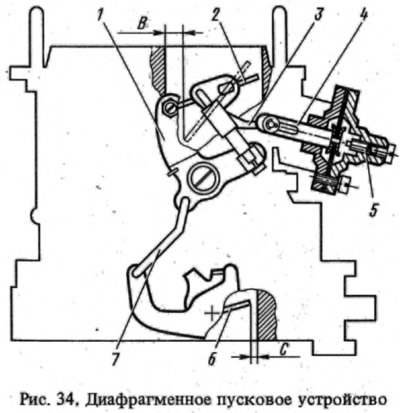
During the first flashes in the cylinders of a cold engine and subsequent idling, the vacuum from the throttle space is transmitted through the air channel to the cavity of the diaphragm mechanism. The diaphragm acts on the rod 4, rod 3 and slightly opens the air damper, providing the required composition of the combustible mixture. The spring in the telescopic rod allows the air damper to occupy intermediate positions depending on the magnitude of the vacuum in the throttle space. As the engine warms up, the air damper is opened manually by a button from the car interior.
Secondary chamber throttle valve pneumatic drive
It is designed for smooth activation of the main metering system of the secondary chamber (Fig. 35) and elimination of the need for strong enrichment of the combustible mixture compared to carburetors with sequential opening of the throttle valves. The pneumatic drive automatically adjusts the position of the valve depending on the speed mode of the engine.
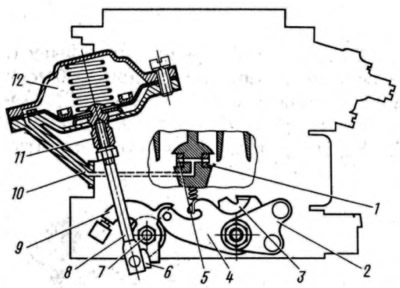
Fig. 35. Pneumatic drive of the secondary chamber throttle valve of carburetors 2105-1107010-20 and 2105-1107010-10:
1 - pneumatic drive jet located in the primary chamber diffuser; 2 - throttle valve drive lever; 3 - lever rigidly connected to the axis of the primary chamber throttle valve; 4 - lever limiting the opening of the secondary chamber throttle valve; 5 - pneumatic drive jet located in the diffuser of the secondary mixing chamber; 6 - lever connected to lever 9 via a spring; 7 - secondary chamber throttle valve axis; 8 - pneumatic drive rod; 9 - secondary chamber throttle control lever; 10 - channel for supplying vacuum to the pneumatic drive; 11 - rod bushing; 12 - working cavity of the pneumatic drive.
With the first chamber throttle valve open, with increasing vehicle load, the crankshaft speed and, consequently, the vacuum in the mixing chambers decrease, and the secondary chamber valve closes. The main air flow will pass through the primary mixing chamber, improving fuel atomization. When the primary chamber throttle valve control pedal is sharply lowered, the primary chamber valve closes and lever 4 forcibly closes the secondary chamber throttle valve, preventing an increase in the crankshaft speed. The possibility of self-oscillation of the pneumatic drive mechanism is eliminated by connecting cavity 12 to the diffusers of both the secondary and primary mixing chambers through jets 1 and 5.
Carburetor control drive
The throttle valve is opened by pedal 9 (Fig. 36), which is attached to the lever of shaft 12. The shaft is mounted pivotally in two brackets 13, which are attached to the front shield of the body. Levers and are welded to the shaft. The action from lever 14 is transmitted to longitudinal rod 2, intermediate lever 15, transverse rod 1 and then to the throttle valve drive lever. Rods and 2 have plastic adjustable tips.
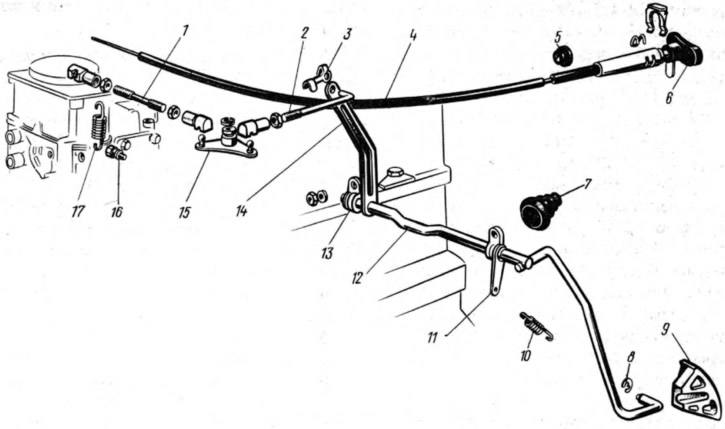
Fig. 36. Carburetor control drive:
1 - transverse thrust; 2 - longitudinal thrust; 3 - traction rod mounting bracket; 4 - air damper control cable; 5 and 7 - seals; 6 - cable handle; 8 - lock washer; 9 - throttle control pedal; 10 - return spring; 11 - lever; 12 - roller; 13 - roller mounting bracket; 14 - lever; 15 - intermediate lever; 16 - return spring mounting screw; 17 - return spring.
The air damper is controlled by button 6, which is connected by rod 4 to the air damper drive lever. The rod casing is attached to the cover of the secondary chamber throttle pneumatic drive. When the button is fully pulled out, the air damper should be fully closed, and when it is recessed, it should be fully open.
Carburetor 2101-1107010-03
Differs from carburetors 2105-1107010-20 and 2105-1107010-10 in jet diameters (see table 3) and the presence of heating of the throttle body. The carburetor with sequential opening of the throttle valves does not have a pneumatic drive of the secondary chamber throttle valve. The limiting sleeve in the idle system is installed only on the mixture quality screw.
Carburetors 2101-1107010 and 2101-1107010-02
They differ from 2105-1107010-20, as well as from each other in jet diameters. Carburetors with sequential opening of throttle valves have a float chamber imbalance valve and throttle body heating.
The float chamber unbalance valve facilitates hot engine starting by preventing fuel vapors from entering the engine intake tract, which can lead to excessive enrichment of the mixture and, consequently, difficult starting. When the throttle valves are closed, the float chamber is connected to the atmosphere through the valve. When the throttle valve is turned, the valve drive lever is released and the valve, closing, disconnects the float chamber from the atmosphere.