




Contents: Removal and installation ↓ Checking and adjusting the pressure…↓ Disassembly, inspection of parts and…↓ Testing the pressure regulator on…↓
Removal and installation
Disconnect the elastic lever 10 (see figure 106) of the pressure regulator drive from the rear suspension arm, for which purpose the retaining ring 14, washer 13, and then earring 11 are removed from pin 15. The pipes are disconnected from the pressure regulator, preventing leakage of brake fluid. When disconnecting the pipes, pay attention to their position so that they can be connected to the same sockets during installation. Mixing up the pipes is unacceptable. Unscrew the nuts securing bracket 9 of the pressure regulator to bracket 8 of the body and remove the bracket together with the pressure regulator and its drive levers.
Installation of the pressure regulator is carried out in the reverse order.
Checking and adjusting the pressure regulator drive
Place the car on a lift or inspection pit. The car should be on wheels and in running order. The tank should be about half full. If there is less than half of the fuel, compensate for the missing part of the fuel with weights, placing them in the trunk.
View the original on the internet resource: VazBook.ru
Press the rear of the car, applying 2-3 times a force of 40-50 kgf, directed from top to bottom on the rear bumper of the car, to set the rear suspension to the middle position.
Install strut rods with wing nuts between the rear suspension arms and the body (figure 116 - right) to fix it in this position.
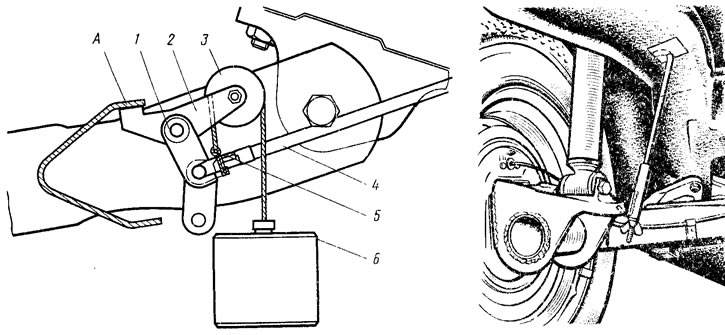
Figure 116. Adjusting the pressure regulator drive
A preliminary estimate of the pressure regulator drive setting can be determined by the gap between the lower part of the lever 5 (see figure 106) pressure regulator drive and spring 7. The gap should be within 2.0-2.1 mm.
The pressure regulator drive is adjusted using a special device, for which:
- disconnect the earring 11 from the rear suspension arm bracket pin and lower the earring down. Install the device on the rear suspension arm bracket axle (see figure 116) to adjust the pressure regulator drive to a position in which the stop A of the lever 2 of the device rests against the shelf of the rear suspension arm connector;
- hook the load cable grip 6 onto the bracket 5, and throw the cable over the roller 3 and, pressing lightly on the load with a force of approximately 0.5 kgf downwards, lower the load (its mass should be equal to (1.5±0.05) kg);
- make sure that lever 4 does not touch the rear suspension lever;
- install a template on the rear suspension arm bracket axle and check whether the template fits into the groove, the pressure regulator drive lever 4. This indicates the correct adjustment of the drive, in which the distance between the center of the rear suspension arm bracket axle and the axle of lever 4 is (28±0.2) mm.
If the drive is not adjusted correctly, loosen bolts 16 and 2 (see figure 106) of the pressure regulator fastening, insert the pins of the auxiliary lever into the holes A and B and move the bracket to the side until the position in which the lever 10 of the pressure regulator drive enters the groove of the template. In this position, tighten the bolts 16 and 2 of the pressure regulator fastening and, having made sure that the adjustment is correct, connect the earring 11 to the bracket of the rear suspension lever.
Disassembly, inspection of parts and assembly
Disassembly
Unscrew bolts 16 and 2 (see figure 106) regulator mounts and disconnects it from bracket 9. Having unscrewed plug 16 (see figure 107), remove gasket 15, take out spring 12 and support plate 11. Remove protective cap 3, press on piston bushing 5, moving it inside the housing. Holding the piston bushing in this position, remove retaining ring 4. Hold bushing 5 until it comes out of the housing due to the force of spring 6, remove it. Remove piston 2 with seals 23 and 21, washers 22, spring 6. Remove pusher 20 with sealing rings 10, bushing 19 and washer 9. If necessary, remove bushing 7 from the housing using a special puller.
Checking the details
Wash the parts with isopropyl alcohol or brake fluid and carefully inspect them. The surfaces of the parts should not have any damage or noticeable wear. Check the condition and elasticity of the pusher bushing spring. Its length in a free state should be 13.3 mm, under a load of (1.4±0.15) kgf - 7.5 mm. Replace damaged and worn parts, as well as sealing rings with new ones.
On the BS-134.000 stand, the tightness of the pressure regulator valve, crimped into the plug 16 (see figure 107). If it leaks liquid (ring 13 is damaged), replace the regulator plug together with the valve.
Assembly
Install bushing 7 if it was removed, assemble piston 2 together with seals 21 and 23, washers 22, spring 6, bushing 5 and insert into regulator housing 1. Pressing on bushing 5, move it inside the housing, insert retaining ring 4. Lubricate the end of bushing 5 and the protruding part of the piston with DT-1 grease. Put on cap 3. Assemble pusher 20 together with washer 9, sealing rings 10, bushing 19, support plate 11 and insert into the regulator housing. Install spring 12, gasket 15 and tighten plug 16 with a torque of 4-5 kgf·m.
If plug 24 has been lost, install a new one so that it is recessed into the regulator body by 1-2 mm. During assembly, all parts are lubricated with brake fluid.
Testing the pressure regulator on the bench
Install the pressure regulator on the stand and connect it as shown in Figure 117. Secure the end of the elastic lever in the loading device 3. Pump the system through valves 1. Check the tightness of the connection of the regulator to the stand (no leaks allowed). The tension of the elastic lever is adjusted using a loading device: the switching point should be (30±1) kgf/cm². The determination of the switching point is described in Section. "Adjusting the pressure regulator drive". To determine the switching point, use pressure gauges 2 (M ₁ and M ₂). Apply a pulsating pressure of 0-80 kgf/cm² with a frequency of about 1 Hz through cylinder 4 to the regulator inputs A and G. Perform 15-20 cycles to run in the regulator parts. Then apply a pressure of 80 kgf/cm² to inputs A and G. The reading of pressure gauge M ₂ should be 42+3-5 kgf/cm².
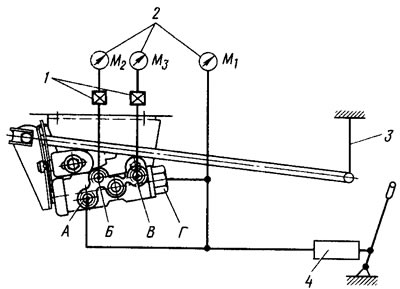
Figure 117. Pressure regulator test diagram on the bench
The operation of the pressure regulator is checked in the pressure range at inputs A and G of 30-100 kgf/cm². Pressure at output B (pressure gauge reading M ₂) must fit within the shaded area (figure 118). The readings of the pressure gauges M ₁ and M ₂ should not differ by more than 4 kgf/cm² in the pressure range at the regulator inputs from 0 to 100 kgf/cm².
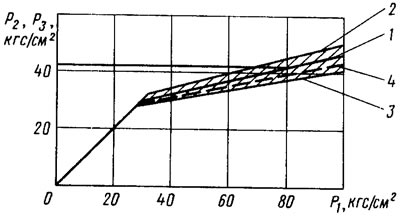
Figure 118. Pressure regulator performance test diagram: P ₁ - pressure at inputs A and G (see figure 117) pressure regulator; P₂ - outlet pressure B; P₃ is the outlet pressure in; 1 - nominal pressure P ₂; 2 - upper pressure limit P ₂; 3 - lower pressure limit P ₂; 4 - pressure P ₃