




Contents: Removal and installation ↓ Disassembly and assembly ↓ Checking the technical condition ↓ Checking the brake disc runout ↓ Replacing brake pads ↓
Removal and installation
Raise the front of the car, place it on stands and remove the wheel. Unscrew the pipe fitting and disconnect the flexible hose from the main line; plug the holes in the hose and tube to prevent brake fluid from leaking. Remove the hose from the guide bracket. Unscrew the two bolts that secure the shoe guide to the steering knuckle and remove the guide assembly with the caliper and working cylinder.
The brake mechanism is installed in the reverse order. After installation, the brake fluid level in the reservoir is restored and the hydraulic drive is bled to remove air.
Disassembly and assembly
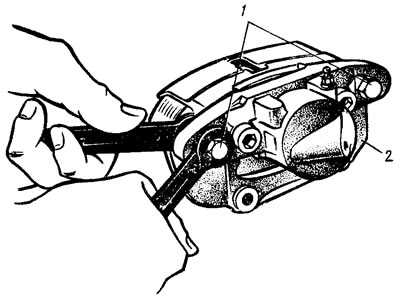
Figure 119. Unscrewing the cylinder mounting bolt
Disconnect the hose from the wheel cylinder 2 (figure 119). Unlock and unscrew bolts 1 securing the wheel cylinder to the guide pins, holding the guide pin by the edges with a wrench so as not to damage the protective cover. Remove guide 8 (figure 120) pads assembled with pins. Remove brake pads 9. It is not recommended to unscrew bolts 14 connecting the caliper and cylinder, except in cases of replacing the caliper or cylinder.
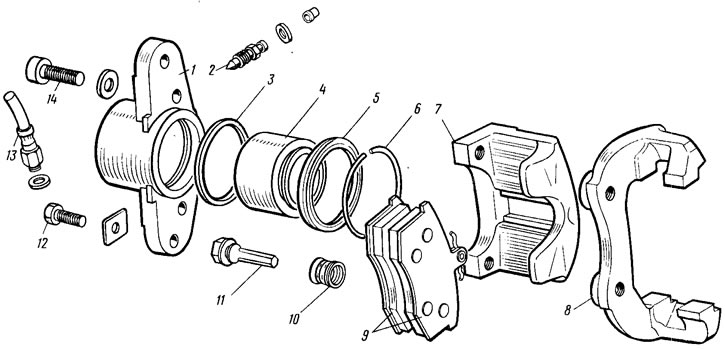
Figure 120. Front wheel brake mechanism parts
Remove retaining ring 6 (see figure 120) and protective cap 5 from the cylinder and piston. Carefully, forcing a stream of compressed air through the hole for the hose 13, push piston 4 out of cylinder 1. In order not to damage the piston on the surface of the support 7 when pushing, place a wooden pad under the piston. Unscrew the nipple 2 for bleeding from the cylinder body and carefully inspect the working surface of the cylinder. There should be no scoring, damage or corrosion on it.
The brake mechanism is assembled in the reverse order. In this case, it is recommended to replace the sealing ring 3 and cap 5 with new ones. The cylinder mirror, piston and sealing ring are lubricated with brake fluid, and graphite grease is applied to the piston surface, the piston is installed in the cylinder and, without removing the remaining grease, the protective cap 5 is put on so that its edges enter the grooves of the piston and cylinder, after which the retaining ring 6 is installed. Guide pins 11 are lubricated with Uniol-1 grease. Bolts 12 for fastening the caliper and cylinder to the pins are tightened to the torques specified in Appendix 1, after which they are locked. Before tightening the bolts, apply a sealant to them so that the threaded part of the connection does not corrode. After assembling and installing the brake mechanism, restore the fluid level in the reservoir and bleed the hydraulic drive.
Checking the technical condition
Clean all parts and carefully check their condition: no signs of wear, damage or corrosion. Pay special attention to the surface of the piston and cylinder. If they are worn, damaged or heavily corroded, replace the cylinder and piston. Remove corrosion from the cylinder body with a wire brush. Check the guide pins 11 (see figure 120) and their sealing boots 10. Make sure that the pins are free of corrosion and damage, that they do not jam in the guide holes. The pins must move freely. In case of corrosion or damage, replace the pins and protective boots with new ones. Check the condition of the brake disc. No scoring or deep scratches are allowed on its working surface, as well as other damage that increases lining wear or reduces braking efficiency. Check the thickness of the disc, which must be at least 10.8 mm. If the thickness is less than specified, replace the disc. It is allowed to turn or grind the discs, but both sides must be processed to the same depth, and the resulting disc thickness must not be less than 10.8 mm. Replace the brake pads with new ones if the pressure springs break, or if the linings wear to a thickness of 1.5 mm. Replace the pads with new ones simultaneously on both brake mechanisms, i.e. both pairs.
Checking the brake disc runout
Check the axial runout of the working surface of the brake disc without removing it from the car. The maximum permissible runout according to the indicator is 0.15 mm. If the runout is greater, the disc is replaced or ground, but the final thickness of the disc must be no less than 10.8 mm.
Replacing brake pads
If it is necessary to replace the brake pads, bend the corner of the lock washer 9 (figure 121) from the edge of the lower bolt 8, unscrew it, holding the guide pin by the edges with a key. Then turn the caliper 1 assembled with the cylinder 7 relative to the other pin, remove the brake shoe 6 from the piston side and lower the caliper to the working position. Carefully, so as not to damage the dust cap and prevent splashing of brake fluid from the master cylinder reservoir, move the piston through window A as far as possible inside the cylinder, pushing off the surface of the brake disc 5 with a screwdriver. Having lifted the caliper, replace the worn outer shoe with a new one and lower the caliper to the working position. Once again move the piston inside the cylinder and, having lifted the caliper, replace the inner brake shoe. Having lowered the caliper, tighten and lock bolt 8, the thread of which has a coating that prevents the guide pin from self-loosening.
(The information can be read on the website: VazBook.ru)
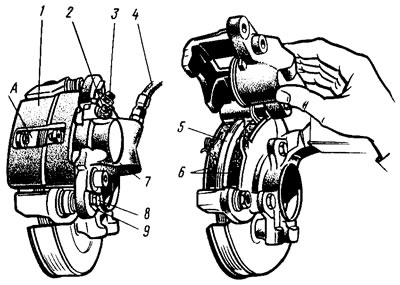
Figure 121. Replacing brake pads
If brake fluid was added to the reservoir during vehicle operation, some of the brake fluid is removed from the reservoir before the piston is pressed down to prevent it from spilling out of the reservoir neck. When replacing the pads, the condition and fit of the piston protective caps and guide pin covers in the sockets are checked. If necessary, they are replaced or their correct fit in the sockets is ensured. After replacing the pads, the condition and fastening of nipple 2, cap 3 and hose 4 are checked.