




Contents: Removal and installation ↓ Disassembly and assembly of wheel…↓ Checking the details ↓ Checking wheel cylinders on a stand ↓
Removal and installation
Raise the rear of the car and remove the wheel. Remove the brake drum. Loosen the parking brake cable and disconnect it from the lever 10 (see figure 110) manual drive of the shoes, the cable end, remove the cotter pin, press on the finger 9 and remove the lever 10. Remove the guide springs 5 of the shoes, disconnect the upper 7 and lower 3 tension springs of the shoes and remove the shoes 4.
Having taken measures to prevent leakage of brake fluid from the master cylinder, disconnect the brake fluid supply pipe from the wheel cylinder and plug the inlet holes of the cylinder and pipe. Remove wheel cylinder 6. When replacing brake shield 11, unscrew the bolts securing it to the flange of the rear wheel axle.
Installation of brake mechanism parts is carried out in the reverse order, taking into account the following:
- after installing the pads on the brake shield, make sure that the ends of the pads are correctly positioned in the grooves of the piston stops of the wheel cylinder and on the support plate;
- before installing the drum, lubricate the seat belt of hub 2 with graphite grease or LSC-15.
After assembling the brake mechanisms, press the brake pedal 2-3 times with a force of 40 kgf to set the pistons to the working position. After this, check the ease of rotation of the wheel (slight contact of the drum with the pads is allowed). Then adjust the parking brake.
Disassembly and assembly of wheel cylinders
Remove protective caps 2 (see figure 111), then pressed out (in any direction) from the cylinder body, pistons 4 assembled with parts for automatic adjustment of the clearance between the shoes and the drum. Install the piston assembly on device 67.7820.9525 so that the projections of the device cover the head of the stop screw 10. Using a special screwdriver, turning piston 4, unscrew the stop screw 10 from the piston. Remove seal 5 with support cup 6 and crackers 8 from the screw. Disconnect stop ring 9 and stop screw 10.
The assembly of the automatic device and the cylinder itself is carried out in the reverse order, taking into account the following:
- the piston stop screws are tightened with a torque of 0.4-0.7 kgf·m;
- slot A on the thrust rings must be directed vertically upwards, the deviation from the vertical is allowed no more than 30°. This arrangement of the slot ensures complete removal of air from the brake drive of the wheel when bleeding the brake;
- when pressing rings, use device 67.7823.9532;
- to pre-compress the thrust rings, the pistons are pressed into the cylinder body using a special device shaped like a cylinder with a conical internal hole;
- the force required to press the piston into the cylinder must be at least 35 kgf. If the force is less, replace the thrust ring;
- when pressing the piston into the cylinder, it is necessary to maintain a size of 4.5-4.8 mm and 67 mm (maximum) for free fit of brake drum; before installing the parts into the cylinder body, they are generously lubricated with brake fluid.
After assembly, check the movement of each piston in the cylinder body. They should move easily within 1.25-1.65 mm. The protective caps 2 are installed last.
Checking the details
Wheel cylinders
Check the cleanliness of the working surfaces of the cylinder, pistons and thrust rings. The surfaces must be mirror-like, without visible irregularities, so that there is no leakage of liquid and premature wear of the seals and pistons. Defects on the cylinder mirror are eliminated by lapping or grinding. However, an increase in the internal diameter over 20.7 mm is not allowed. Check the condition of the thrust screw 10 (see figure 111), spring 7, support cup 6 and crackers 8. If necessary, replace damaged parts with new ones. Replace seals 5 with new ones. Check the condition of protective caps 2 and replace them if necessary.
Pads
Carefully check the pads for damage and deformation. Check the elasticity of the tension and guide springs of the pads. If necessary, replace them with new ones. The tension springs should not have residual deformations when the lower spring is stretched with a force of 14 kgf and the upper one with 30 kgf (in good springs, the coils are in close contact with each other). Check the cleanliness of the linings, if dirt or traces of grease are found, the linings are thoroughly cleaned with a metal brush and washed with white spirit. In addition, check for grease leaks inside the drum. Detected faults are eliminated. The pads are replaced with new ones if the thickness of the linings has become less than 1.5 mm. The replacement is carried out simultaneously on both brake mechanisms, i.e. both pairs.
Brake drums
The brake drums are inspected. If there are deep scratches or excessive ovality on the working surface, the drums are bored on a machine. Then, also on a machine, the drums are ground with fine-grained abrasive bars. This increases the durability of the linings and improves the uniformity and efficiency of braking. An increase in the drum diameter after boring and grinding is allowed up to 201 mm. The maximum permissible drum diameter is 201.5 mm. These requirements must be strictly observed, otherwise the strength of the drum, as well as the braking efficiency, are impaired.
Checking wheel cylinders on a stand
The cylinder is installed on the stand and the pipeline from the pressure gauges is connected to it (figure 122) and bleed the system. Adjust stops 1 so that the wheel cylinder pistons rest against them. Make sure there is no fluid leakage. Connect a low-pressure gauge; slowly rotating the flywheel of the drive cylinder control, set the fluid pressure to 0.5 kgf/cm². Make sure that the set pressure is maintained for 5 minutes. Repeat the test similarly at a pressure of 1 kgf/cm²; 2; 3; 4 and 5 kgf/cm².
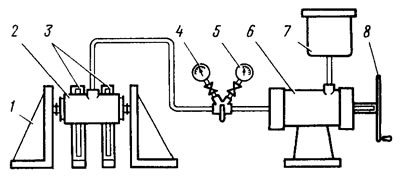
Figure 122. Rear brake wheel cylinder testing diagram: 1 - piston stops; 2 - test cylinder; 3 - cylinder bracket; 4 - low pressure gauge; 5 - high pressure gauge; 6 - cylinder for creating pressure; 7 - vessel; 8 - flywheel
The original is available on the website: www.VAZbook.ru
Then reduce the pressure and connect the high pressure gauge. Following the specified rules, repeat the test at a pressure of 50 kgf/cm²; 100 and 150 kgf/cm². Pressure drop due to fluid leakage through sealing elements, pipeline connections, fluid pumping nozzles or through casting pores is not allowed. A slight pressure drop is allowed (no more than 5 kgf/cm² for 5 min) pressure loss, especially at higher pressures, due to shrinkage of seals.