




Contents: Checking the high voltage part ↓ Checking the switch ↓ Checking the controller ↓ Checking the ignition coil ↓ Checking the temperature sensor ↓ Testing on the stand ↓
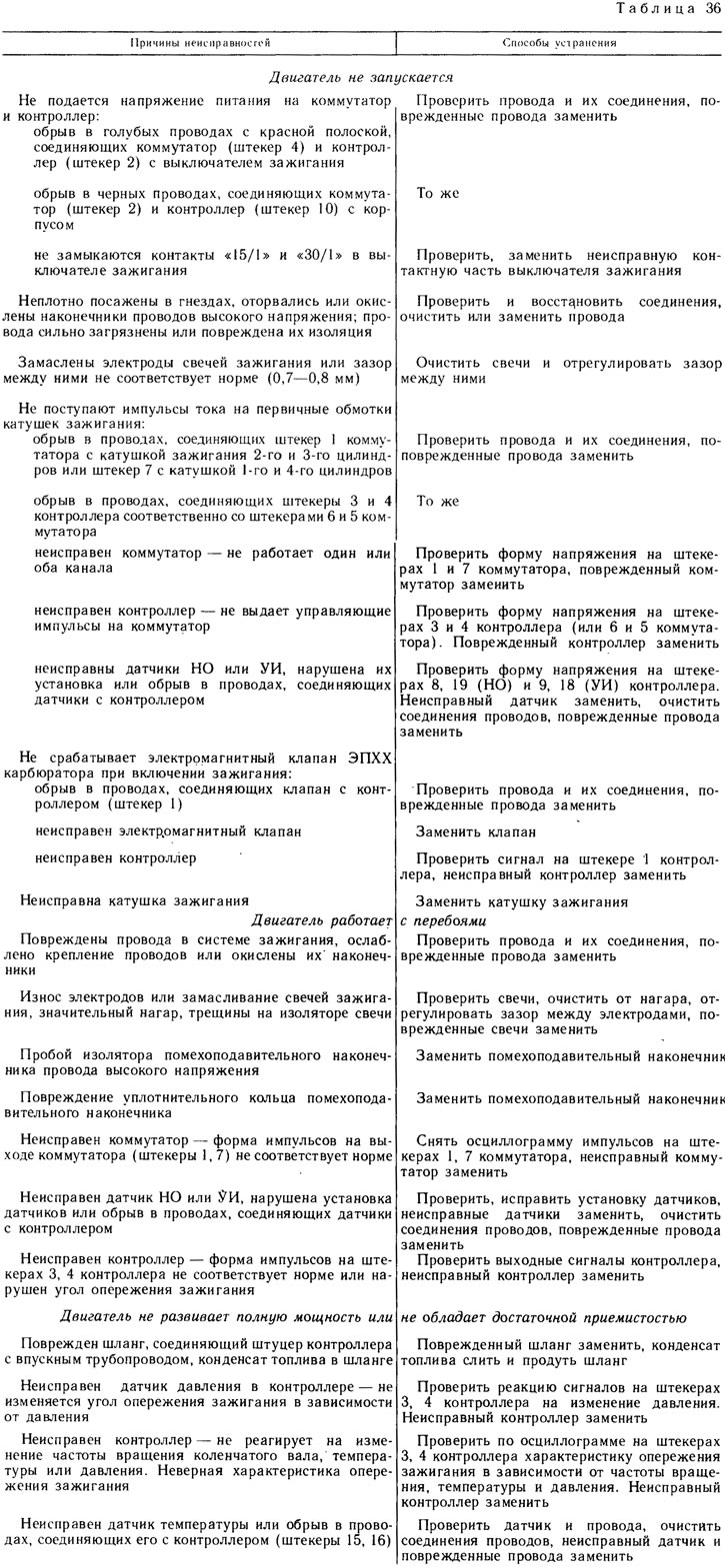
The main faults of the microprocessor engine control system are listed in Table 36. If the engine does not start or runs intermittently, it is recommended to start checking the ignition system from the high-voltage part in the following order.
Checking the high voltage part
To check, you will need a simple spark gap (figure 193) with two pairs of metal rods 2, 5 (electrodes), fixed to a plate made of electrically insulating material (plastic, textolite). The lower part of the rods together with the insulators 7 must correspond in shape and size to the size of the insulator and the tip of the spark plugs. Screws 6 with pointed ends are screwed into the upper parts of the rods. The gap between the ends of the screws can be adjusted by turning the screws.
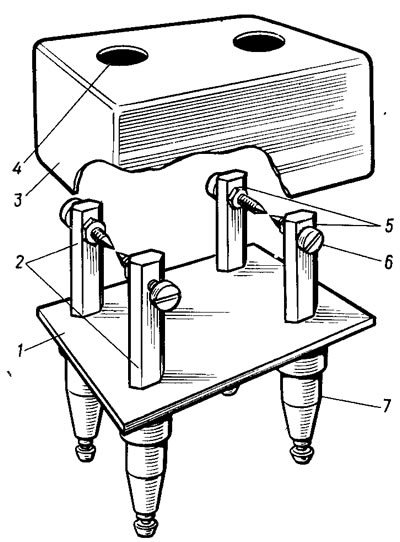
Figure 193. Surge arrester for testing the high-voltage part of the system: 1 - insulating base; 2 - electrodes connected to the spark plug wires of the 1st and 4th cylinders; 3 - casing; 4 - viewing window; 5 - electrodes connected to the spark plug wires of the 2nd and 3rd cylinders; 6 - adjusting screws; 7 - insulating bushings
When checking the high-voltage part, care must be taken. For this purpose, the arrester must be covered from above with a cover 3 made of insulating material with viewing windows 4. The arrester must be fixed to the car body.
Disconnect the wire tips from the spark plugs and connect them to the spark gap electrodes. Connect the wires from the 1st and 4th spark plugs to one pair of spark gap electrodes, and from the 2nd and 3rd spark plugs to another pair of electrodes. Set the gap between the spark gap electrodes to 7-10 mm and turn the engine with the starter.
At low crankshaft speed, alternate "jumping" of sparks between pairs of electrodes 2 and 5 will be noticeable. If spark formation on the spark gap is normal, then it is necessary to check the spark plugs.
If there is no sparking on one pair of electrodes, then it is necessary to check the electrical circuit from the commutator to these electrodes: high-voltage wires, interference suppression tips, ignition coil and the connection of the coil to the commutator.
When there is no sparking on both pairs of spark gap electrodes, it is necessary to check whether power is supplied to the switch, controller and ignition coils, and also to check the switch, controller and NO, UI sensors if the power supply circuits are in good condition.
Checking the switch
The functionality of the switch must be checked using a switch diagnostic device (development of SCB diagnostics, Riga) or a two-channel electronic oscilloscope by measuring the parameters of input and output pulses (see figure 191). The simplest check can be performed using the A12.3 W test lamp. To do this, disconnect the low-voltage wires from the ignition coil, connect the lamp to them and turn the engine with the starter. The flashing of the lamp will indicate that the switch is producing current pulses.
If there are no current pulses on only one ignition coil, then either the wires connecting this coil to the switch are damaged, or one of the switch channels is faulty.
If there are no current pulses on both coils, then either the supply voltage is not supplied to the ignition coils, the switch or the controller (via the blue wire with the red stripe), or the fault must be looked for further. It may be in the switch, controller or in the connections between them.
If you have a known good switch, you can replace the car's switch with it and check the operation of the ignition system. Its normal operation in this case will indicate that the car had a faulty switch.
Checking the controller
The controller's performance and accuracy of reproduction of ignition timing characteristics are checked using the "MSUAD Tester" (SKB diagnostics, Riga) in accordance with the operating instructions for the tester. You can also check the controller's operation using a two-channel electronic oscilloscope using the following method.
1. Connect the electronic oscilloscope to the diagnostic terminals of the controller in the following order:
- apply angular pulses to the input of the first channel amplifier (plug 7 controller);
- apply count start pulses to the input of the second channel amplifier (plug 5 controller);
- apply a diagnostic pulse SZ to the external sweep trigger input of the oscilloscope (plug 13 controller);
2. Turn on the "waiting" mode of the oscilloscope sweep, synchronization - by transition from a high signal level to a low one (spark moment);
3. Calculate the ignition timing angle using the formula
Θ = nUI·1.4°,
where nUI — the number of transitions of the UI signal from high to low level and vice versa in the sweep range of the oscilloscope from the moment of spark formation to the front (transition from low to high level) nO signal (TDC); 1.4° is the angle of rotation of the crankshaft during half the period of angular impulses.
Example. Let's assume that during the rotation of the crankshaft by an angle of 0, eight transitions of the UI signal are observed (see figure 191, a), then: Θ = 8·1.4 = 11.2°.
The simplest check of the controller's performance can be performed using an indicator made according to the diagram in Figure 194. The indicator uses MLT type resistors (1 W), a KT817B type transistor, and an A12 automobile lamp (3 W) is used as an indicator lamp.
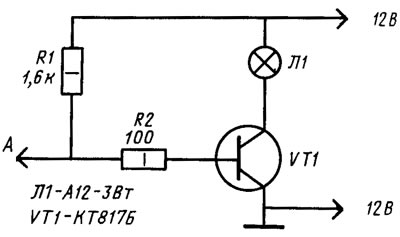
Figure 194. Controller Test Indicator Circuit
The source is on the website vazbook.ru
To check the controller, connect the "-" and "+" terminals of the indicator to the battery, disconnect the plug connector block from the switch and connect the A input of the indicator to the "5" plug of this block (connected to the white wire). The engine is turned over with the starter. If the indicator lamp flashes, the controller issues "Channel Selection" pulses.
Similarly, check for the presence of SZ pulses by connecting the indicator input to plug "6" (there is a blue wire coming to it) disconnected from the switch wiring block.
If there are no pulses, then check whether the supply voltage is supplied to the controller and whether there is a break in the wires connecting the controller to the switch and to the NO and UI sensors. If the wires are intact and the supply voltage is supplied to the controller, but there are no pulses, then it is necessary to check the controller on the stand.
To check the control function of the electromagnetic valve of the carburetor idle speed control system, disconnect the green wire from the limit switch 8 (see figure 190) carburetor and connect the tip of this wire to the body. Then start the engine and gradually increase the crankshaft speed. At 1750 rpm (measured by some additional tachometer) the valve should turn off. Now smoothly reduce the rotation speed. When it decreases to 1650 rpm, the valve should turn on.
Set the rotation speed to 2000 rpm, disconnect the tip of the wire going to the carburetor limit switch from the housing, and then reconnect it to the housing. When disconnecting the wire from the housing, the valve should turn on, and when connected to the housing, it should turn off.
The moment of valve operation can be determined by a characteristic click or by using a voltmeter connected to the valve and the body. If the valve is on, the voltmeter should show a voltage of at least 10 V, and if it is off, then no more than 1.5 V.
Checking the ignition coil
The ignition coil is checked for winding resistance, for short circuits between windings and insulation breakdown on the housing. The resistance of the primary winding is (0.5±0.05) Ohm, and the secondary is (11±1.5) kOhm.
A breakdown of the insulation on the housing is detected by burnout or melting of the plastic shell of the coil on the surface adjacent to the mounting bracket.
Checking the reference and angular pulse sensors. The sensor installation should be checked. For normal operation of the sensor, the gap between the sensor and the top of the flywheel ring gear tooth must be (or the end of the pin for the NO sensor) was within 0.3-1.2 mm (figure 195). The gap can be determined by removing the sensor, measuring the distance from the surface of the clutch housing to the top of the tooth and subtracting 25 mm from it.
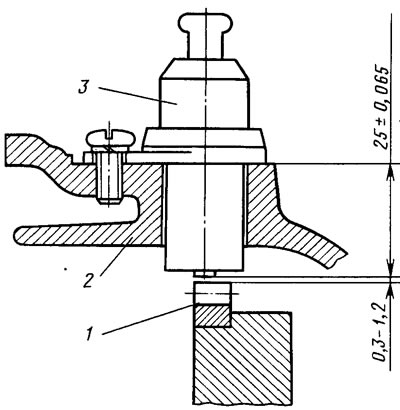
Figure 195. Installing the angular momentum sensor: 1 - flywheel crown; 2 - clutch housing; 3 - sensor
The resistance of the sensor winding is (400±50). Ohm and is measured with an ohmmeter. The shape and amplitude of the pulses generated by the sensor are checked with an electronic oscilloscope (see figure 192).
The presence of pulses generated by the sensor can be roughly assessed using an AC voltmeter by turning the engine with the starter.
The resistance of the sensor winding and voltage can be measured with a combination device (for example C4317).
Checking the temperature sensor
The sensor is tested by inserting it into a tank with water or coolant that can be heated. A 12 V power source and a voltmeter are connected to the sensor (figure 196). The voltmeter must be a direct current voltmeter with a measurement range of 0-5 V and an accuracy class of 1.5 (for example, C4317). The supply current of the temperature sensor is set by resistor R1.
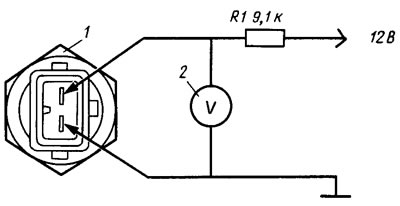
Figure 196. Temperature sensor testing diagram: 1 - sensor; 2 - voltmeter
After turning on the water heating, measure the voltage drop on the sensor at different temperatures in the tank. The voltage drop should not differ by more than ±0.1 V from the calculated value, determined by the formula given in the section "Device Features".
Testing on the stand
For precise functional testing of the elements of the microprocessor engine control system, it is necessary to use a special stand consisting of a 21083 engine flywheel simulator and elements of the MSUD system connected using a wire harness in accordance with figure 190.
The flywheel simulator is an aluminum disk with a pressed-on toothed rim of the 21083 engine flywheel and a marker pin for the NO sensor fixed to the disk. The disk is installed on the electric motor shaft and covered with a metal casing with holes for the NO and UI sensors. To check the parameters of the sensors, the mounting places for them are made so that the installation gap can be adjusted within 0.3-1.2 mm using gaskets.
Instead of spark plugs, the stand is equipped with arresters similar to the one shown in figure 193.
The stand is equipped with the following devices and equipment:
- DC voltage source 0-15 V, 0-10 A (for example, TES-15);
- dual-channel electronic oscilloscope (for example C1-6I);
- combined measuring instrument (for example C4317);
- mSUAD tester with vacuum unit (SKB diagnostics, Riga);
- device for testing switches (SKB diagnostics, Riga).
When diagnosing a microprocessor engine control system, it is necessary to be guided by the following materials:
- technical conditions for controllers of the type "Electronica MS-2713-01" BK0.305.077 TU;
- technical conditions for a two-channel switch type 42.3734—TU 37.464.008—85;
- technical description and operating instructions for the MSUAD tester;
- technical description and operating instructions for the switch testing device.