




Contents: Device ↓ Work of the cleaner ↓
Open large image in new tab »
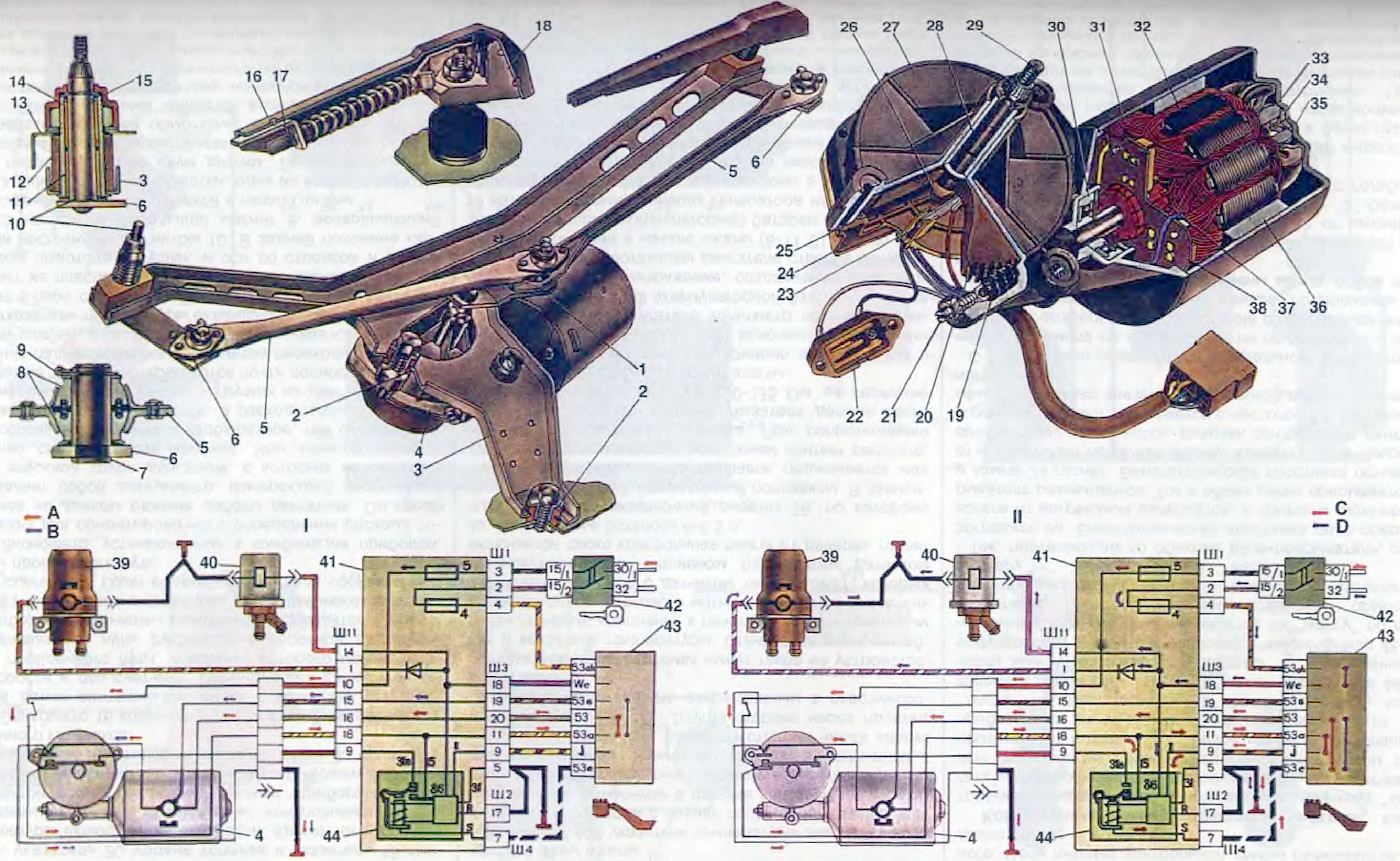
Figure 34. Windshield wiper: 1. Crank; 2. Rubber bushings; 3. Wiper drive bracket; 4. Cleaner gear motor; 5. Intermediate lever; 6. Leash; 7. Axis; 8. Insert; 9. Lock washer; 10. Lever axis; 11. Lever axle bushing; 12. Lining; 13. Windscreen frame panel; 14. Lever axle nipple; 15. Cap; 16. Brush lever; 17. Lever rod; 18. Lever base; 19. Anchor shaft; 20. Gear reducer; 21. Adjusting screw; 22. Thermal bimetallic fuse; 23. Limit switch spring plate; 24. Lid; 25. Panel; 26. Cam; 27. Gearbox cover; 28. Gear axle bushing; 29. Gear axis; 30. Anchor shaft ball bearing; 31. Anchor winding; 32. Armature core; 33. Anchor shaft rear end sleeve; 34. Heel pad; 35. Body; 36. Permanent magnet; 37. Collector; 38. Brush holder; 39. Washer pump electric motor; 40. Windshield washer electromagnetic valve; 41. Mounting block; 42. Ignition switch; 43. Windscreen wiper and washer switch; 44. Windscreen wiper relay; I. Wiring diagram for the 1st and 2nd speed of the cleaner; II. Windshield wiper and washer intermittent mode switching circuit; A. 1st (low) speed of the cleaner; B. 2nd (high) speed cleaner; C. Intermittent operation, D. Turning on the washer.
Device
Electric windshield wiper with two brushes and parallel movement of brushes. It has two constant operating modes, but with different brush speeds, and one mode with intermittent operation. The wiper consists of a gear motor (electric motor with gearbox) 4, crank mechanism and brushes with levers. The dimensions of the mechanism parts are selected so that the swing angle of the leashes is about 85°.
Levers 5 are connected to the leashes by a crank 1 with spherical hinges, allowing the mechanism to operate reliably with some non-parallelism of the leash axes. In the hinges there are two hemispherical metal-ceramic inserts 8, impregnated with oil, which also fills the space between the inserts. The inserts are released from the inside by a spring.
The electric motor of the direct current gear motor is a three-brush, two-pole motor with excitation from permanent magnets with two rotation speeds. It has a stamped steel housing 35, inside which two permanent magnets 36, having the shape of semicircles, are fixed with spring holders riveted to the walls of the housing. These magnets together with the housing form the stator of the electric motor.
The electric motor anchor consists of shaft 19, core 32 and commutator 37. The core grooves, insulated with cardboard, contain the anchor winding 31, the section terminals of which are soldered to the copper plates of commutator 37. The anchor shaft rotates in ball bearing 30 and metal-ceramic bushing 33. The outer surface of the bushing is spherical, which allows it to rotate in the housing socket and self-align along the anchor shaft axis. A felt ring is placed around the bushing. The bushing and felt are impregnated with oil. Bearing 30 is also filled with grease. Therefore, it is not necessary to lubricate the electric motor during maintenance.
The electric motor housing is closed by cover 27, which is also the gearbox housing. The gear ratio of the gearbox is 74:1. The gearbox housing is closed by plastic panel 25 and cover 24. The panel contains contact posts to which wires are soldered and a spring plate 23 with switch contacts is attached, ensuring that the electric motor stops when the brushes are in the lower position. Under the action of elasticity, plate 23 is pressed against the upper (in the picture) rack. When the projection of cam 26 is against the plate, it presses it away from the upper rack and locks it with the lower rack.
To protect the electric motor from overloads when the brushes freeze to the glass, there is high resistance to their movement, or when the windshield wiper mechanism jams, a reusable thermal bimetallic fuse is installed in the wiper.
Two speeds of rotation of the electric motor shaft are achieved by using three brushes to supply voltage to the armature winding. The 1st speed (low) is provided by supplying voltage to the brush located in the geometric neutral of the electric motor. When the supply voltage is supplied to the brush shifted from the geometric neutral, the armature of the electric motor rotates at the 2nd (higher) speed.
Windshield wiper relay. Relay 44 type 52.3747 is designed to create an intermittent windshield wiper mode. The relay is installed in the mounting block 41 and consists of an electronic control circuit and an executive electromagnetic relay.
The relay ensures that the wiper is turned on approximately 14 times per minute. In addition, when the windshield washer is turned on, the relay turns on the 1st speed of the wiper if it was turned off or was operating in intermittent mode. After the windshield washer is turned off, the relay delays the wiper from turning off until it has completed 2-4 more complete wipe cycles with its brushes.
Work of the cleaner
1st speed. In this mode, contacts "53a" and "53" of the switch are closed. The current goes to the wiper motor along the following path: contact "53" of the switch, gray wire, through the mounting block to the brush of the motor, which is in geometric neutral, and then to the "ground".
2nd speed. This mode is obtained by closing contacts "53a" and "53v" of the switch. Current flows from contact "53v" along the gray wire with an orange stripe through the mounting block to the electric motor brush, shifted from the geometric neutral, and then to the "ground".
Intermittent mode is provided by closing contacts "53a-j" and "53-53e" of the switch. From contact "j" of the switch, voltage goes to terminal "1" of relay 44. The electromagnetic relay is triggered and contacts "15" and "S" are closed. Current goes from terminal "15" of the relay to "S", then to the closed contacts "53-53e" of the switch and through the gray wires to the electric motor brush. In this case, the relay switches off and on again with a frequency of 14 cycles per minute, creating intermittent operation of the cleaner.
Turning off the cleaner. Switch lever 43 is moved to the initial position, in which contacts "53-53e" are closed. At the relay, terminals "31 V" and "S" are closed. Spring plate 23 is pressed against the right pillar (in the picture) limit switch. The current supplying the armature winding of the electric motor goes from fuse 22, through plate 23 to terminal "31 V" of the relay, then from terminal "S" of the relay to the closed contacts "53e-53" of the switch and, further, through the gray wires to brush "a" of the electric motor. The cleaner operates at low speed until cam 26 presses plate 23 away from the right rack and closes it with the left (in the picture) stand. At this point, the cleaner will stop and its brushes will remain in the lower position.
Turning on the windshield washer. The contacts "W" and "53ah" of the switch are closed, and the current goes from the closed contacts "30" and "15/2" of the ignition switch through the fuse "4" of the mounting block to the closed contacts "53ah" and "W" of the switch. Then the current goes through the pink wire to the mounting block and from it to the electric motor 39 of the washer pump to the valve 40 of the windshield washer. The valve opens and the washer pump supplies liquid for washing the windshield.
At the same time, voltage is supplied to the terminal "86" of the relay. It is triggered, and the terminals "31 V" and "S" are closed. Since the contacts "53e" and "53" of the switch are closed when the wiper is off, current begins to flow along the circuit: from fuse 22 to the terminals "31 V" and "S" of the relay, then to the contacts "53e" and "53" of the switch and from them to the brush of the electric motor. Thus, when the windshield washer is turned on, the wiper begins to work at the 1st (low) speed.