




Open large image in new tab »
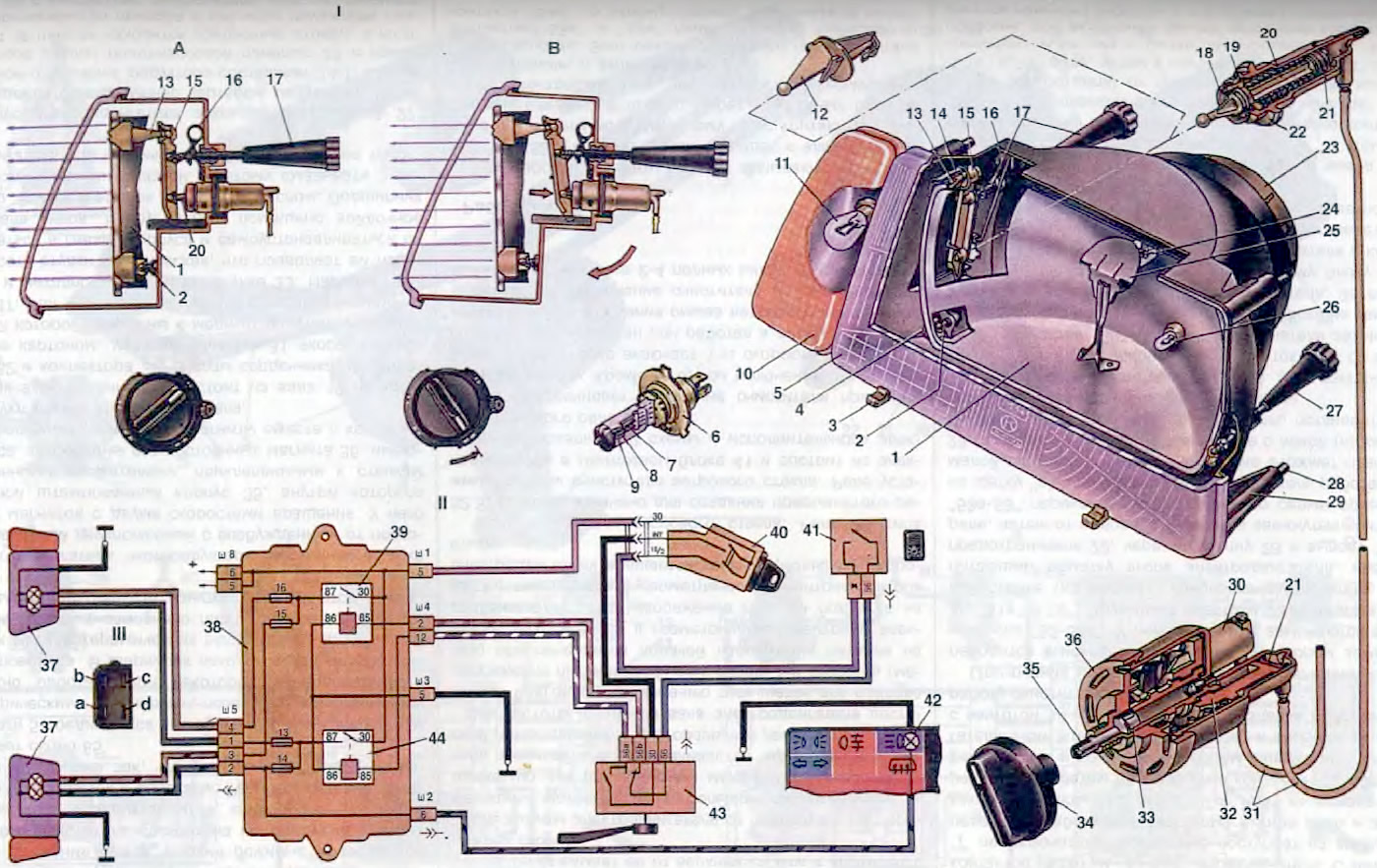
Figure 33. Headlights: 1. Reflector; 2. Lower reflector support; 3. Wiper brush limiter; 4. Lower reflector holder; 5. Headlight diffuser; 6. Lamp flange; 7. High beam thread; 8. Low beam filament screen; 9. Low beam thread; 10. Direction indicator lens; 11. Lamp A12-21-3; 12. Plug installed in place of the hydraulic corrector working cylinder; 13. Upper reflector holder; 14. Tension spring; 15. Lever; 16. Lever return spring; 17. Headlight vertical adjustment screw; 18. Case; 19. Bushing; 20. Working cylinder rod; 21. Cuff; 22. Working cylinder body; 23. Headlight housing; 24. Lamp AKG12-60+55; 25. Screen; 26. Lamp A12-4: 27. Headlight horizontal adjustment screw; 28. Headlight mounting stud; 29. Headlight housing; 30. Hydraulic corrector master cylinder housing; 31. Tubes connecting the master cylinder with the working ones; 32. Double piston; 33. Drive screw; 34. Handle; 35. Nozzle; 36. Lid; 37. Headlight; 38. Mounting block; 39. Low beam headlight relay; 40. Ignition switch; 41. Outdoor lighting switch; 42. High beam indicator lamp; 43. Headlight switch; 44. High beam headlight relay; I. Scheme of operation of the headlight hydraulic corrector: A - a car with one driver; B - with driver and cargo in the trunk; II. Headlight connection diagram; III. View of the headlight plug connector: a - low beam plug; in - high beam plug; c - parking light plug; d - ground plug.
To illuminate the road at night, two headlights are installed (right and left). They consist of rectangular headlights with headlamps and sidelamps, combined with a side turn signal section. The headlight units are attached to the front of the car with four 28 studs and serrated-edge nuts, which prevent them from loosening.
The low and high beam headlights are switched by the left lever of the steering column switch 43, if the external lighting switch is on. In addition, the electrical circuit provides for the possibility of light signaling, i.e. short-term switching on of the high beam headlights in any position of the external lighting switch. In this case, the high beam headlights are switched on by pulling the left lever of the steering column switch towards you, and power is supplied to the contacts of the light signaling in the headlight switch 43 directly from the "INT" plug of the ignition switch 40, bypassing the external lighting switch.
The filaments of the two headlamps consume a fairly significant current - 8-10 A. Therefore, in order to relieve the contacts of the headlamp switch 43 and increase its service life, the headlamps are switched on not directly by the switch 43, but through additional relays 39 and 44 of type 113.3747. They have powerful contacts and are installed in the mounting block 38. Relay 39 switches on the low beam in both headlamps, and relay 44 - the high beam. As a result, only the supply current of the relay windings, not exceeding 0.2 A, flows through the contacts of the headlamp switch.
Reflector 1 of the headlight is made of steel and has the shape of a paraboloid, limited at the top and bottom by horizontal planes. To create a mirror reflective surface, the reflector is coated inside with a special heat-resistant varnish, and then a thin layer of aluminum is applied to it in a vacuum. This coating reflects 90% of the light falling on it.
The diffuser 5 of the headlight is made of colorless silicate glass with a high degree of transparency. On its inner surface is pressed a complex system of lenses and prisms that scatter light in the horizontal plane and concentrate the light flux in the required directions according to international standards.
The 24 headlamp lamp is halogen. The lamp bulb is made of quartz glass and filled with iodine vapor (halogen) and some inert gas. Halogen lamps have increased luminous efficiency, which is ensured by a higher heating temperature of the filament and an increased service life due to the chemical process occurring in the lamp. This process is as follows. When burning, tungsten particles evaporate from the filament and settle on the walls of the lamp. Iodine vapor comes into contact with them and at a temperature of about 600°C, iodide tungsten is formed. This compound is unstable at high temperatures and, getting into the area of the hot filament, decomposes into iodine and tungsten, which is deposited on the filament, and iodine moves to the walls of the bulb. Thus, when the lamp is on, there is a constant transfer of tungsten from the walls to the filament. Therefore, the walls of the bulb remain clean, the filament thins out more slowly, and the service life of the lamp increases.
When replacing halogen lamps, you must be careful and handle the lamp with gloves or a handkerchief to avoid leaving greasy fingerprints on the lamp glass. If there are such fingerprints on the lamp, remove them with alcohol. Grease stains cause the lamp glass to darken because it heats up to high temperatures. As a result, it overheats and quickly fails.
The lamp contains two tungsten filaments; one (55 W) for low beam and the other (60 W) for high beam. High beam filament 7 is in the focus of the reflector, and therefore the high beam rays are collected into a narrow beam directed almost parallel to the road and illuminating it well at the maximum distance from the car. Low beam filament 9 is brought forward from the focus of the reflector and is covered from below by a special metal screen 8. This is done in order to limit the spread of low beam upward.
(The information is posted on the portal: VAZBOOK)
If you direct the low beam beam at a wall, the light spot will have the shape of an ellipse with the upper half cut off. In the left part of the spot, the upper boundary of the illuminated area will pass exactly along the horizontal axis of the ellipse, and in the right part along the line emanating upward from the center of the ellipse at an angle of 15° to its horizontal axis. This shape of the light beam provides good illumination of the road in front of the car (especially its right side and the shoulder) and reduces the possibility of blinding oncoming drivers.
The direction of the headlight beam in the horizontal plane can be adjusted by screw 27, and in the vertical plane - by screw 17. When turning screw 27, the left edge of the reflector moves forward or backward, and it rotates relative to the lower support 2 and the ball head of the upper holder 13. When turning screw 17, the reflector rotates via lever 15 relative to the lower support 2 and the ball head of screw 27.
Depending on the vehicle load, the angle of the headlight axes relative to the road changes and, accordingly, the direction of the headlight beams deviates. To adjust the direction of the beam of light depending on the load, a manual headlight hydraulic corrector is installed on some vehicles, which can be used to adjust the direction of the beam of light in the vertical plane within small limits from the driver's seat. If there is no hydraulic corrector on the vehicle, then a plug 12 is inserted into the headlight housing instead.
The headlight range control consists of a transmission mechanism (or master cylinder), secured with a nut on the instrument panel, two working cylinders mounted on the headlight housings, and connecting tubes. The cylinders and tubes are filled with a special liquid that does not freeze at low temperatures. The design of the hydraulic corrector is non-separable, and in case of damage it must be replaced entirely, assembled with cylinders and tubes.
When the car is loaded with only one driver, the piston 32 of the drive mechanism is pushed all the way into the cylinders of the housing, and the rods 20 of the working cylinders are pulled out of the housings as far as possible. If you put a load in the trunk, the rear of the car will lower, and the beam of light from the headlights will rise up. To return it to its previous position, turn the handle 34 of the hydraulic corrector counterclockwise until it stops. In this case, the piston 32 moves back out of the cylinders and sucks out the liquid from the tubes and working cylinders. The rods of the working cylinders are pushed into the housings by the return springs, and the levers 15 of the headlights are turned counterclockwise by the springs 16. The upper part of the headlight reflector moves forward, and the beam of light from the headlights rises.