




Open large image in new tab »
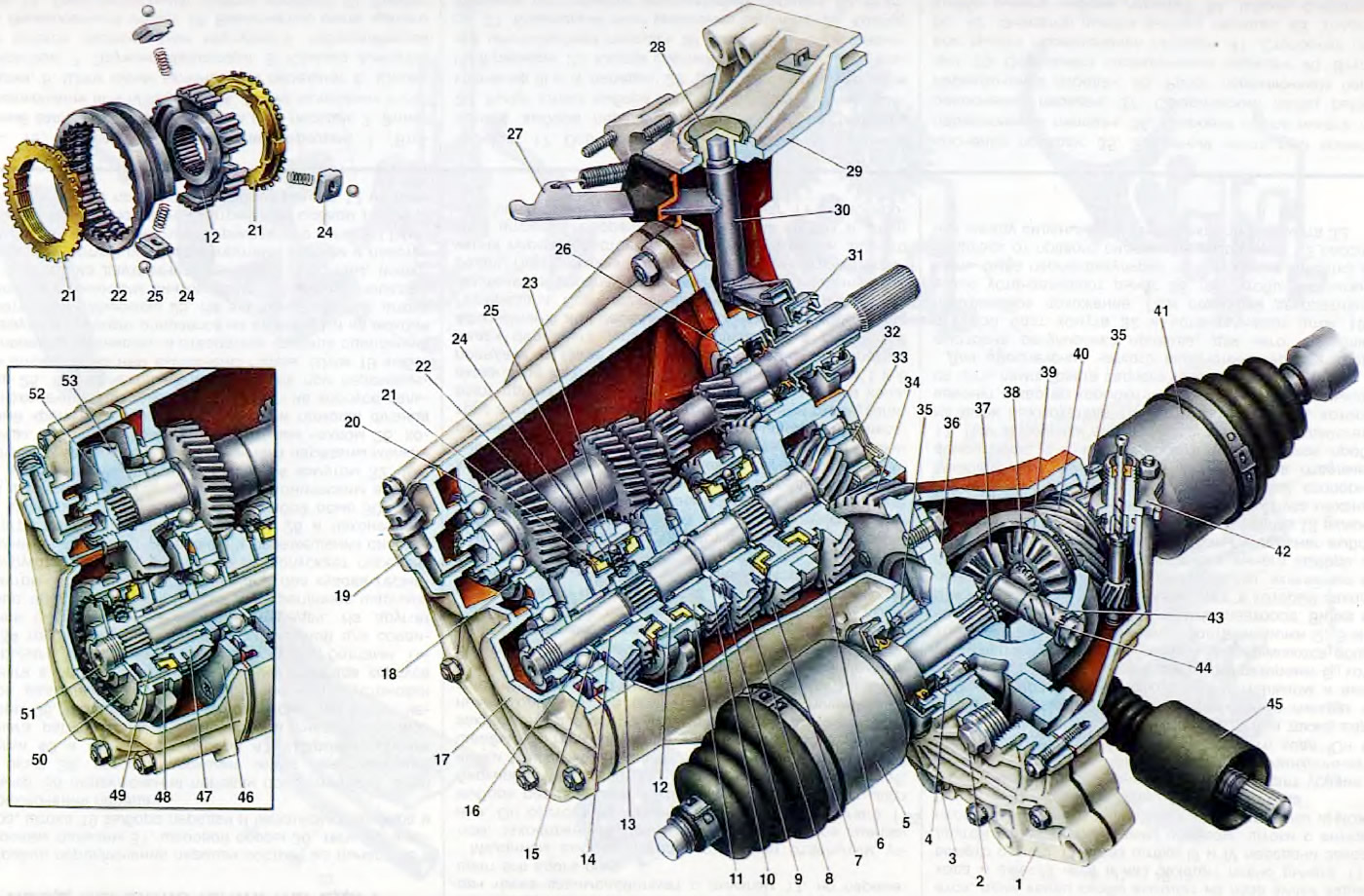
Figure 18. Gearbox: 1. Gearbox housing; 2. Filler and inspection hole plug; 3. Drain plug; 4. Adjusting ring; 5. Left front wheel drive; 6. Driven gear of the 1st gear of the secondary shaft; 7. Synchronizer clutch of 1st, 2nd gears and reverse; 8. Secondary shaft driven gear II; 9. Retaining ring; 10. Thrust half ring; 11. Driven gear of the 3rd gear of the secondary shaft; 12. Hub of synchronizer clutch of III and IV gears; 13. Driven gear of the 4th gear of the secondary shaft; 14. Secondary shaft pinion needle bearing; 15 Thrust washer of the fourth gear pinion; 16. Secondary shaft ball bearing; 17. Rear cover of the gearbox; 18. Primary shaft ball bearing; 19. Sapun; 20. Primary shaft; 21. Locking ring of synchronizer of III and IV gears; 22. Sliding clutch of synchronizer III and IV gears; 23. Fork of sliding clutch of synchronizer of III and IV gears; 24. Retainer cracker; 25. Locking ball; 26. Primary shaft cylindrical bearing; 27. Clutch release fork lever; 28. Clutch release fork shaft sleeve; 29. Clutch housing; 30. Clutch release fork; 31. Clutch release bearing; 32. Secondary shaft roller bearing; 33. Secondary shaft; 34. Driven gear of the main transmission; 35 Differential tapered roller bearing, 36 Differential box; 37. Satellite; 38. Retaining ring of the axle gear; 39. Half-axle gear; 40. Speedometer drive pinion; 41. Right front wheel drive; 42. Speedometer drive assembly; 43. Axle of satellites; 44. Satellite axle retaining ring; 45. Gear shift drive joint protective cover; 46. Secondary shaft bearing mounting plate; 47. Driven gear of the V gear of the secondary shaft; 48. Sliding clutch of the 5th gear synchronizer; 49. Hub of the 5th gear synchronizer clutch; 50. Thrust washer; 51. Secondary shaft of a five-speed gearbox; 52. Primary shaft V-gear drive gear; 53. The primary shaft of the five-speed gearbox is transmitted; I. Synchronizer parts; II. Rear part of the five-speed gearbox.
Depending on the vehicle's configuration, a four- or five-speed gearbox is installed.
Structurally, the gearbox is combined with the main gear and differential. Torque from the gearbox is transmitted to the drive wheels through the drive 41 and 5 front wheels.
The four-speed gearbox consists of a housing 1, primary 20 and secondary 33 shafts, two synchronizers, an axle with an intermediate reverse gear, a final drive, a differential and a gear shift drive.
The crankcase 1 is made of aluminum alloy, closed by the rear cover 17, into the seat of which the breather 19 is pressed. In the rear part of the crankcase there are seats for bearings and two holes closed by plugs 2 and 3. In the crankcase, on two bearings 18 and 26, the primary shaft 20 is located, made in the form of a block of gears of the 1st, 2nd, 3rd and 4th gears and reverse. The secondary shaft 33 is made together with the main gear pinion. The shaft rotates in roller 32 and ball 16 bearings. On the secondary shaft belts, the gears of the 1st, 2nd, 3rd and 4th gears are located on needle bearings, and on two belts there are cut splines for fastening the hubs 12 of the synchronizers. Each gear has two rims: one helical, the other spur. The helical rims are in constant mesh with the same gears of the primary shaft. Sliding clutches of synchronizers are connected to straight-toothed rims when the gear is engaged.
The synchronizer ensures silent gear shifting by equalizing the angular velocities of the primary and secondary shaft gears. It consists of a hub 12 mounted on the secondary shaft splines, a sliding clutch 22, two locking rings 21, three crackers 24 with balls 25 and retainer springs and gear rims. Synchronizers of all gears differ slightly from each other. The hub of the synchronizer of the 1st and 2nd gears is locked on the secondary shaft by two retaining rings, and the hub of the other synchronizer is clamped between the shaft flange and the sleeve of the needle bearing of the 4th gear pinion. Sliding clutch 7 of the synchronizer of the 1st and 2nd gears has an outer rim for engaging reverse gear, unlike the clutch of the other synchronizer. In the hub of each synchronizer, six longitudinal grooves are made, three of which have sockets for the retainer springs. Crackers 24 with locking balls are installed in these grooves. Springs press the balls to the annular grooves of the coupling. On both sides of the hub there are bronze blocking rings with six projections that enter the grooves of the hub. In this case, three short projections enter the grooves in which the locking devices are located, and the longer and wider ones enter other grooves. These projections are installed in the grooves with a lateral clearance equal to half the thickness of the coupling (hub) tooth, and limit the angle of rotation of the blocking ring relative to the hub. With such a connection, the hub rotates together with the blocking rings. The conical part of the blocking rings is located on the conical belts of the gears and at the moment of gear engagement, contact of the conical surfaces occurs. To break the oil film at the point of contact and increase friction forces, a thread is cut on the conical surface of the ring and longitudinal grooves are made. The blocking rings have toothed rims, the teeth of which are beveled at a certain angle. The sliding clutch is connected to the teeth of the locking ring at the initial moment of gear engagement. The sliding clutch has an internal crown, which it is located on the teeth of the hub. For longitudinal movement of the clutch along the hub, the gear shift fork enters its annular groove. The ends of the clutch teeth are beveled at the same angle as the teeth of the locking rings and synchronizer crowns.
The reverse intermediate gear is used to engage reverse gear (see figure 18, pos. 29). A metal-ceramic bushing is pressed into the central hole of the gear, which is located on the axis installed in the holes of the clutch housing and gearbox. When reverse gear is engaged, the intermediate gear connects the primary shaft gear and the toothed ring of the synchronizer clutch of the first and second gears, as a result of which the secondary shaft rotates in the opposite direction.
The main gear consists of a pair of helical cylindrical gears, one of which is made together with the secondary shaft, and gear 34 is bolted to the flange of differential box 36.
The differential is conical, two-satellite, rotates on two tapered roller bearings 35, the preload in which is regulated by selecting the thickness of the adjusting ring 4. The internal cavity of the differential box has the shape of a solid sphere. In this cavity are located two half-axle gears 39 and two satellites rotating on the axis 43. The axis is held in the differential box by locking rings 44. The half-axle gears are mounted on the splines of the tailstocks of the housings of the inner hinges of the wheel drive and are locked by rings 38.
The plastic gear 40 of the speedometer drive is pressed onto the differential box, with which the driven gear of the speedometer drive is in engagement. It is located with its shaft in the housing of the speedometer drive 42, which is attached to the gearbox housing. At the exit from the housing 42, the shaft of the gear is sealed with an oil seal. To seal the gap between the speedometer drive and the mounting socket, a rubber sealing ring is installed in the groove of the housing. A thread for the union nut of the cable fastening is cut on the upper part of the speedometer drive housing.
The five-speed gearbox is based on the four-speed gearbox and has the following main differences:
- the rear parts of the primary shaft 53 and secondary shaft 51 are extended to accommodate the gears 52 and 47 of the fifth gear and its synchronizer;
- the ball bearings of the primary and secondary shafts are fixed in the housing sockets by plate 46, which is fastened with four screws to the housing wall;
- the rear cover of the gearbox is made deeper;
- the V gear synchronizer has one locking ring, since it only engages one gear;
- the fifth gear is mounted on the splines of the primary shaft.