




Contents: Removal ↓ Installation ↓
To carry out repair work on replacing the main brake cylinder, you will need a special 10 mm wrench for the brake pipe fittings.
Removal
1. Prepare the car for repair work (see points 2b and 4 "Preparing a car for maintenance and repair").
2. Remove the left part of the heat-insulating noise insulation of the engine compartment (see items 3-7 "Windshield wiper - removal and installation").
3. Using a rubber bulb or syringe, remove brake fluid from the master brake cylinder reservoir.
4. Using a special 10 mm wrench, loosen the tightening of the fittings of the four brake pipes of the master brake cylinder.
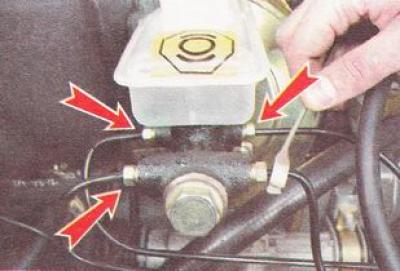
5. Using a 10 mm open-end wrench, completely unscrew the fittings of the four brake pipes.
6. Carefully, without bending the brake pipes too much, move them away from the master brake cylinder.
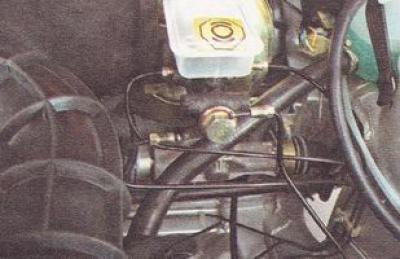
7. Using a 17 mm wrench, unscrew the two nuts securing the master brake cylinder to the brake booster housing.

8. Remove the main brake cylinder, complete with reservoir, from the vacuum booster.
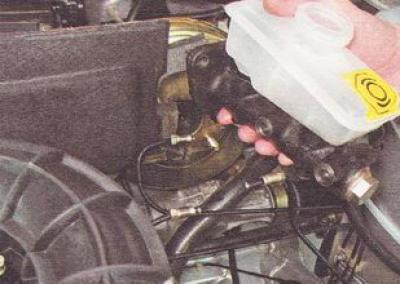
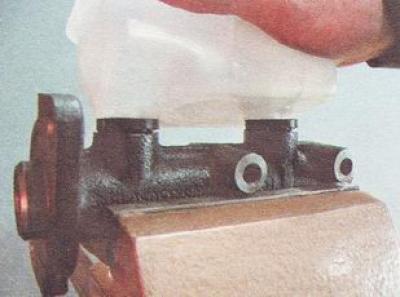
9. Clamp the main brake cylinder in a vice. Tilt the brake reservoir to the side and remove its pipes from the rubber sealing bushings.
Installation
1. Before installing the brake reservoir on the new master cylinder, wet the reservoir pipes with clean brake fluid.
2. Assembly and installation of the master brake cylinder on the vehicle is carried out in the reverse order.
3. The final tightening of the connecting fittings of the brake pipes is done using a special key.
4. Fill the brake reservoir of the master cylinder with fresh brake fluid and bleed the brakes on the car (see "Bleeding brakes (brake system), brake fluid replacement").
5. Check for any brake fluid leaks from the brake pipe fittings.