




Service brake system it is designed to reduce the speed of the vehicle, even to the point of bringing it to a complete stop and to hold the vehicle stationary for a short time.
The service brake system is dual-circuit, diagonal, with hydraulic drive, consists of a main brake cylinder with a vacuum booster, four wheel brake mechanisms and a fluid pressure regulator in the rear brake mechanisms. The front wheel brake mechanisms are disc, ventilated, the rear ones are drum.
Note. Some early-model VAZ 2110, VAZ 2111, VAZ 2112 vehicles with 8-valve 1.5-liter engines were equipped with front wheel brakes with non-ventilated discs.
Each of the vehicle's contours includes brake mechanisms for two wheels: one front and one rear, located diagonally on the vehicle.
Thus, one circuit includes the brake mechanisms of the front right and rear left wheels, and the second - the brake mechanisms of the front left and rear right wheels. If one of the circuits fails, the second circuit, although with less efficiency, will ensure the car stops.
The pressure regulator limits the flow of brake fluid to the rear brake mechanisms when the load on the rear axle is insufficient, thereby preventing the rear wheels from locking and the rear axle from skidding during sudden braking. The brake force regulator housing has a control hole closed with a plastic plug. Brake fluid leakage from this hole indicates that the brake force regulator rings are not tight.
To reduce the force applied by the driver to the brake pedal, a vacuum booster is installed on the main brake cylinder, which operates by using the vacuum created in the intake manifold of the running engine.
Warning: Do not turn off the engine until the vehicle has come to a complete stop.
A reservoir with brake fluid is installed on the body of the main brake cylinder. A sensor is installed in the cover of the main brake cylinder reservoir. If the brake fluid level in the reservoir drops dangerously, the sensor turns on the control lamp on the instrument panel.
Handbrake system designed to prevent spontaneous movement of the vehicle while parked.
The handbrake lever is connected to the rear wheel brake mechanisms by two cables. When the handbrake lever is moved to the upper position, the levers mounted on the shoes turn and begin to press on the spacer bars. The brake shoes of the rear brake mechanisms move apart and fix the brake drum from turning.
During operation, the handbrake requires periodic adjustment. This is due to wear of the brake shoe linings and stretching of the drive cables. The stroke of the handbrake lever should be 2-4 clicks. If it is less, it is necessary to increase the length of the drive, if more - to reduce it.
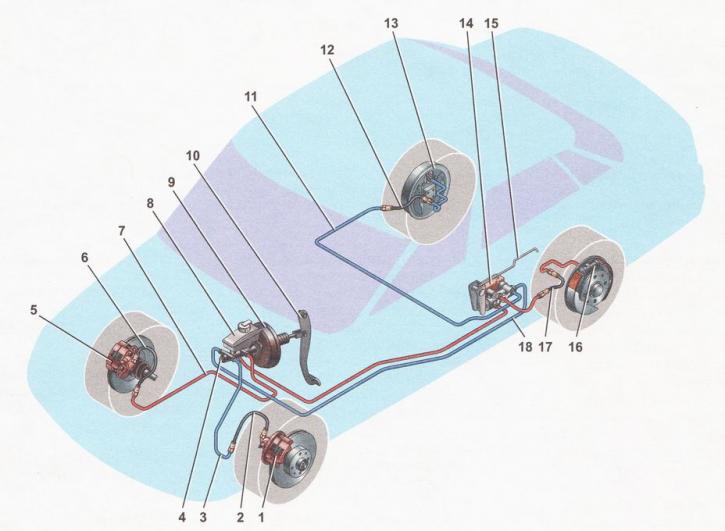
Diagram of the brake system: 1 - front left wheel brake mechanism; 2, 6, 12, 17 - brake hoses; 3, 7, 11, 18 - brake pipes; 4 - master brake cylinder; 5 - front right wheel brake mechanism; 8 - master brake cylinder reservoir; 9 - vacuum booster; 10 - brake pedal; 13 - rear right wheel brake mechanism; 14 - brake fluid pressure regulator in the rear wheel brake mechanisms; 15 - brake fluid pressure regulator lever in the rear wheel brake mechanisms; 16 - rear left wheel brake mechanism
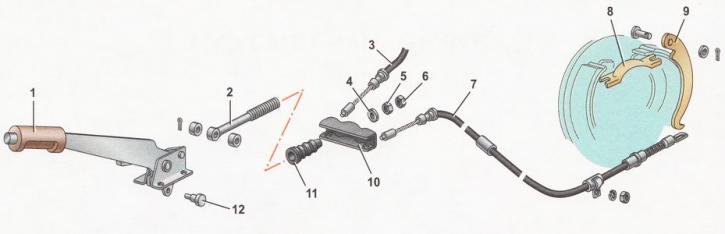
Handbrake device diagram: 1 - handbrake drive lever; 2 - lever rod; 3 - right rear wheel brake drive cable; 4 - washer; 5 - adjusting nut; 6 - lock nut; 7 - left rear wheel brake drive cable; 8 - spacer bar; 9 - lever; 10 - cable equalizer; 11 - rubber cover; 12 - thrust axis