




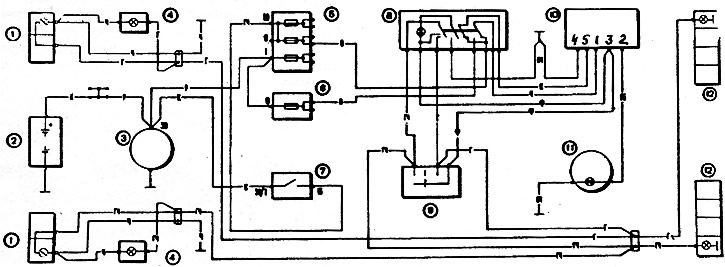
7-29. Schematic diagram of the hazard warning and direction indicator system: 1 - front lights; 2 - battery; 3 - generator; 4 - side direction indicators: 5 - main fuse box; 6 - additional fuse box; 7 - ignition switch; 8 - hazard warning light switch, 9 - turn signal switch, 10 - hazard warning light and turn signal relay; 11 - direction indicator lamp located in the speedometer; 12 - rear lights
The relay-breaker is mounted under the instrument panel on a bolt welded to the wall of the air intake box. A faulty relay-breaker cannot be repaired and should be replaced with a new one.
The flasher relay must ensure flashing of the direction indicator lamps at a frequency of 90±30 cycles per minute at a nominal load of 92 W, an ambient temperature of -20 to +50°C and a voltage of 10.8 to 15 V.
Until 1985, the 23 3747 type interrupter relay (Fig. 7-30) was used, assembled on integrated microcircuits. Since 1985, the 231.2747 interrupter relay, made from discrete elements, has been installed.
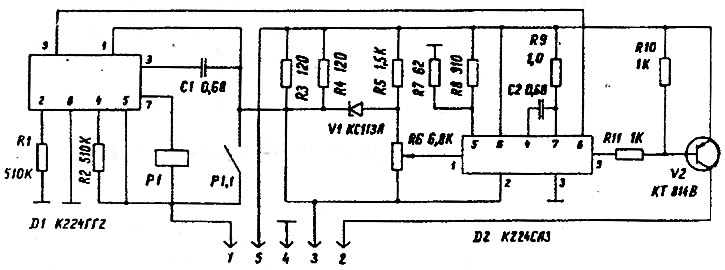
Fig. 7-30. Schematic diagram of the emergency alarm and direction indicator relay-interrupter
The characteristics of both flasher relays are the same. The external difference is the absence of plug "5" in flasher relay 231.3747. The supply voltage is supplied only to plug "7". Therefore, the brown wire connecting plug "5" of the flasher relay to the hazard warning switch is not needed. Flasher relay 231.3747 creates a double frequency of flashing of control lamp 11 (see fig. 7-29) in case of burnout of any of the turn signal lamps or a break in its power supply circuit.