English Русский
Български
Беларускі
Український
Српски
Hrvatski
Română
Polski
Slovenský
Magyar
| Articles | Contacts | Sitemap |   
Repair and maintenance Lada Repair and maintenance Mazda Repair and maintenance Mitsubishi Repair and maintenance Toyota Repair and maintenance Land Rover Repair and maintenance Hyundai Repair and maintenance Nissan
VAZbook.ru


Main     1111   2101   2105   2106   2107   2109   2110   2115   2121  
VAZ-2101 (1970-1983) VAZ-21011 (1974-1983)
  • Main
  • «Zhiguli»
  • VAZ-2101
  • General information
  • Main malfunctions
  • Coolant disappearing

Coolant disappearing (VAZ-2101)

            0

Let us remind you once again that the cooling system of VAZ cars is sealed and the coolant should not disappear without a trace. The exception is a small part of the liquid, which still evaporates. If there is an increased consumption of coolant, then you need to look for where it disappears: does it come out or flow into the engine crankcase. It is difficult to immediately identify this defect. It can be given away by whitish streaks in certain places. You can determine the leak by touch, running your finger along this or that connection of the hose with the branch pipe. In short, a thorough inspection of the entire cooling system is necessary. Most often, liquid comes out of the system through loose connections in the clamps.

To find the true cause of the leak, you need to know some of the features of Tosol. For example, a leak is easier to detect on a cold engine, apparently, cooled Tosol has better penetrating ability.

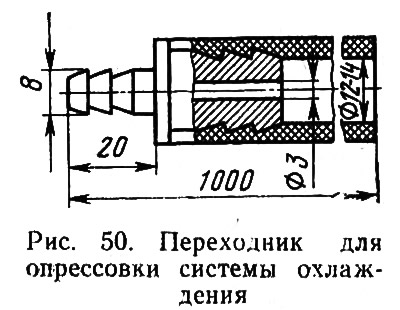
There are often cases when no thorough searches and observations reveal the leak location, but the Tosol still decreases. In this case, you cannot do without special measures. Check how tight the cooling system is under pressure. It is convenient to use a foot pump for pumping tires, as it is equipped with a pressure gauge. Having made a simple adapter (Fig. 50), insert it into the radiator pipe instead of the temporarily removed plastic hose going to the expansion tank, and, having connected the pump hose, bring the pressure in the system to 0.1 MN. If there is a leak through leaks in the connections, it will immediately give itself away.


There are often cases when no thorough searches and observations reveal the leak location, but the…


Sometimes the radiator is "to blame" for excessive coolant consumption. If you discover a defect while on the road, it makes sense to try to fix it (temporarily to the nearest station) small measures, i.e. seal the fire with plasticine, if you happen to have it lying around, or with soap.

Having reached a workshop that can repair the radiator, drain the remaining coolant into a clean container, having first unscrewed the drain cocks (plugs) in the lower tank of the radiator and on the cylinder block and removed the covers (plugs) of the radiator and expansion tank. The location of the plug in the lower tank is weak, therefore when unscrewing the plug with one key, use a second 17 mm key to support the plug so as not to tear it out of the tank body.

To remove the radiator, loosen the clamp on the radiator inlet hose and remove the hose from the inlet pipe. Do the same with the clamp on the outlet hose and remove the hose from the outlet pipe. Loosen the clamp on the expansion tank tube and remove the tube from the radiator filler neck pipe. Disconnect the upper and lower halves of the fan shroud and remove them from the radiator. Unscrew the nuts securing the radiator to the body and carefully remove the radiator from the engine compartment.


On cars with an electric fan, before removing the radiator, it is necessary to dismantle the electric fan. Installing the radiator in its place is performed in the reverse order.

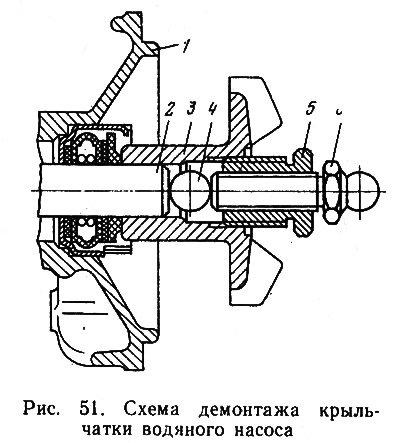
It is rare that coolant (it has excellent penetrating ability - better than water) finds a loophole through the water pump seal. To almost certainly clarify the condition of the water pump bearings (and, consequently, a breach of the sealing of the gland), it is necessary to check for play. This operation is performed by trying to move the fan or crankshaft pulley away from you and towards you. Noticeable play is a sign of bearing wear and the need to measure the seal. Having discovered this, it makes sense to contact a service station, since special pullers are needed to disassemble the pump. However, the operation can be performed on your own, using the idea of a car enthusiast from Ochemchire. Sleeve 5 (Fig. 51) and adjusting bolt 6, under normal conditions, serve as a support for the lever in the valve drive. Ball 4 with a diameter of 12 mm is placed in the impeller of the water pump, then sleeve 5 is screwed in until it stops, and then bolt 6 is tightened. Impeller 3 easily comes off shaft 2, located in block 1.

It is rare that coolant (it has excellent penetrating ability - better than water) finds a loophole…


It can be very unpleasant when no traces of leaking fluid are found, but it still disappears. Most likely, it has found its way into the engine crankcase. And if this is really the case, then the oil level (now diluted with Tosol) should increase. Such a defect should be dealt with by specialists at a service station.


This article is available at russian, bulgarian, belarusian, ukrainian, serbian, croatian, romanian, polish, slovak, hungarian
The text was reviewed by the specialist: Grigory Vologodtsev

Share with friends:

Previous articles
VAZ-2101: Main malfunctions
Next articles

Increased oil consumption
Extraneous knocking sounds appeared in the engine
The engine does not develop full power and does not have sufficient throttle response
The engine runs unstably at high crankshaft speed
The engine runs unsteadily at idle speed and when driving
Incomplete clutch disengagement
Incomplete clutch engagement
Increased noise when disengaging the clutch
Cardan transmission faults
Rear axle faults

More articles from other manuals on VAZ cars:
➠ Checking the coolant level VAZ-1111 (1988-1996)
➠ Coolant level VAZ-2105 (1979-2010)
➠ Coolant — Checking Level and Replacing VAZ-2106 (1976-2006)
➠ Coolant Temperature Sensor — Checking and Replacing VAZ-2107 (1982-2012)
➠ Coolant pump device VAZ-2109 (1984-1997)
Link in different formats to this page


Visitor comments

No comments yet


How much will 30 + 24 ?


VAZ-2101 (1970-1983) 
  • General information
  • Vehicle description
  • Vehicle device
  • Vehicle operation
  • Maintenance
  • Main malfunctions
  • Applications
  • Power unit
  • Engine repair
  • Cooling and lubrication system
  • Supply system
  • Transmission
  • Clutch
  • Transmission
  • Cardan gear
  • Rear axle
  • Chassis
  • Front suspension
  • Rear suspension
  • Steering
  • Brake system
  • Body
  • Exterior
  • Interior
  • Electrical equipment
  • Engine electrics
  • Equipment and devices


VAZ-21011 (1974-1983) 
  • General information
  • Specifications
  • Operation and maintenance
  • Power unit
  • Engine repair
  • Cooling system
  • Lubrication system
  • Power and exhaust system
  • Ignition system
  • Engine electrics
  • Transmission
  • Clutch
  • Car gearbox
  • Cardan gear
  • Rear axle
  • Chassis
  • Car suspension
  • Steering
  • Brake system
  • Body
  • Exterior
  • Interior
  • Doors and locks
  • Electrical equipment
  • Equipment and devices
  • Lighting and signaling


VAZbook.ru © 2017 · Mobile version · Contact with administration · Sitemap: EN BG BY UA RS HR RO PL SK HU · Site search · News and articles VAZ-1111 · VAZ-11113 · VAZ-2101 · VAZ-21011 · VAZ-2104 · VAZ-2105 · VAZ-21051 · VAZ-2106 · VAZ-21061 · VAZ-2107 · VAZ-21099 · VAZ-2109 · VAZ-2108 · VAZ-2110 · VAZ-2112 · VAZ-2114 · VAZ-2115 · VAZ-2121 · VAZ-21213 · VAZ-21214 ·
The site stores technical data using cookies to improve the service.