

Looking for a possible cause of insufficient power and poor throttle response of the car, it is again necessary to revise: the ignition system (breaker-distributor, high voltage wires, candles); the fuel pump, since its unstable operation does not allow the engine to develop the maximum crankshaft speed; fuel poured into the fuel tank (it makes no sense to demand maximum power from the engine when filled with low-octane fuel); air filter (clogged and oily, it will become a barrier to incoming air); carburetor, which in most cases (on cars 1-3 years of operation) turns out to be the number one culprit (in the carburetor, pay attention to the fuel level in the float chamber, as in this case the level will be underestimated); state (purity) main jets; performance of the accelerator pump; engine operating temperature.
accelerator pump (pic. 45) serves to temporarily enrich the combustible mixture with a sharp opening of the throttle, which improves the throttle response of the car. Lever 6 has an unusual configuration, but this is not a designer's fantasy, but an exact calculation. The accelerator pump must provide fuel to both chambers (primary and secondary) carburetor. This is due to the intricate profile of the lever 6. Thanks to it, the pump performs the second injection at the moment when the throttle valve of the secondary chamber opens. When you press the fuel supply control pedal, the lever 7 of the accelerator pump actuates the diaphragm 10, which, overcoming the resistance of the spring 8, pushes the fuel out of the cavity 9 into the channel 3 and through the ball screw valve 1 and the atomizer 2 into the diffuser of the primary chamber of the carburetor. Valve I is closed. If a sharp increase in power is not required and a smooth pressure is applied to the diaphragm, then with the help of jet 4 all the fuel displaced by the diaphragm enters the float chamber 5, which ensures the stability of the required engine operation mode. For the vapors formed in the cavity of the accelerator pump, a special chamber 12 is assigned.
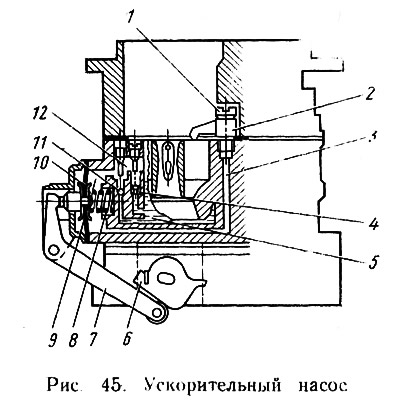
The performance test of the accelerator pump usually begins with an external examination. It is important to make sure that gasoline does not leak from under the pump cover. Its leakage suggests that the diaphragm is faulty. Next, you can check the performance of the pump. It is enough to remove the air cleaner cover and turn the lever 6. A full and even jet of gasoline from the atomizer 2 will dispel all fears about the accelerator pump. Otherwise, you will have to blow out the system with compressed air or (if purge fails) disassemble and check every detail until the cause is found. When checking, we advise you to pay special attention to the lever 6 and its spring. And one more thing: make sure that during operation the roller of lever 7 does not jump off lever 6.
If you forgot about the carburetor and haven’t looked into it for a long time, then the possibility is not ruled out that the ball valve 11 has lost its mobility (pitched in). Pulling the ball out of the socket is a delicate job, but with the help of a pointed beard you can remove it. After the ball is removed, it and the seat are washed with a solvent (acetone or gasoline) and set the ball in place.
For all VAZ car models, a normally operating accelerator pump should inject from 5.25 to 8.75 cm3 in 10 full strokes3 or 3.5 to 4.5 cm3 gasoline for car VAZ-2105. For those who wish to find out the performance of the accelerator pump, we remind you that before starting the test, you must first make 10 trial runs (lever turns) to fill the channels of the pump with fuel.
If the normal temperature regime of the engine is disturbed (in this case, the engine overheats), You won't get maximum power. On VAZ vehicles with a working cooling system, the thermometer needle after the engine warms up is installed in the center of the device (regardless of the ambient temperature and the nature of the movement). On models where electric fans are installed, the arrow deviates to the red zone, and this is provided for by the design. Engine overheating is a serious malfunction leading to engine failure. If such a defect occurs, check:
- coolant level in the expansion tank and, if necessary, (if the level is below the risk «min» side of expansion tank) refill;
- fan drive belt tension (if it is loose, the belt may slip and intermittently rotate the water pump pulley) and, if necessary, tighten;
- thermostat operation and intervene if necessary.
It is possible that the engine is overheating due to the radiator. In the absence of a special liquid Tosol, some motorists pour water into the radiator. The resulting scale can clog the radiator tubes and practically disable part of the radiator area. They fight this defect with the help of a special preparation for descaling. The removal technology is indicated on the drug packaging. Pervouralsk Khrompikovy Plant produces the drug «Icarus». It not only prevents the formation of scale, but also protects parts of the cooling system from corrosion.
It may happen that you do not find any of the above reasons, but the engine did not develop full power, and does not develop. Considering that miracles do not happen, there is still a reason, and, most likely, it is hidden inside the engine. Burning or deformation of valves, burning of a piston, breakage or burning of piston rings, excessive wear of cylinders - this is a list of defects that can cause loss of power, and which of them specifically will be shown by an inspection in a service station.
With the advent of new car models VAZ-2105 and VAZ-2107 new reasons also emerged. So, for example, when accelerating or driving uphill, the engine suddenly starts to work unevenly, with a loss of power. Most often this is due to the vacuum ignition timing controller. It must rotate the movable plate along with the contacts, depending on the change in engine load, changing the ignition timing accordingly.
The movable plate is mounted on a ball bearing and, if it rotates unevenly with jamming, the breaker contacts work inconsistently with the camshaft cams, and therefore do not provide the optimum ignition timing.
You can check that this is the reason by turning off the vacuum regulator, disconnecting the hose and plugging it. If the engine has improved its performance, then you can drive like this until it becomes possible to replace or repair the regulator.
But it happens that the movable plate oscillates relative to the horizontal plane, again due to the bearing. In this case, nothing will be achieved by the previous method, i.e., disconnecting the hose. The distributor needs to be repaired or replaced, but if the distributor of the old model is in stock (from the car VAZ-2101) you can temporarily use it.