

Increased oil consumption is the result of two types of faults:
1) violation of the tightness of the joints of engine parts and assemblies, due to which the oil flows out. The defect, as a rule, occurs due to loosening of the mating parts (cylinder head covers, cylinder head, fuel pump - cylinder block, cylinder block - sump, etc.) or deformation of gaskets;
2) failure in the operation of parts of the crank mechanism; wear of piston rings, pistons or cylinders; occurrence of piston rings in the grooves of the pistons; breakage of piston rings; damage to valve stem seals; increased wear of the valve stem or guide bushings. These defects occur due to prolonged operation of the engine with overheating. Oil easily enters the combustion chamber and is already half-burnt thrown out of the muffler. In order to correctly assess the malfunction, based on emissions from the muffler, we remind you that blue exhaust smoke occurs when oil enters the combustion chamber, black smoke - when the mixture is rich, white - when coolant enters the combustion chamber. Spark plugs are also not left unattended, more and more often they have to be removed and burned.
You should not worry when film oil stains appear in certain places of the engine. This is not criminal. Another thing is when the oil clearly tends to penetrate through leaks in the joints and, mixing with dust, contaminate the surface of the engine. The places of possible oil penetration are well studied.
If dirt periodically forms along the contact contour of the timing cover with the cylinder head, either the gasket is to blame, or insufficient uneven tightening, or protrusion of the gasket from under the flanging of the cover.
The approach to the front of the engine is inconvenient, and oily dirt tends to accumulate there. The reason is the loosening of the camshaft drive cover. The heads of the bolts that secure the cover fit a 10 mm wrench, and if the key shaft is artificially lengthened, it will not be difficult to tighten the cover fastening.
If you open the hood and find more and more oil stains around the oil filler neck, you should rinse the filler cap well in gasoline. The culprit for oil penetration and contamination of the front and rear parts of the engine in the crankshaft area are usually oil seals. Here it is necessary to realistically assess the situation. If only a small area is oiled directly at the crankshaft pulley and crankcase cover, then there is no reason to replace the oil seals.
Dealing with all kinds of oil leaks is unpleasant, but not so difficult, if only because it is clear where it is flowing from. It is more difficult when the reason is not clear. If there are suspicions that the parts of the crank mechanism are faulty, it is necessary to contact specialists.
So, when the muffler emits blue smoke, the reason is clear. The engine will be dismantled and, most likely, a number of parts will be replaced. But it happens that everything is fine with the exhaust gases, there are no traces of oil leaks, but the oil still disappears. The reason will become clear if one or more engine cylinders periodically refuse to work. Remove the spark plug or plugs from these cylinders and you will see that they are splattered with oil. Refused to work rubber oil deflector cap 10 (see fig. 47), and the oil got the opportunity to enter the combustion chamber.
The cap costs a penny, and the work to replace it is more than 25 rubles. Naturally, experienced motorists solve this problem on their own, although to solve the problem, preparatory work is required to dismantle the parts that interfere with the approach to the caps and to manufacture the appropriate equipment and, above all, the device shown in Fig. 49.
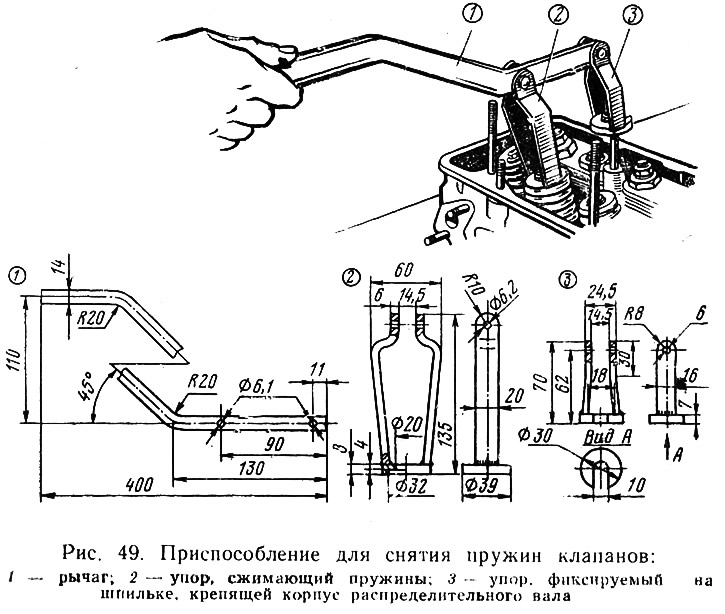
The operation must be performed with an assistant in the following order:
- using the crank or a special key to turn the crankshaft of the car engine VAZ-2105 and VAZ-2107 turn the crankshaft to such an angle that the piston in the cylinder under study reaches top dead center;
- given that the chain or belt is free from tension, it is necessary to artificially roll the gear over the chain. This work should be done by an assistant;
- with the aid of a device (see fig. 49) remove valve springs. To hold the valve in place, an assistant with a long screwdriver or a metal rod with a diameter of 9-10 mm and a length of 300 mm should hold the valve, acting through the spark plug hole. To prevent all sorts of accidents, the device (its working body) and it is advisable to cover the spring being removed with a rag at the time of dismantling the valve;
- prying with two screwdrivers at the bottom edge of the cap, remove it. When performing this work, care must be taken, since one unsuccessful movement with a screwdriver and the thin-walled part of the valve guide sleeve is deformed and it is necessary to remove the block head to replace the sleeve;
- press a new cap using a mandrel, a tube of suitable diameter. The main thing is that the cap sits in its place without skew, since a new one, but installed skewed, will not be able to keep the oil from penetrating to the candle.
Having completed the work on replacing the cap, it is necessary to install all the previously dismantled parts, and then carry out adjustment operations similar to those performed after replacing the engine camshaft.