

Sometimes a defect can be identified by a specific smell that burnt friction linings emit. There is another old way of determining clutch slip. To do this, with the engine running, tighten the parking brake to failure, press (turn off) on the clutch pedal, gently depress the throttle control pedal and slowly release the clutch pedal. If the engine stalls when the clutch pedal is fully released and the fuel control pedal is fully depressed, then the clutch is normal. When the clutch slips, the engine, despite all the manipulation of the pedals, continues to work. What are the underlying causes of incomplete engagement of the clutch?
1. There is no or very little free play in the clutch pedal.
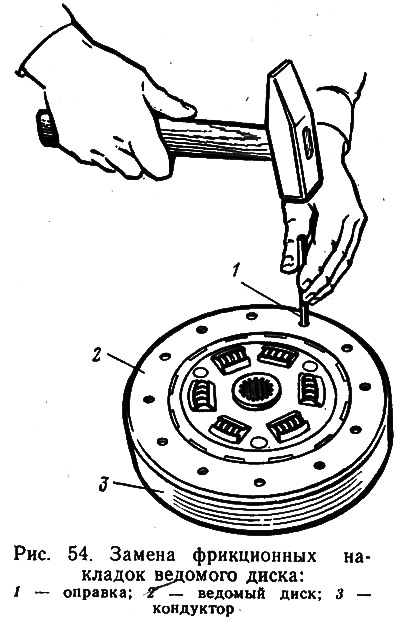
2. Friction linings of the driven disk are worn out or burnt out. Usually worn discs are replaced with new ones, but this is not necessary. If everything is in order with the disc, except for worn friction linings, they can be replaced. To do this job, new friction linings and rivets are needed. For those who will be replacing pads (pic. 54), you need to know the following:
- the lining is considered completely worn out if the distance between the rivet and the working surface of the lining is less than 0.2 mm;
- linings must be replaced if cracks appear on their surface;
- flared rivets should not have gaps;
- runout of the working surface of the friction linings should not exceed 0.5 mm.
3. The friction linings of the driven disk, the surface of the flywheel and the pressure plate are oiled. Naturally, in this case, first of all, it is necessary to find out where the lubricant came from, and only after detecting and eliminating the penetration of the lubricant, disassemble the clutch and thoroughly rinse the oily parts in gasoline, wipe dry and lightly sand the lining.
4. The rubber parts of the main and slave cylinders of the clutch swelled and blocked the compensation hole due to the ingress of mineral oil, gasoline or kerosene into the hydraulic system.