

Premature tread wear
The tire is one of the most important elements that affect the safety of traffic and the duration of the entire vehicle. A tire is quite an expensive thing, and its price is a convincing argument expressing the complexity of the design and the conditions in which the tire has to work. Everyone who drives a car should remember that the tire experiences heavy loads during movement, which increase during acceleration, braking and cornering. For a car to move at a speed of 100 km / h, the wheels must rotate, making over 900 rpm. How hard it is for a tire can be appreciated by remembering that only a small part of the tire, i.e., its contact patch with the road, takes all the loads.
These are the so-called objective, regular conditions for the operation of tires. However, there are also subjective reasons that affect their service life. These are: driving style, cruising speed, frequency of brake application, wheel alignment, balance and tire pressure.
To use tires competently and economically, you need at least a minimum of information about them.
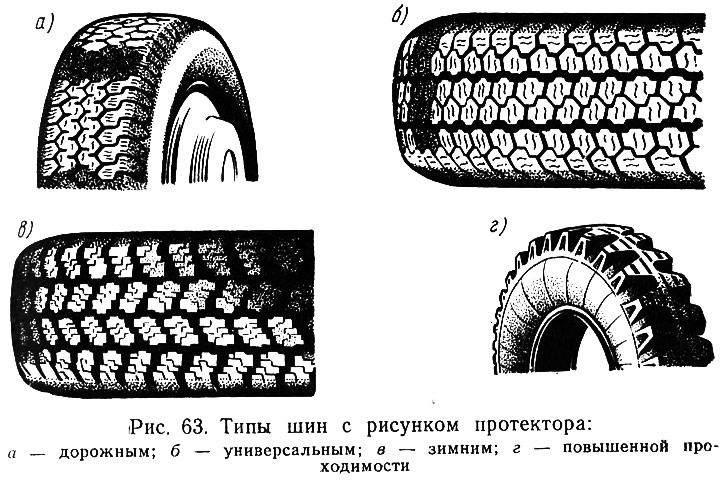
Depending on the purpose of the car and operating conditions, tires with four types of tread pattern are used (pic. 63): road, universal, winter and cross-country.
It is not easy for a car enthusiast when he needs to drive in a city-type car to places where asphalt ends, or drive in winter. No better for the car owner VAZ-2121 «Niva», if he mainly travels on city highways. A good option is to have two sets of tires, but not everyone can afford it. When buying a new set of tires, it is necessary to analyze the conditions for the upcoming operation, weigh all «behind» and «against», as well as to study the possibilities and features of each type of tire -
The creators of tires strive to design a tread in each new sample, which would have: increased wear resistance, reliable grip with the road surface; improved damping qualities that could dampen shocks and shocks transmitted to the tire carcass, protect the tube and carcass from mechanical damage, and reduce the vibrations transmitted to the transmission.
The very name of the tread pattern is a kind of tire passport. In order to have something to compare with, we will take a tire with a tread that has a road pattern as a starting point (see fig. 63, a). The main advantage of this type of pattern is a very dense accumulation of elements separated by narrow grooves and furrows. This density provides the tire with reliable grip on any hard dry or wet surface. A serious disadvantage of these tires is their unsuitability for driving on muddy and snowy roads. Mud and snow instantly fill the narrow grooves, and the tire turns into a smooth skating rink.
For driving on unpaved smooth roads, tires with a universal pattern are most suitable (pic. 63b). The tread elements are located loosely. Sufficiently wide transverse and longitudinal grooves allow the dirt accumulated in them to be removed without much difficulty. It should be remembered that a loose pattern reduces the contact area, and therefore increases the specific load. This leads to increased wear of tires with a universal tread pattern by 10-15% when driving on asphalt relative to tires with a road pattern.
Considering that most modern passenger cars are all-weather, there was a need for wide profile tires (in a figurative sense), capable of replacing tires with road and universal patterns in inclement, snowy weather. To provide such a compromise solution, the tread of tires with a winter pattern (pic. 63, in) It is composed of separately located blocks, the area of which is 30-35% less than the area of contact between the tires and the road pattern.
Even such relative versatility of tires with a winter tread pattern does not exclude the increased wear of these tires when operating on paved roads compared to tires with a road pattern. This is especially noticeable with an increase in air temperature. Tires emit increased noise and, most importantly, fuel consumption increases.
The best option for using tires with a winter pattern is to use them in winter together with studs. Use off road tires (see fig. 63, g) useful only if they are used for their intended purpose. For driving on paved roads, they are not suitable either from the point of view of economy or from the point of view of traffic safety. Tires wear out very quickly, you need to drive 2 times slower than on tires with a road tread pattern. Constant vibrations adversely affect the general condition of the car and its units. Tires create increased noise and cause significant fuel consumption.
In order to freely understand the data indicated on the sides of tires of different models, you need to know what information each letter and number carries, cast or applied to the tire. First, the tire size is indicated, and then all other data: model; marking «Steel» for tires with steel cord breaker and marking «Radial» for radial tires; the maximum allowable speed; sign «M-S» on tires with a winter tread pattern; load index; inscription «Tubeless» on tubeless tires; direction of rotation with a strictly directional tread pattern. In addition to the above data, the letter E may be on the tire - an attestation mark in accordance with the Rules of the Economic Commission for Europe (EEC) UN. And that is not all. A group of numbers and letters printed without any intervals, for example, 114Я200133, will tell you that tire No. 200133 was made in Yaroslavl in the 11th week of 1984.
Each new tire model, of course, is more perfect than its predecessor. The well-proven tire MI-166 was replaced by the universal tire of the Bobruisk Association IN-251, designed for cars VAZ-2105 and VAZ-2107, and hence for all other VAZs. This is the first domestic model in which the ratio of the height of the tire profile to its width is 70%. Marking of this tire: 175/70 13. Official tests confirmed that the mileage of IN-251 tires lies within 56-58 thousand km, which is 25% higher than the mileage of MI-166 tires. In addition, fuel consumption when installing these tires is reduced by 2%.
Given that radial tires are the most widely used, let us dwell on the issues of operating such tires in more detail. The radial design is primarily sidewalls of increased flexibility. Thanks to this quality of the sidewalls, the contact patch of the tire with the road is increased, which ensures good grip and increased vehicle stability when driving. However, radial tires have one very weak spot - all the same sidewalls. When the wheel hits, the weakest point is destroyed - the sidewall. Therefore, driving on radial tires over stones and potholes is an unreasonable occupation. To overcome such sections, it is necessary to reduce speed to a minimum and exercise special care.
Using radial tires, you need to learn how to carefully drive up to the sidewalks, remembering that even on a good asphalt city road, you can damage the tire in an instant, unsuccessfully hitting it on a curb.
It has long been known that low tire pressure is one of the causes of premature tread wear. On diagonal tires, the pressure drop is immediately noticeable. Radial - often mislead the motorist. The fact is that thanks to the elastic carcass, the inflated tire seems to be lowered to the norm. This phenomenon lulls the vigilance of motorists, since the decrease in pressure from 0.19 to 0.12 MPa is practically not noticeable to the eye, and at this time the tires wear out intensively. Do not be lazy, leaving, once again check the pressure in the tires. The attention paid to them pays off handsomely.
And the last. There are cases when, for unknown reasons, it is not possible to eliminate the puncture of the camera on its own. The secret is that often radial tires are equipped with tubes made of butyl rubber. Such rubber is used to minimize the penetration of air through the walls of the chamber, and therefore, to eliminate the need for periodic tire inflation. Repair of the butyl rubber tube must be done with raw butyl rubber. Different materials are incompatible. Distinctive features of these chambers are a yellow BK stamp or a yellow stripe applied on the side facing the wheel disk.
In order for the tread to wear naturally, without accelerating causes, it is necessary to know exactly what are the main factors that affect wear. First of all, they are: wheel alignment, imbalance and air pressure in tires.
The wheels of VAZ vehicles require a comprehensive and accurate check. This can be done qualitatively only on stands that are regularly calibrated. If the wear is uniform and does not cause alarm, it makes no sense to drive the car for inspection. If the need to check the wheel alignment is ripe (accidental wheel strike, driving on a bumpy road, etc.), it is advisable to conduct an express check, as they say, «hastily». For this purpose, it is desirable to have simple devices with which you can control the toe and camber at any time.
Toe-in is usually checked with traditional sliding rulers. They are on sale, and it is not difficult to make them yourself. To control the camber at home, it is more convenient and more accurate to use the levels. The simple design of such a device (pic. 64) offered by one of the car enthusiasts.
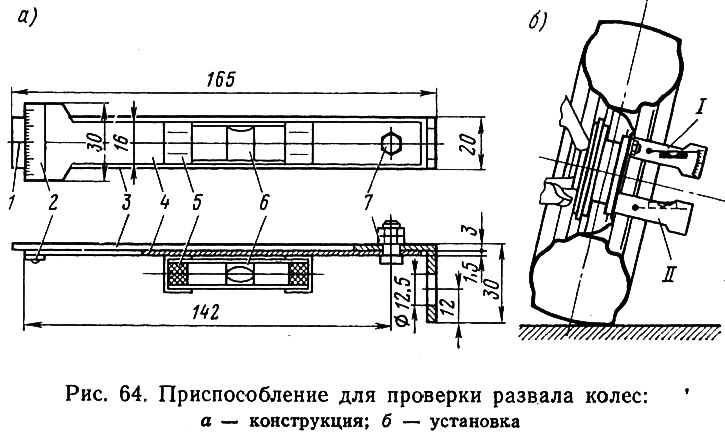
A rotary bar 4 is attached to the base 3, and a level 6 installed in the frame 5 is attached to it. A scale 2 with a division value of 1 mm is also fixed on it. The main condition in the manufacture of fixtures is to ensure a distance of 142 mm from the axis of the bolt 7, which secures the fixture, to the edge of the scale. Subject to this size, moving the scale by one division (1 mm) will correspond to the rotation of the bar by an angle equal to 24 '.
To control the angles of the wheels, a horizontal, level platform is required. The check sequence is as follows:
- set the wheels of the car to the position of rectilinear movement;
- ensure tire pressure according to the instructions, taking into account the type of tires;
- make a few clicks on the front of the car from top to bottom, which will ensure the normal position of the suspension parts;
- fix the device with the wheel bolt, which is at this moment in the upper position I;
- by turning the bar 4 up or down, set the air bubble to the middle of the level and note its position relative to the risk on the base;
- move the car forward or backward to position II, when the device is at the bottom;
- re-set the level bubble to the middle and determine how much the scale has shifted relative to the first position. This value, divided by 2 and converted to degrees (remember, 1 mm equals 24') gives the camber angle. Do the same with the other wheel.
The collapse is considered positive if in the second case, to set the bubble to the middle position, the bar with the level has to be turned up.
Camber angles are adjusted by removing or installing additional washers between the lever axis and the cross member. To increase the angle, the same number of washers must be removed from both bolts. To decrease, add. Part of the shims has been removed (slightly larger than the bolt diameter), therefore, when removing or installing washers, it is only necessary to unscrew the bolts a few turns.
Unbalanced, unbalanced tires cause a lot of trouble. Firstly, - imbalance - a violation of the mass of the wheel, which leads to its intensive wear. Secondly, the imbalance causes the vehicle to vibrate under certain driving conditions, and thirdly, the stability and controllability of the vehicle deteriorate. The unbalance of the wheel can be made up of the imbalance of the tire, disk, uneven density of the material of the chamber and tire, and a number of other factors.
To eliminate imbalance, the wheels are subjected to static and dynamic balancing, i.e., processes that first determine the magnitude and direction of unbalanced forces, and then eliminate them. The most perfect balancing method is dynamic, however, its implementation requires rather complex equipment, so dynamic balancing must be performed at the station.
True, operating experience confirms the opinion that when driving at speeds not higher than 90 km / h, one can limit oneself to only static balancing.
Static imbalance is, simply put, the presence of a heavy place in the wheel. When the car is moving and the wheel speed is increased, this heavy place creates sharp impacts of the tire on the road. There is no need to comment on the results of such strikes.
To statically balance a wheel, proceed as follows:
- a wheel put on a device simulating an axle is mounted on two prisms;
- providing the wheel with rotation, give it the opportunity to stop on its own. Having a heavy seat will cause the wheel to stop in a position where the heavy seat is at the bottom. After repeating the experiment several times, they are convinced of the stable location of the heavy place;
- after the wheel stops, a weight is placed on the upper part of the rim and the wheel is spun again. When the weight of the weight is chosen correctly, the wheel will stop in a different position.
To ensure the most uniform placement of weights at home, you must remember that:
- if the mass of the weight does not exceed 80 g, it is divided in half and each half is installed respectively on the inner and outer edges of the rim;
- if the mass of the weight exceeds 120 g, then most of it (80 g) installed on the inner edge.
Driving the vehicle away from straight ahead
The appearance of this defect should alert the driver, as the car loses its maneuverability, resists the driver, and all together affects traffic safety.
What causes a car to be stolen? There are several reasons. The most frequent: different air pressure in the left and right tires; violation of the angles of the front wheels; deformation (due to impact) suspension arms; incomplete release of one of the wheels; loss of elasticity of one of the front suspension springs; displacement of the rear axle from the vehicle axis due to deformation of the rear suspension rods.
Check the pressure in the tires after they have cooled down to ambient temperature. The right and left tires must have the same pressure.
The correct alignment of the front wheels must be regularly checked on special stands that are available at each service station. When installation angles cannot be adjusted, «guilty» deformed front suspension arms. More often the lower arms are deformed. If you find a deformation of the lever, it must be replaced.
Incomplete release of one of the wheels can be determined by touch. The disk of the wheel on which suspicion fell must be hot. If this is indeed the case, it is necessary to find out the cause of the braking, i.e., disassemble the wheel cylinder and eliminate the defect.
If one of the springs has lost its former strength, it will immediately give itself away - it will shrink more than its partner and warp the car. The replacement of the spring, the front suspension arm and the elimination of such malfunctions as the displacement of the rear axle, violation of the installation angles of the front wheels, must be done «and service stations, since in these cases you cannot do without special devices and stands.