




Only experienced specialists and at least a tester can check the starter's serviceability. Everyone else can only check the reliability of the wire connections and the absence of external breaks.
It's easier with the ignition switch. There is a plate on the back of it, with wires attached to the contacts using plugs. It happens that the plug disconnects and the circuit breaks. Therefore, it is useful to check the fastening of the wires. The contacts can also oxidize and then they lose conductivity.
To get to the ignition switch contact plate, you need to remove the upper and lower halves of the steering wheel casing. To tidy up burnt or oxidized ignition switch contacts, you don't have to remove the switch itself. The contact plate is held in the switch housing by a spring ring, which is very easy to remove by prying it off with a thin screwdriver blade. Before removing the retaining spring ring holding the plate with contacts, remove the "negative" terminal of the battery. This precaution will save you from a short circuit if you are careless with the wires leading to the ignition switch. After removing the ring, you can take out the plate with contacts. If the contacts are not very worn, the malfunction can be eliminated by cleaning. When the contacts are completely worn out, the entire contact plate, or even the entire ignition switch, is replaced (due to lack of plates).
To remove the ignition switch with the steering wheel cover removed, unscrew the two screws that hold the switch in the holder. Then place the ignition key in the lock in a horizontal position and press the spring plate of the lock from the left through the hole in the holder, which will release the lock from the steering wheel anti-theft device. Install the ignition switch in the reverse order.
If one of the ignition switch terminals breaks off on the way, the wire can be put on any free terminal, and the lock will work again. It also happens like this: the starter is working, but the engine does not start.
This can happen in three cases:
- 1) fuel does not enter the carburetor;
- 2) there is no spark capable of igniting the mixture;
- 3) The air damper remains closed when not needed.
1. The indicator should inform about the presence of fuel in the tank, although it may also have malfunctions. In extreme cases, you can dip a clean twig into the neck of the fuel tank. If the tube from the fuel tank to the pump is not clogged, then the presence of gasoline can be detected by removing the tube from the pump nipple.
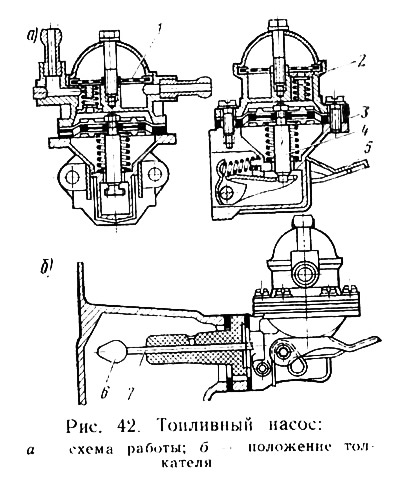
Let's assume there is fuel. Then it's the turn of the fuel pump (Fig. 42). Remove the tube going to the carburetor and pump it a few times using manual drive 5 of the pump. Its operability will be immediately clear. However, there is one nuance: the manual pumping mechanism will be inactive if pusher 7 is located at the top of eccentric in, and rod 4 of diaphragm 3 is, accordingly, in the extreme lower position. You just need to turn the engine crankshaft one revolution using the starting handle, the eccentric and rod will take a different position, and the manual pumping mechanism will work again. If the check showed that the fuel pump is unable to supply fuel upward to the carburetor, you need to sort it out. Wear or damage of diaphragm 3, clogging or sticking of valves 2, clogging of filter 1 or loss of tightness are the main reasons for the fuel pump failure. First of all, you need to check the tightness of the fuel pump, as this is fraught with a fire. In addition, it is economically unprofitable. And one more thing. A breach of tightness allows air to penetrate into the pump, into the vacuum cavity.
2. If we exclude the fuel system, the ignition system may be the cause of the engine's inaction. For some reasons that are still unknown to us, the ignition system is unable to create a spark that could ignite the mixture compressed in the combustion chamber.
The ignition system has two circuits: low and high voltage. The low voltage circuit includes: battery - ignition switch - primary winding of the ignition coil - capacitor - breaker contacts. The high voltage circuit consists of the secondary winding of the ignition coil - central high voltage wire - distributor cap carbon - rotor - distributor cap - high voltage wires - spark plugs.
In the case under consideration, the engine crankshaft is turned by the starter, therefore, the battery is in good condition. Check for a spark between the spark plug high-voltage wire and the ground. To do this, remove one wire from the spark plug, expose the end of the wire (the cap is moved up) and install it so that there is a gap of no more than 5 mm between the end of the wire and the ground.
Turn the crankshaft using the starter or starting handle. A spark should jump between the wire and the ground. If the spark jumps on all the wires (each wire is checked separately), then the only possible causes may be spark plugs. If there is no spark on any of the wires, then it is necessary to check the high-voltage wire itself and the distributor cap. If there is no spark on any of the spark plug wires, then the central wire is removed from the distributor cap socket and the presence of a spark between it and the ground is checked. The following options may occur during the check:
- when the crankshaft rotates, there is a spark between the central wire and the ground. In this case, the fault is in the distributor (cover, rotor with resistor, coal);
- when the crankshaft rotates, no spark occurs. In this case, it is necessary to check the low-voltage circuit: close the breaker contacts and, using a test lamp, check for voltage on all elements of the low-voltage circuit from the contacts to the battery.
If the low voltage circuit is in good condition, and when the contacts are opened, a spark jumps between them, then the defect is in the ignition coil (in the secondary winding). When there is no spark between the contacts, the cause should be sought primarily in the contacts themselves, i.e. how clean are their surfaces and what is the gap between them.
(The original is on the portal: «VAZbook.ru»)
If the cause is not in the contacts, it is necessary to connect the test lamp wire to the "ground" and with the contacts open and the ignition on, touch the other end of the test lamp wire first to terminal B, and then to the terminal without a designation. Most often, the lamp will not flash when in contact with the unmarked terminal. In such a case, many drivers believe that the cause is in the ignition coil, but there is another reason - the plastic washer to which the breaker wire is attached. The washer gets oily, as a result of which the insulation of the moving contact is damaged.
When there is a current leak due to cracks in wires, caps and other parts, the leak location is easiest to determine in the dark. A jumping spark is clearly visible in the dark.
Often, an engine with a functioning fuel system cannot be started due to faulty distributor cap or rotor. Cracks, heavy contamination, loss of carbon electrode - these are the main reasons. They are eliminated by replacing low-quality parts with new ones. Sometimes, if the malfunction caught you on the road, and there are no new parts, they try to repair the cap or rotor. They find cracks, clean them, wipe them and fill them with BF glue, if you happen to have it at hand.
Another method of repairing the rotor (runner) has been tested. It is removed by unscrewing two screws, a double-folded polyethylene bag is placed on the centrifugal machine, and then the broken rotor is installed in place. All that remains is to cut off the protruding ends of the film and install the cover. To reduce the likelihood of a rotor breakdown, some car enthusiasts apply several layers of varnish or a thin layer of epoxy resin to the inside of the new runner (rotor). When a coal is lost, it can be temporarily replaced by either a coal from a flashlight battery or an ordinary willow rod, but damp. As you can see, the most persistent and inquisitive achieve their goal and reach the service station. However, it is not always possible to detect a malfunction by moving forward along the chain.
If, for example, no manipulations can produce a spark, touch the ignition coil. It should be hot. This is a symptom of an interturn short circuit. Such a coil must be replaced.
The high-voltage wires and spark plugs are left. The wires can fail if they are very old with cracked insulation or very dirty, especially at the tips. Regularly monitoring their condition is a must, and if the wires have served their purpose, replace them along with the caps.
When searching for a malfunction that causes difficulties when starting the engine, one cannot ignore the moment of ignition timing.
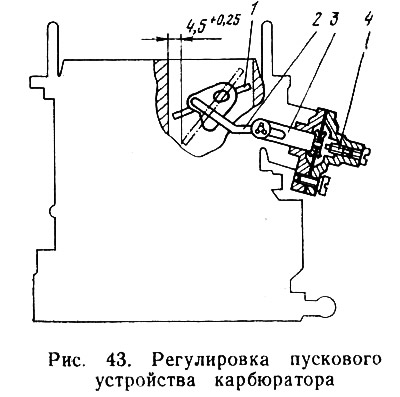
3. A significant factor affecting engine starting is the position of the carburetor air damper at the first sparks in the cylinders. To understand why the air damper is closed when it is not required to be, you should familiarize yourself with the starting device (Fig. 43) of the carburetor. The starting device mechanism is located in the carburetor itself, and the control drive (handle, cable and cable sheath) - outside of it.
The starting device (choke) drive works normally if the rod with the handle moves easily, without jamming. When the handle is pushed in all the way, the air damper should be fully open and vice versa. The quality of the drive operation can be easily checked if you remove the air cleaner and look into the carburetor.
It should be remembered: when the starting device drive handle is fully extended, the air damper should open by 4.5±0.25 mm using rod 3. A cold engine running with the starting device drive handle fully extended has a crankshaft speed of 1800-2500 rpm. Adjustment of the position of the air damper 1, and therefore the specified crankshaft speed, is achieved by bending rod 2 or turning screw 4. By unscrewing screw 4, we weaken the pressure on the diaphragm, and the air damper opens to a larger angle.
It happens that you do not achieve the required results by turning the adjusting screw 4. Then you have to unscrew the screws, remove the cover of the starting device housing and find out the reasons.