




Contents: Differential assembly ↓ Installing and adjusting the drive…↓ Tightening the pinion bearings ↓ Installing the differential box ↓ Checking the contact of the working…↓
Differential assembly
Install the axle shaft gears with support washers and satellites into the differential box. Turn the satellites and axle shaft gears so as to align the rotation axis of the satellites with the rotation axis in the box, then insert the satellite axis.
Check the axial clearance of each axle gear. It should be no more than 0.10 mm. If the clearance is increased, which is a sign of excessive wear of the gears, replace the support washers of the appropriate thickness. If the specified clearance cannot be obtained even when installing washers of the greatest thickness, replace the gears with new ones.
The driven gear is installed and the inner bearing rings are pressed onto the differential box using the A.70152 mandrel. The mandrel is made of a pipe with an outer diameter of 43 mm and an inner diameter of 35.2 mm.
Installing and adjusting the drive gear
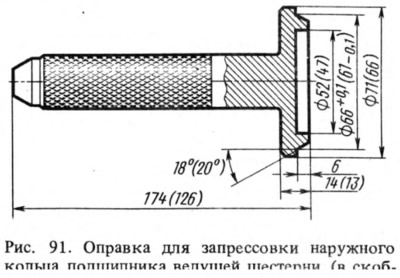
Having secured the gearbox housing on the stand, press the outer rings of the front and rear bearings of the drive gear into the housing sockets, using mandrels for this purpose. A.70185 for the front bearing and A.70171 for the rear (Fig. 91).
On the A.70184 mandrel (7 — Fig. 92), simulating the drive gear, install the inner ring of the rear bearing and insert the mandrel into the neck of the gearbox housing. Install the inner ring of the front bearing, the flange of the drive gear and, turning the mandrel for correct installation of the bearings, tighten the nut (tightening torque 0.8-1 kgf·m).
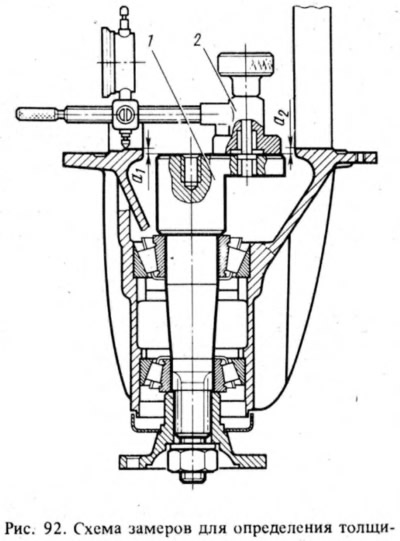
Fix the device (A.95690) on the end face of mandrel 1 and adjust the indicator, which has a division of 0.01 mm to zero, by installing its leg on the same end face of mandrel A.70184. Then move the indicator so that its leg stands on the seating surface of the differential box bearing. By turning the mandrel with the indicator left and right, set it in such a position in which the indicator arrow marks the minimum value a ₁, and record it. Then repeat this operation on the seating surface of the second bearing and determine the value a ₂.
After this, the thickness S of the drive gear adjusting ring is determined, which is the algebraic difference between the values a and b, i.e., where a = (a ₁ + a ₂)/2; b — deviation of the drive gear from the nominal position, mm. The deviation value is marked on the drive gear in hundredths of a millimeter with the sign "+" or "—".
When determining the thickness of the adjustment ring, the sign of the quantity b and its unit of measurement should be taken into account.
Example. Let's assume that the value a set with the indicator is 2.91 mm (but always positive), and on the drive gear after the serial number there is a number minus 14. To get b in millimeters, you should multiply this number by 0.01, i.e. b = -14 0.01 mm = -0.14 mm.
We determine the thickness of the adjusting ring for the drive gear in millimeters:
S = a - b = 2.91 - (-0.14) = 2.91 + 0.14 = 3.05 mm.
In this case, it is necessary to install an adjustment ring with a thickness of 3.05 mm.
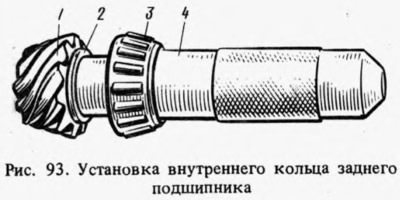
Place the adjusting ring 2 of the required thickness on the drive gear 1 (Fig. 93) and press on the inner ring 3 of the rear bearing, removed from the mandrel A.70184, using the mandrel 4 (A.70152). Place the spacer sleeve on.
When repairing a gearbox, it is necessary to install a new spacer sleeve if the gearbox housing, main gear pinion or pinion bearings have been replaced. If the specified parts remain the same, the spacer sleeve can be reused.
Insert the drive gear into the gearbox housing and install the front bearing inner ring, mud deflector, oil seal, drive gear flange and washer on it. Screw a nut onto the end of the drive gear and, having locked the drive gear flange, tighten it (tightening torque 12-26 kgf·m).
Tightening the pinion bearings
To limit axial displacements of the pinion gear under operating loads, it is very important to create a preload in its bearings within specified limits. The preload is controlled by a 02.7812.9501 dynamometer, which allows measuring the moment of resistance to pinion rotation. This moment determines the degree of bearing tightening. It should be 16-20 kgf cm for new bearings and 4-6 kgf cm for bearings after a run of 30 km or more. The flange nut should be tightened with a moment of 12-26 kgf·m, periodically checking the moment of resistance of the bearings to pinion rotation.
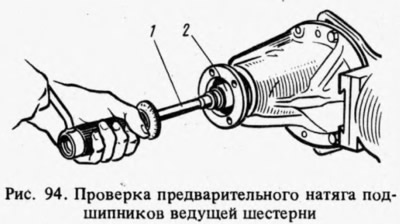
To check the moment of resistance, put the dynamometer 1 (Fig. 94) on the adapter sleeve 2 and make several turns clockwise with the handle. During the rotation of the drive gear, the dynamometer's moving indicator should not go beyond the limiter and should show at least 16 kgf cm. If the moment of resistance to rotation is less than 16 kgf cm (4 kgf cm for bearings after a run of 30 km), then it is necessary to tighten the drive gear flange nut (without exceeding the specified tightening torque) and check the torque of resistance to turning of the drive gear again. If the torque of resistance to turning is more than 20 kgf cm (6 kgf cm for worn-in bearings), this indicates that the preload of the bearings is too high. In this case, it is necessary to replace the spacer sleeve, since it has deformed due to excessive load to a size that does not allow for correct adjustment. After replacing the spacer sleeve, repeat the assembly with the appropriate adjustments and checks.
Installing the differential box
Install the pre-assembled gearbox together with the differential into the gearbox housing, tighten the adjusting nuts 1 (Fig. 95) so that they touch the bearing rings and the bearing caps. Tighten the mounting bolts.
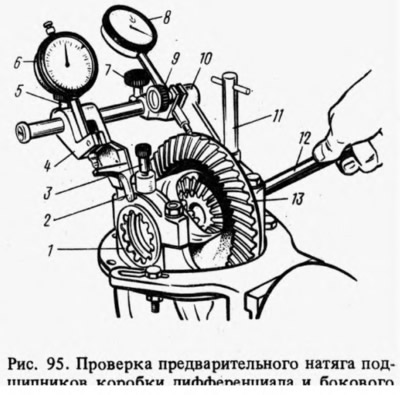
The preliminary tension of the differential box bearings and the adjustment of the lateral clearance in the engagement of the main gear gears are performed simultaneously using the device A.95688/R and the key 12 (A.55085). For this purpose, the device is secured to the gearbox housing with screws 11 and 3, screwed into the holes for the bolts for fastening the locking plates of the adjusting nuts. Bracket 4 of the indicator is moved along the guide of the device until lever 2 touches the outer side surface of the cover and screw 5 is tightened. Screws 7 and 9 are loosened and bracket 10 is installed so that the indicator leg 8 rests on the side surface of the tooth of the driven gear at the edge of the tooth. Then screws 7 and 9 are tightened.
By turning the adjusting nuts, the lateral clearance between the gear teeth is preliminarily adjusted within 0.08-0.13 mm according to indicator 8 while rocking the driven gear 13. In this case, the bearings should not have a preload. The adjusting nuts should only be in contact with the bearings. Otherwise, the correctness of the preload measurement is disrupted.
Sequentially and uniformly tighten the two adjusting nuts 1 and 2 (Fig. 96) of the bearings. In this case, the differential bearing caps diverge and the distance increases. This divergence is noted by indicator 6 (see fig. 95), on the leg of which lever 2 acts. The nuts for adjusting the differential box bearings are tightened until the distance A increases (see fig. 96) by 0.14-0.18 mm.
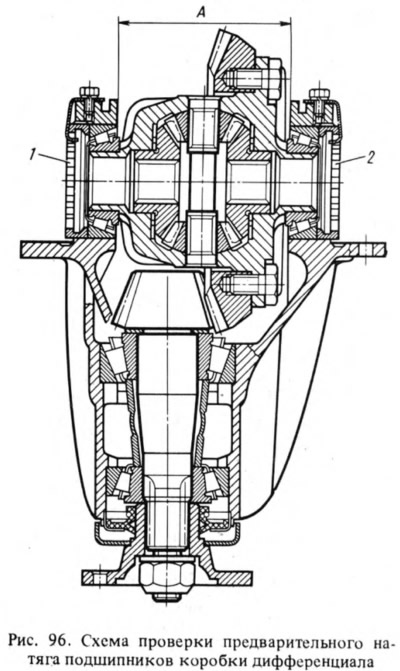
Having set the exact preliminary tension of the differential box bearings, the final check is made of the lateral clearance in the engagement of the main gear gears, which should not change. If the clearance in the engagement of the gears is more than 0.08-0.13 mm, then the driven gear is brought closer to the driving gear. If the clearance is less, then it is moved away. To maintain the set preliminary tension of the bearings, the driven gear is moved by tightening one of the bearing adjusting nuts and loosening the other by the same angle.
To accurately perform this operation, it is necessary to monitor the indicator 6 (see fig. 95), which shows the value of the previously set bearing preload. After tightening one of the nuts, the indicator reading will change as the distance A increases (see fig. 96) and preload of the bearings. Therefore, the other nut is loosened until the indicator arrow returns to its original position.
After moving the driven gear, but the indicator 8 (see fig. 95) check the side clearance. If the clearance is not within the norm, repeat the adjustment.
After adjustment, remove the A.95688/R device, install the locking plates of the adjusting nuts and secure them with bolts and spring washers. Spare parts include two types of locking plates: with one or two tabs. One or the other plate is installed depending on the position of the nut slot.
Checking the contact of the working surface of the gear teeth
To check the quality of engagement:
- install the adjusted gearbox on the stand and lubricate the working surfaces of the driven gear teeth with a thin layer of lead oxide;
- the stand is started and the rotation of the axle shafts is slowed down using the stand levers so that under load, traces of contact with the teeth of the driving gear remain on the surfaces of the teeth of the driven gear;
- change the direction of rotation and, by braking, obtain contact marks on the other side of the driven gear teeth, which corresponds to the vehicle moving backwards.
The engagement is considered normal if on both sides of the driven gear teeth the contact patch is evenly distributed closer to the narrow end of the tooth, occupying 2/3 of its length and not extending to the top and base of the tooth, as shown in Fig. 97, d.
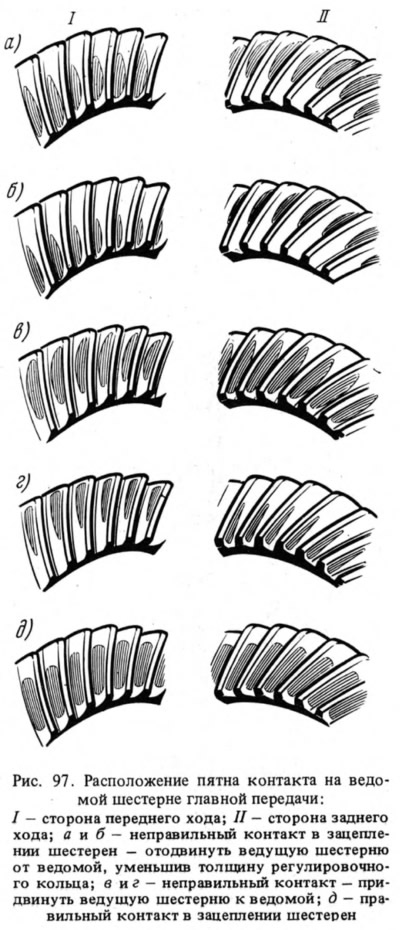
To adjust the correct position of the drive pinion with the replacement of the ring, it is necessary to disassemble the unit. During assembly, it is necessary to repeat all operations on the preliminary tension of the drive pinion bearings, on checking the torque of resistance to rotation, on the preliminary tension of the differential box bearings and on adjusting the lateral clearance of the main gear pinions.