




Anchor
1. Check with a megohmmeter or a lamp powered by 220 V to see if the armature winding is shorted to ground.
2. Voltage is supplied through the lamp to the collector plates and to the anchor core. The lamp burning indicates a short circuit of the collector plates with the ground. When checking, the megohmmeter should show a resistance of at least 10 kOhm. Replace the anchor that has a short circuit with the ground.
3. Use a special device to check for short circuits between the armature winding sections and the collector plates, as well as for breaks where the winding section leads are soldered to the collector plates.
4. Inspect the working surface of the manifold. Clean the dirty or burnt surface with fine-grained sandpaper.
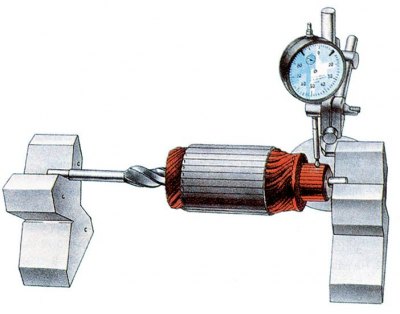
5. For the ST-221 starter, check the runout of the collector relative to the shaft journals.
6. If the runout is more than 0.06 mm, and also if the collector surface is significantly damaged, turn the collector on a lathe, removing as little metal as possible. The minimum diameter to which the collector can be turned is 36 mm. After turning, grind the collector with fine-grained sandpaper.
7. Check the runout of the core relative to the shaft journals. If it is more than 0.08 mm, replace the anchor.
8. Check the condition of the spline and journal surfaces of the anchor shaft. They should be free of burrs, nicks and wear.
9. If yellow marks from the gear bushing appear on the shaft surface, remove them with fine-grained sandpaper, as they may cause the gear to seize on the shaft.
Drive
1. The gear teeth should not have significant wear. If there are nicks on the lead-in part of the teeth, then grind them with a fine-grained emery wheel of small diameter. The gear should easily rotate relative to the clutch hub, but only in the direction of rotation of the anchor when starting the engine.
2. If the drive parts are damaged or significantly worn, replace the drive with a new one.
Stator
1. Check with a megohmmeter or a lamp powered by 220 V to see if the stator winding is shorted to ground. The voltage is supplied through the lamp to the common terminal of the winding and to the starter housing.
2. If the lamp is on or the megohmmeter shows resistance less than 10 kOhm, and also if the windings show signs of overheating (blackening of insulation), replace the housing with windings.
Lids
1. Check the caps for cracks. If there are any, replace the caps with new ones.
2. Check the condition of the cover bushings. If they are worn, replace the covers as a whole or just the bushings. After pressing in, expand the new bushings to 12.015±0.03 mm.
3. For the ST-221 starter, to replace the bushing on the collector side, first remove the plug, and after pressing the bushing, install the plug in place and punch it at three points.
4. Check the reliability of the brush holders fastening on the cover from the collector side. The brush holders of the positive brushes must not have a short circuit with the ground. The brushes must move freely in the grooves of the brush holders. Replace brushes that are worn down to 12 mm in height with new ones, having first ground them to the collector.
Traction relay
1. Check the ease of movement of the relay anchor. Check with an ohmmeter whether the relay contact bolts are closed by the contact plate. Check with an ohmmeter whether there is a break in the windings of the traction relay.
2. If there is a break in the relay windings or the relay contact bolts do not close with the contact plate, replace the relay with a new one.
3. If the relay is of a disassemblable type, it can be disassembled and the contact bolts and plate can be cleaned with fine-grained sandpaper or a flat velvet file. If the contact bolts are significantly damaged at the point of contact with the contact plate, the bolts can be turned 180°.
The text is copied from the online portal: vazbook