




Contents: Checking functionality ↓ Removal and installation ↓ Disassembly and assembly ↓ Checking the details ↓
Checking functionality
To check, place the car on a lift or inspection pit and clean the pressure regulator and protective cover from dirt. Carefully remove the protective cover from the pressure regulator, remove any remaining grease and clean the torsion-piston connection. Press the brake pedal with a force of 70-80 kgf and simultaneously observe the protruding part of the pressure regulator piston. If the piston moves relative to the pressure regulator body by 0.5-0.9 mm, while twisting the torsion lever, then the pressure regulator is operational. Continue pressing the pedal 2-3 times to fully verify the functionality of the pressure regulator. If the piston remains motionless when pressing the pedal, which indicates corrosion between the piston and the body, replace the pressure regulator with a new one.
After making sure that the pressure regulator is working properly and that there is no fluid leakage between the piston and the regulator body, apply a layer of DT-1 grease to the axle and the protruding part of the piston and, having placed 5-6 g of the same grease in the rubber boot, install it.
Removal and installation
Disconnect lever 4 (Fig. 197) from rod 7, then bracket 5 from the body and the brackets for fastening the pipes leading to regulator housing 3. Disconnect the muffler suspension parts from the body and move the pipe with the mufflers to the side.
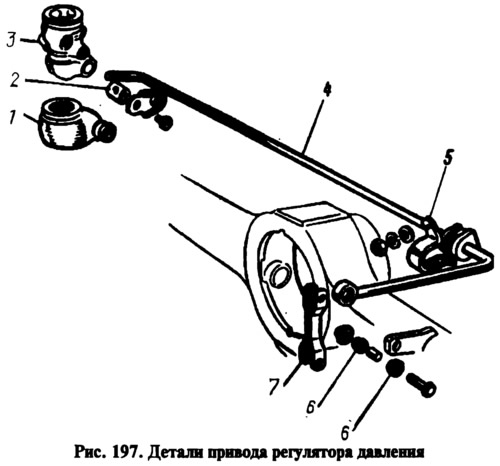
Unscrew the bolts securing the regulator to the bracket and the bracket to the body, remove the regulator mounting bracket, and then lower the regulator down, disconnect the drive lever from it. Plug the pressure regulator holes and pipes.
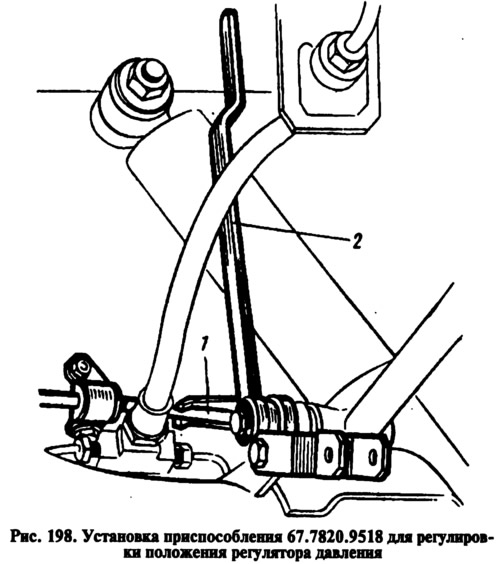
Install the pressure regulator in the reverse order with the rear axle of the vehicle suspended. Before tightening the pressure regulator mounting bolts, install the 67.7820.9518 2 device (Fig. 198) on the end of lever 1 of the drive. Direct the rod of the device upwards until it stops against the body. This sets the distance of 140±5 mm between the end of lever 1 and the body side member.
Lift the protective cap 1 (see fig. 197) and, turning the pressure regulator on the mounting bolts, make sure that the end of the lever is in light contact with the piston of the regulator. Holding the regulator in this position, tighten the mounting bolts to the limit, then cover the axle 2 and the protruding part of the piston with a layer of DT-1 grease. Install the protective cap 1 in place, putting 5-6 g of the same grease in it.
Remove the 67.7820.9518 tool and connect the end of the lever to the rod, having previously lubricated the bushings 6 of the hinge joint of the rod to the lever with DT-1 grease. Attach the exhaust system pipes to the body. Bleed the brakes to remove air from the rear brake drive.
Disassembly and assembly
Having unscrewed the plug 6 (see fig. 196) from housing 4, remove gasket 5, take out piston 10, spacer sleeve 3, seal 7, plate 8, spring 9 and thrust washer with sealing ring 2. When assembling, lubricate all parts with brake fluid and install in the reverse order.
Checking the details
Wash the parts with brake fluid and inspect. The surfaces of the parts should not have visible scratches or irregularities. Replace damaged parts, as well as the seal and sealing ring. Check the elasticity of the spring, while its length in a free state should be 17.8 mm, and under load 7+0,8-0,4 kgf - 9 mm.
[The material is posted on the website: VazBook.ru]