




Main dimensions of the camshaft and bores in the camshaft bearing housing
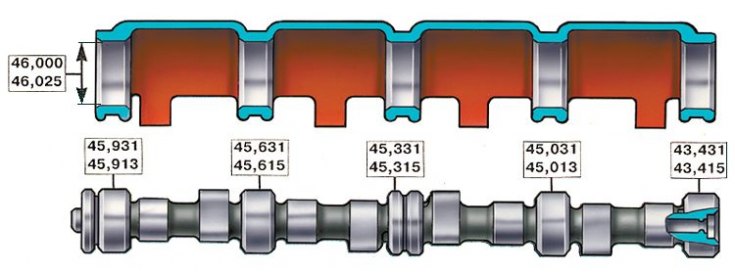
The camshaft is cast iron and rotates on five bearings in an aluminum cast bearing housing mounted on the cylinder head. It is held from axial movement by a thrust flange placed in the groove of the front bearing journal of the shaft. The main dimensions of the camshaft and the camshaft bearing housing are shown in the figure.
On VAZ cars manufactured before April 1982, camshafts with cams and bearing journals hardened by high-frequency currents were installed. Since April 1982, nitrided camshafts have been installed. Since 1984, the year of manufacture has been marked on the shafts. Since 1985, camshafts with cam whitening have been installed; these shafts have a distinctive hexagonal belt between the 3rd and 4th cams.
Section of cylinder head along exhaust valve
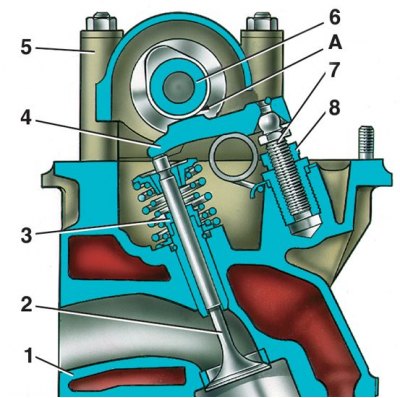
1 – cylinder head; 2 – exhaust valve; 3 – oil deflector cap; 4 – valve lever; 5 – camshaft bearing housing; 6 – camshaft; 7 – adjusting bolt; 8 – bolt lock nut; A – clearance between the lever and the camshaft cam
(The article is copied from the website: vazbook.ru)
The valves are actuated by the camshaft through short steel levers 4. The levers swing on the spherical head of bolt 7, which adjusts the clearance A between the camshaft cams and the levers.
Camshaft Drive Diagram
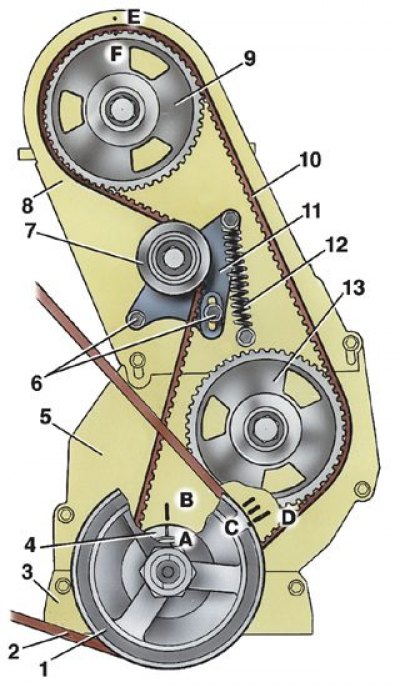
1 – crankshaft pulley; 2 – fan drive belt; 3 – lower protective cover; 4 – toothed pulley of the crankshaft; 5 – middle protective cover; 6 – tension roller bracket mounting bolts; 7 – tension roller; 8 – Upper protective cover; 9 – camshaft pulley; 10 – toothed belt; 11 – tension roller bracket; 12 – bracket spring; 13 – oil pump drive shaft pulley; A – mark on the toothed pulley of the crankshaft; B, D – TDC marks on the camshaft drive cover; C – mark on the crankshaft pulley; E – mark on the cylinder head cover; F – mark on the camshaft pulley
The camshaft is driven from the leading pulley 4 of the crankshaft by a toothed belt. The same belt also drives the pulley 13 of the oil pump drive shaft. The belt tension is adjusted by means of the tension roller 7, which is fixed on the bracket 11 and rotates on a double-row ball bearing.
The drive is isolated from oil ingress by three seals covering the pulley hubs. The drive is covered from the outside by three plastic covers: upper, middle and lower (see Fig. Disassembling the front part of the engine).