




Drain the oil (see Oil change).
Drain the coolant (see Replacing the coolant).
Remove the radiator together with the thermostat (see Replacing the radiator and Replacing the thermostat).
Remove the carburetor (see Replacing the carburetor).
Remove the fuel pump (see Replacing the fuel pump).
Remove the ignition distributor (see Replacing the ignition distributor).
Having drawn the connection order, we disconnect the hoses and wires from the engine, and lighten the cylinder block by removing the cylinder head (see Replacing the cylinder head gasket).
Remove the generator (see Removal the generator).
Remove the starter (see Starter replacement).
Remove the coolant pump (see Replacing the coolant pump).
Unscrew the upper or lower nuts securing the engine mount cushion (see Replacing the engine mount cushion).
We unscrew the bolts securing the clutch housing to the engine.
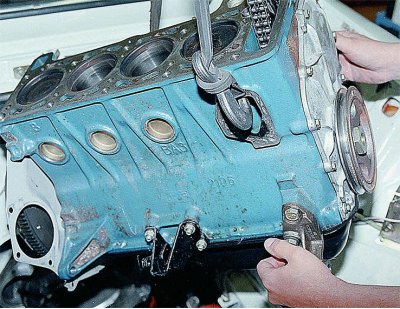
We fix the cables of the lifting device on the block and lift it. Having installed the jack under the gearbox and slightly rocking the block, we disconnect the block and the clutch housing.
We install the cylinder block on the stand.
Remove the clutch (see Replacing the pressure plate assembly and clutch release bearing).
Remove the pulley, camshaft drive cover, chain and oil pump drive gear (see Replacing the camshaft drive chain).
Remove the auxiliary drive shaft (see Replacement of auxiliary drive shaft).
Remove the flywheel and the rear crankshaft oil seal holder (see Replacing the rear crankshaft oil seal).
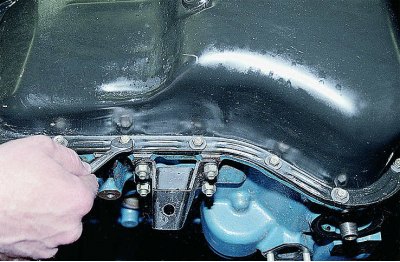
Using a 10 mm spanner, unscrew the fourteen bolts securing the oil pan to the cylinder block...
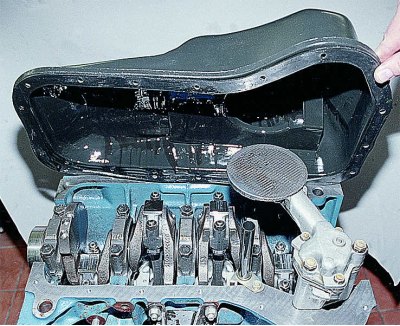
...and remove it together with the sealing gasket.
Remove the oil pump (see Removal and disassembling the oil pump).
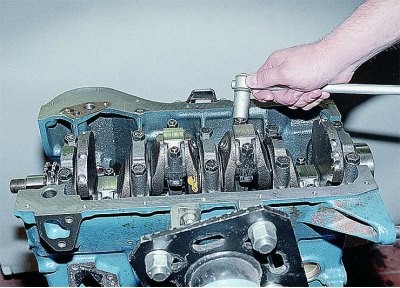
Using a 14 mm socket, unscrew the two nuts securing the connecting rod cap...
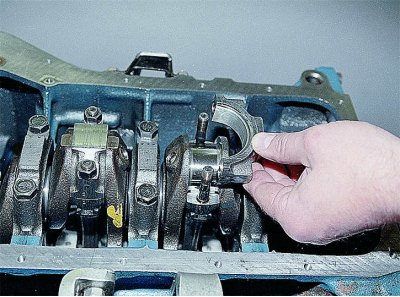
...and remove the connecting rod cover.
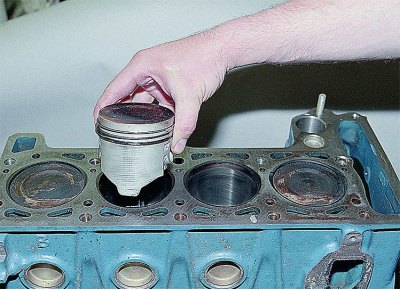
Using the wooden handle of the hammer as a support against the connecting rod, we push the piston out of the cylinder.
We remove the remaining three pistons in the same way.
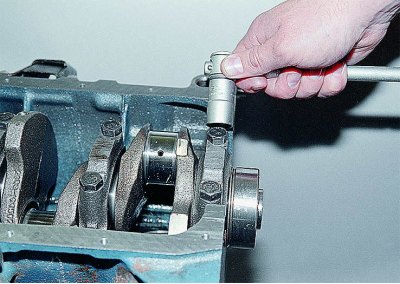
Using a 17 mm socket head, unscrew the two bolts securing the crankshaft main bearing cover...
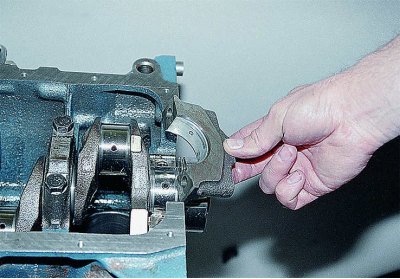
...and we take it off.
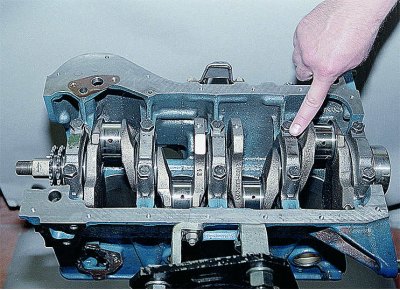
In the same way, we remove the remaining four main bearing caps. They are marked with marks corresponding to their serial number (count from crankshaft nose). On the last (fifth) cover there are two marks stamped, spaced apart at the edges.
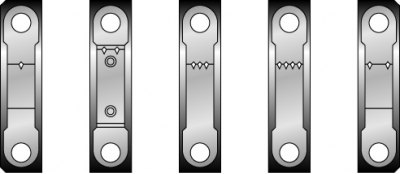
Marks on the main bearing caps.
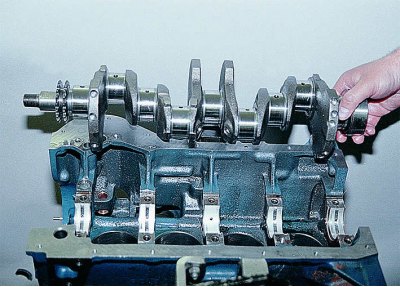
We remove the crankshaft.
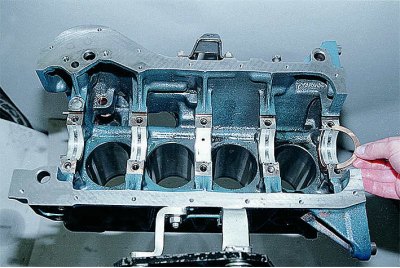
From the grooves of the bed of the fifth main bearing we remove two half rings of the crankshaft thrust bearing.
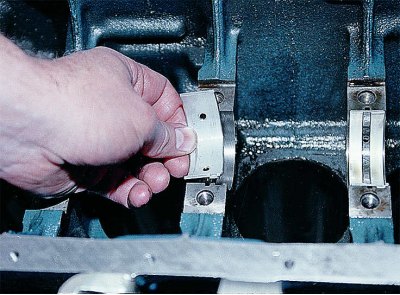
The steel-aluminum liners installed in the beds of the 1st, 2nd, 4th and 5th main bearings have a groove. The liner of the 3rd bearing does not have a groove (similar to the liners installed in the main bearing caps).
We disassemble the crankshaft (see Disassembling the crankshaft).
We take out the old main bearing shells. We wash the cylinder block and crankshaft in diesel fuel or kerosene. We blow out their internal cavities and oil channels with compressed air.
We wipe the seats of the main bearings with a napkin and install new liners of the appropriate category (nominal or repair).
We lubricate the main and connecting rod journals of the crankshaft with engine or transmission oil and install the shaft into the block.
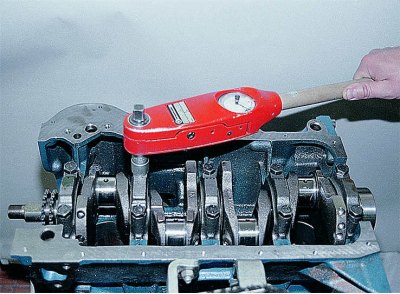
We install the main bearing caps in accordance with the marks with new liners of the category corresponding to the crankshaft journals installed in them. We tighten the cap fastening bolts with a torque wrench (see Applications).
We check the rotation of the crankshaft. It should be easy and smooth, without jamming or play.
We install new steel-aluminum liners into the lower heads and connecting rod caps (see Replacing the piston).
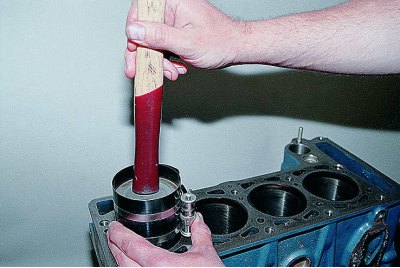
Lubricate the piston, rings and cylinder walls with engine oil. Compress the rings with a special device and turn the piston with the "P" mark toward the crankshaft nose. Lightly tap the piston bottom with a wooden hammer handle to push it into the cylinder.
We put on the connecting rod cover and tighten the bolts with a torque wrench (see Applications).
We carry out further assembly of the engine in the reverse order of disassembly.