




The fuel used is AI-93 gasoline.
The fuel system includes: fuel tank, fuel pump, air filter, carburetor, intake and exhaust pipes, muffler pipe, main and additional mufflers.
The basic diagram of the fuel system of the engine of the Niva VAZ-2121 car is shown in Fig. 13. Fuel from tank 1 is supplied by pump 7 through pipelines to carburetor 4. Air enters the carburetor through air filter 5. The combustible mixture prepared in the carburetor is supplied to the engine cylinders through intake pipe 3. Exhaust gases are discharged from the engine cylinders into the atmosphere through exhaust pipe 2, muffler pipe 8 and mufflers 9 and 10.
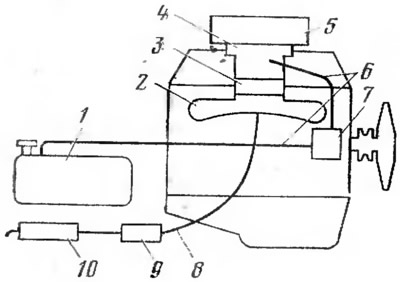
Fig. 13. Schematic diagram of the engine power supply system:
1 - fuel tank; 2 - exhaust pipe; 3 - inlet manifold; 4 - carburetor; 5 - air filter; 6 - pipelines; 7 - fuel pump; 8 - muffler pipe; 9 - additional muffler; 10 - main muffler.
Fuel tank the capacity of the car is 45 liters. A filled tank provides a range of 350-400 km. The fuel tank is welded from two steel stamped trough-shaped halves. In the upper part, the tank has a filler neck with a sealed plug, and in the lower part, a drain hole with a plug. The amount of fuel in the tank is controlled by an indicator, the sensor of which is installed inside the tank. The tank is connected to the atmosphere and ventilated through an air tube.
Fuel pump (Fig. 14) serves to feed fuel from the fuel tank to the carburetor. The fuel pump is of the diaphragm type. Between the upper 3 and lower 13 parts of the pump body, a diaphragm block 15 is installed, which is connected to the rod 7. The rod is grasped by the forked end of the balancer 11 of the lever 12 of the pump drive. The spring 14 of the diaphragm block is installed on the rod. In the upper part of the pump body there are suction 6 and discharge 16 valves. The pump is driven by a pusher from the eccentric of the oil pump drive shaft. Under the action of the eccentric, the pusher presses the upper part of the lever 12, and the balancer 11 through the rod 7 moves the diaphragm block 15 downwards. In this case, the spring 14 is compressed. The volume of the cavity above the diaphragm block increases, and fuel under the action of vacuum from the tank enters the pump through the suction branch pipe 4, mesh filter 2 and suction valve 6. The pump discharge valve is closed. The diaphragm block moves upward under the action of spring 14 when balancer 11 does not hold rod 7. Under the fuel pressure, discharge valve 16 opens, and fuel enters the carburetor through discharge branch pipe 1. The pump suction valve is closed in this case. When the carburetor float chamber is filled, the float shut-off needle will block the fuel supply to the carburetor. In this case, the diaphragm block of the fuel pump will remain in the lower position, and lever 12 with the balancer will move idle. Lever 8 is used to manually pump fuel into the carburetor before starting the engine. It acts on balancer 11 through eccentric 10.
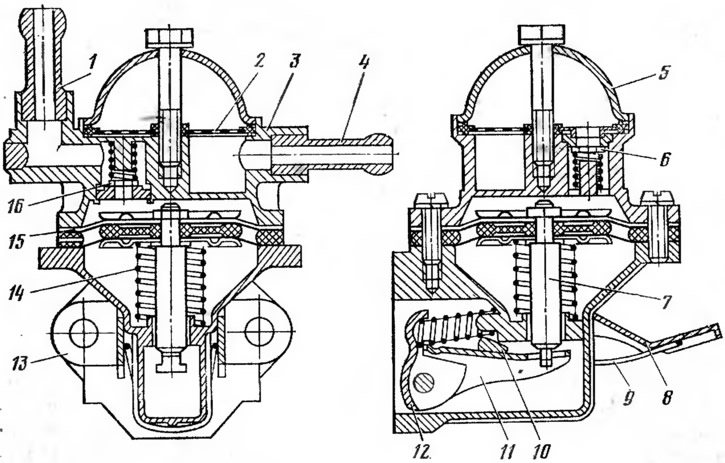
Fig. 14. Fuel pump:
1 - discharge pipe; 2 - mesh filter; 3 - upper part of the body; 4 - suction pipe; 5 - lid; 6 - suction valve; 7 - rod; 8 - manual fuel pumping lever; 9 - spring of manual pumping lever; 10 - eccentric; 11 - balance beam; 12 - lever of mechanical fuel pumping; 13 - lower part of the body; 14 - diaphragm block spring; 15 - diaphragm block; 16 - discharge valve.
Air filter cleans the air entering the carburetor from dust and other impurities. Dust contains tiny crystals of hard quartz, which, settling on the lubricated surfaces of parts, cause their intensive wear.
The air filter on the car is of the dry type. It has a replaceable filter element consisting of a paper filter and a layer of synthetic cotton wool. In the filter, the air first passes through a layer of synthetic cotton wool during cleaning, and then through the paper filter element.
(View the original on the internet resource VAZbook.ru)
Carburetor prepares a combustible mixture that corresponds in composition to the engine operating mode. It is two-chamber, with a falling flow, balanced.
The carburetor has two mixing chambers that are switched on sequentially: first the main (primary) chamber, and when the load increases, the additional (secondary) chamber. This allowed increasing the engine power due to better dosing and distribution of the combustible mixture among the engine cylinders. The flow of the combustible mixture in the carburetor chambers moves from top to bottom, which improves filling the cylinders with the mixture. The float chamber of the carburetor is balanced (balanced), since its connection with the atmosphere is carried out through the air filter. This ensures that the carburetor prepares a combustible mixture that does not depend in its composition on the degree of clogging of the air filter.
The diagrams of the carburetor systems and devices that ensure the preparation of the combustible mixture in various engine operating modes are presented in Fig. 15.
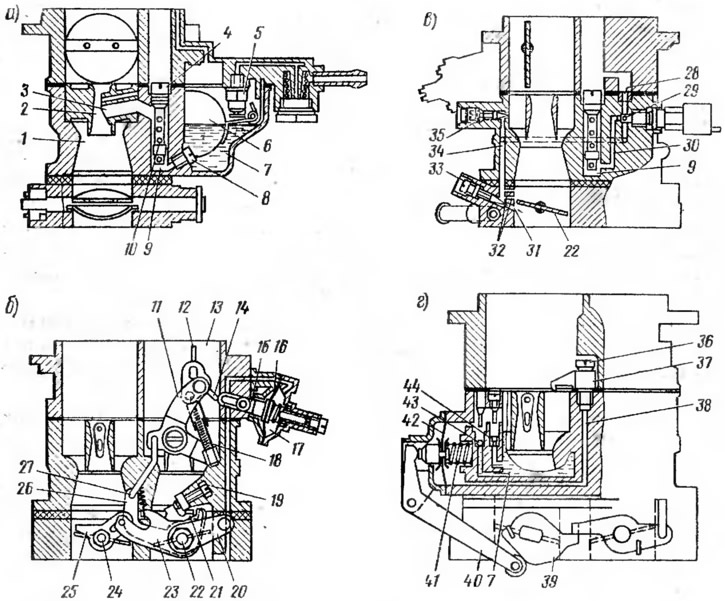
Fig. 15. Schemes of carburetor systems and devices:
a - main dosing system; b - starting device and throttle actuator; in - idle system; g - accelerator pump;
1 - large diffuser; 2 - small diffuser; 3, 47 - sprayers; 4, 28 - air jets; 5 - needle valve; 6 - float; 7 - float chamber; 8 - fuel jet; 9 - emulsion well; 10 - emulsion tube; 11 - air damper control lever; 12 - air damper; 13 - air duct; 14 - air damper rod; 15 - rod; 16, 42 - diaphragms; 17 - vacuum cavity; 18 - telescopic rod; 19 - throttle valve adjusting screw; 20 - throttle control lever; 21, 39 - sectors; 22 - primary chamber throttle valve; 23 - intermediate lever; 24 - Secondary chamber throttle valve; 25, 26, 40 - levers; 27 - traction; 29 - idle jet; 30, 38 - fuel channels; 31 - adjustable hole; 32 - transient mode holes; 33, 35 - adjusting screws; 34 - emulsion channel; 36 - ball valve; 41 - diaphragm spring; 43 - Inlet ball valve; 44 - bypass jet.
Main dosing system prepares a lean fuel mixture (1 kg of gasoline contains up to 16.5 kg of air) when the engine is running at partial (medium) loads. The prepared mixture is close in composition to the economical one in the entire range of partial loads.
Fig. 15a shows the main dosing system of the primary chamber.
Fuel from the float chamber 7 of the carburetor through the main fuel jet 8 enters the emulsion well 9. In this well, the fuel mixes with the air coming out of the holes of the emulsion tube 10, into which the air enters through the air jet 4. The emulsion through the sprayer 3 enters the small 2 and large 1 diffusers of the carburetor and mixes with the air passing through the diffusers, as a result of which a combustible mixture is formed. The main metering system of the secondary chamber is designed and operates similarly to the primary one. The throttle valve of the secondary chamber begins to open after turning the throttle valve of the primary chamber by approximately 50° from its initial position.
Throttle actuator (fig. 15, b) is carried out through the lever 20 and sector 21, which are fixed on the axis of the flap 22 of the primary chamber of the carburetor. In this case, the lever 20 and sector 21 turn counterclockwise. The flap 22 opens, and the sector acts on the intermediate lever 23, which through the lever 25 opens the flap 24 of the secondary chamber of the carburetor. Full opening of the throttle valves of the primary and secondary chambers of the carburetor occurs simultaneously.
Starting device (see fig. 15, b) ensures the preparation of a rich combustible mixture (1 kg of gasoline contains less than 13 kg of air) when starting a cold engine. The starting device of the carburetor is the air damper 12, which is installed in the air branch pipe 13 of the primary chamber. When starting a cold engine, the three-arm lever 11, with the help of the rod 27 and the lever 26, slightly opens the throttle valve 22 of the primary chamber of the carburetor. In this case, the telescopic rod 18 acts on the lever of the axis of the air damper 12, which closes the air branch pipe 13 in front of the sprayers and diffusers. The amount of air passing through the carburetor decreases. The vacuum in the diffusers increases, and the fuel begins to flow out of the sprayers of the main metering system of the carburetor, ensuring the formation of a combustible mixture. During the first flashes and subsequent engine idling, the vacuum from under the throttle valves is transferred to cavity 17 under diaphragm 16. The diaphragm bends and through rod 15 and rod 14 opens the air damper to allow the required amount of air to enter.
Idle system (fig. 15, in) prepares an enriched combustible mixture (1 kg of gasoline contains up to 13 kg of air) when the engine is idling. Fuel from the emulsion well 9 through channel 30 enters the idle jet 29, where it mixes with air entering through the air jet 28. The resulting emulsion mixes with the air passing through the hole adjusted by screw 35. Then the emulsion exits under the throttle valve 22 of the primary chamber through channel 34 through the hole 31, which is adjusted by screw 33. The holes 32, located above the throttle valve 22, ensure a smooth transition of the engine from idle to partial loads. Only the primary chamber of the carburetor is equipped with an idle system. The secondary chamber of the carburetor has a transition system, which smoothly switches the chamber into operation at small openings of the throttle valve. In terms of its design and operating principle, the secondary chamber transition system is similar to the primary chamber idle system and is distinguished by the absence of adjustment screws.
Accelerator pump (fig. 15, g) enriches the combustible mixture during a sharp transition of the engine from partial to full load (overtaking, etc.). It improves engine responsiveness, i.e. the ability to quickly develop maximum power.
When the primary chamber throttle valve of the carburetor is opened abruptly, sector 39, mounted on the valve axis, acts on lever 40, which presses on diaphragm 42. The diaphragm, overcoming the force of the return spring, bends and pushes fuel through channel 38, valve 36 and sprayer 37 into the diffuser of the primary chamber. Valve 43 closes. Sector 39 has a profile that provides double fuel injection. Moreover, the second fuel injection coincides with the moment of opening of the secondary chamber throttle valve of the carburetor.
Inlet and outlet pipes. The intake manifold serves to uniformly supply the combustible mixture from the carburetor to the engine cylinders. It is cast from an aluminum alloy. For better evaporation of the fuel settling on the walls, the intake manifold has a heater (jacket), which is connected to the cooling jacket of the cylinder head.
The intake manifold heater is connected to the carburetor throttle body heater via a fitting. The intake manifold is connected to the atmosphere via a special tube. The exhaust manifold removes exhaust gases from the engine cylinders. The manifold is cast iron. The intake and exhaust manifolds are attached to the cylinder head via a gasket.
Muffler reduces noise when exhaust gases are released from engine cylinders. The car muffler is made of steel, welded from two stamped halves. Inside the muffler there is a pipe with a large number of holes and transverse partitions. On the outside, the muffler is covered with heat-insulating asbestos pads and enclosed in a protective steel casing. Exhaust gases entering the muffler expand and, passing through the holes in the pipe, sharply reduce their speed. This leads to a decrease in noise from the exhaust gases.